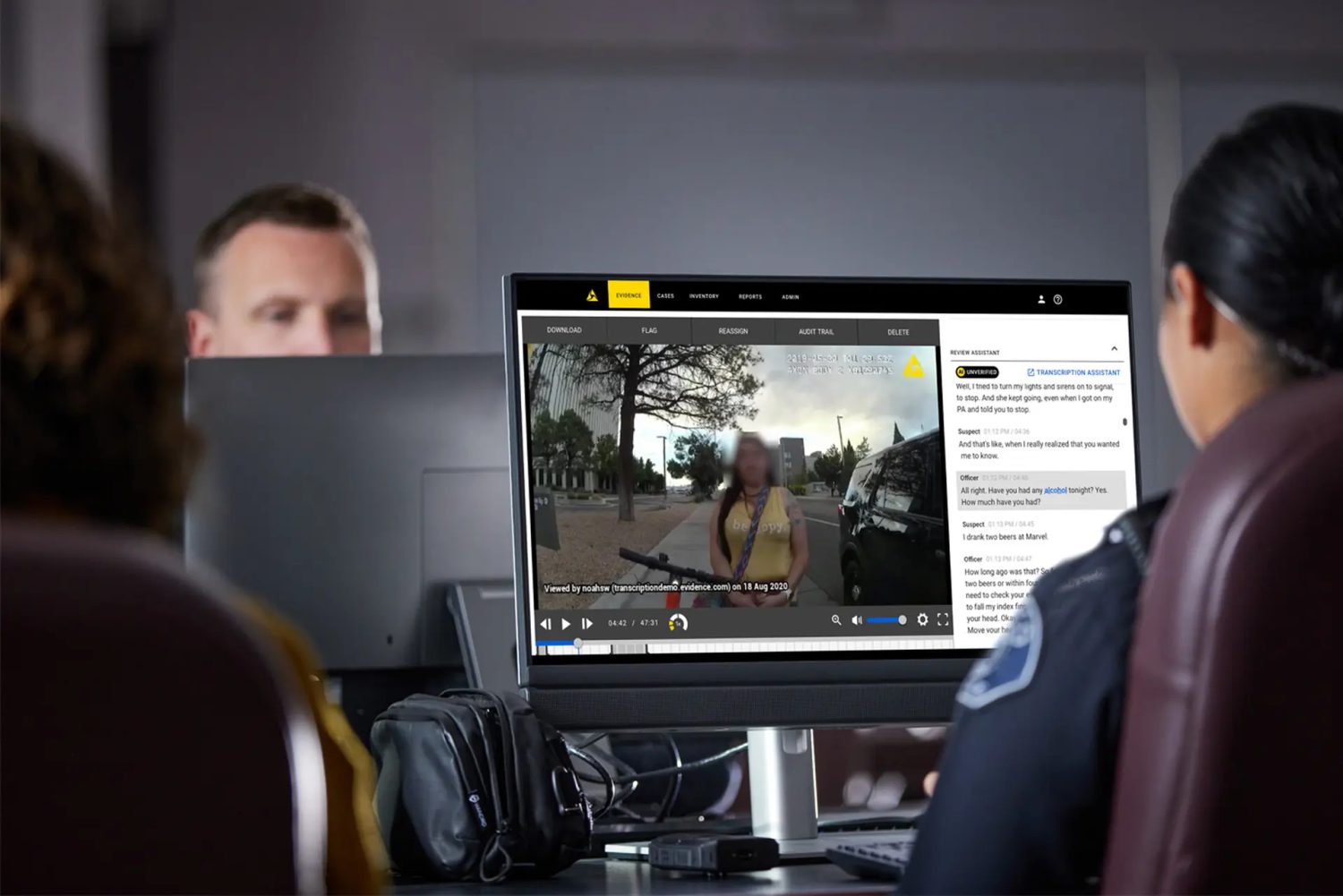
Every time an officer hits record, that footage eventually lands somewhere. For hundreds of thousands of officers across the country, it lands in Axon‘s Evidence.com — a surveillance app that doesn’t just store video anymore. It transcribes it, searches it, and, according to Axon’s own materials, uses some of that content to develop AI features. Axon calls it a secure evidence vault. Critics are asking whether it’s quietly becoming something else.
What Axon Says It’s Doing
Axon’s AI improvement program is voluntary — but the scope of what it can access is worth reading carefully.
Axon’s AI Customer Experience Improvement Program, or ACEIP, allows the company to use what it calls “Customer Content” in a “secure and controlled manner” to develop automated features. According to Axon’s transparency materials, participating agencies agree to this voluntarily.
Some ACEIP use cases access transcripts, metadata, case information, and officer interactions with Evidence.com. Axon says certain use cases do not touch raw video, facial features, or raw pixels — though the exact scope reportedly varies by case, and the program’s use-case descriptions differ across categories.
The platform’s AI tools already include transcription, translation, redaction support, and one-click evidence search by officer name, incident ID, and location. Evidence.com also maintains a permanent, immutable activity log of every upload, view, edit, and share — one that, according to Axon’s own documentation, cannot be changed or deleted.
CEO Rick Smith has been quoted in published reporting discussing AI tools designed to detect anomalous officer search behavior, suggesting the system could flag potentially abusive patterns before they escalate. Axon did not answer follow-up questions about what those tools specifically do, according to the same reporting.
- ACEIP can access transcripts, metadata, and case information
- Permanent audit logs record user actions tied to evidence files on the platform
- AI features include transcription, redaction support, and searchable evidence
- One-click search works across officer name, location, and incident ID
- Smith discussed AI-based search monitoring; specifics remain unanswered
Where the Concern Has Real Footing
No smoking gun — but the architecture itself raises legitimate questions about privacy and oversight.
None of this proves a covert surveillance scheme. What it does describe is a system where body-camera footage, searchable records, AI-processed transcripts, and immutable behavioral logs all converge in one privately operated platform. That’s not a conspiracy. That’s an infrastructure question — and a serious one.
For civil-liberties advocates, the concern isn’t any single feature. It’s the stack. People whose most vulnerable moments were captured during a police encounter have limited visibility into how that data flows through Axon’s AI pipeline — a point privacy scholars and digital-rights groups have raised broadly about secretly tracking users in cloud-based evidence systems. Public agencies procuring these platforms need to ask harder questions about data governance, consent scope, and oversight mechanisms. The time to ask them is before the contracts are signed, not after.