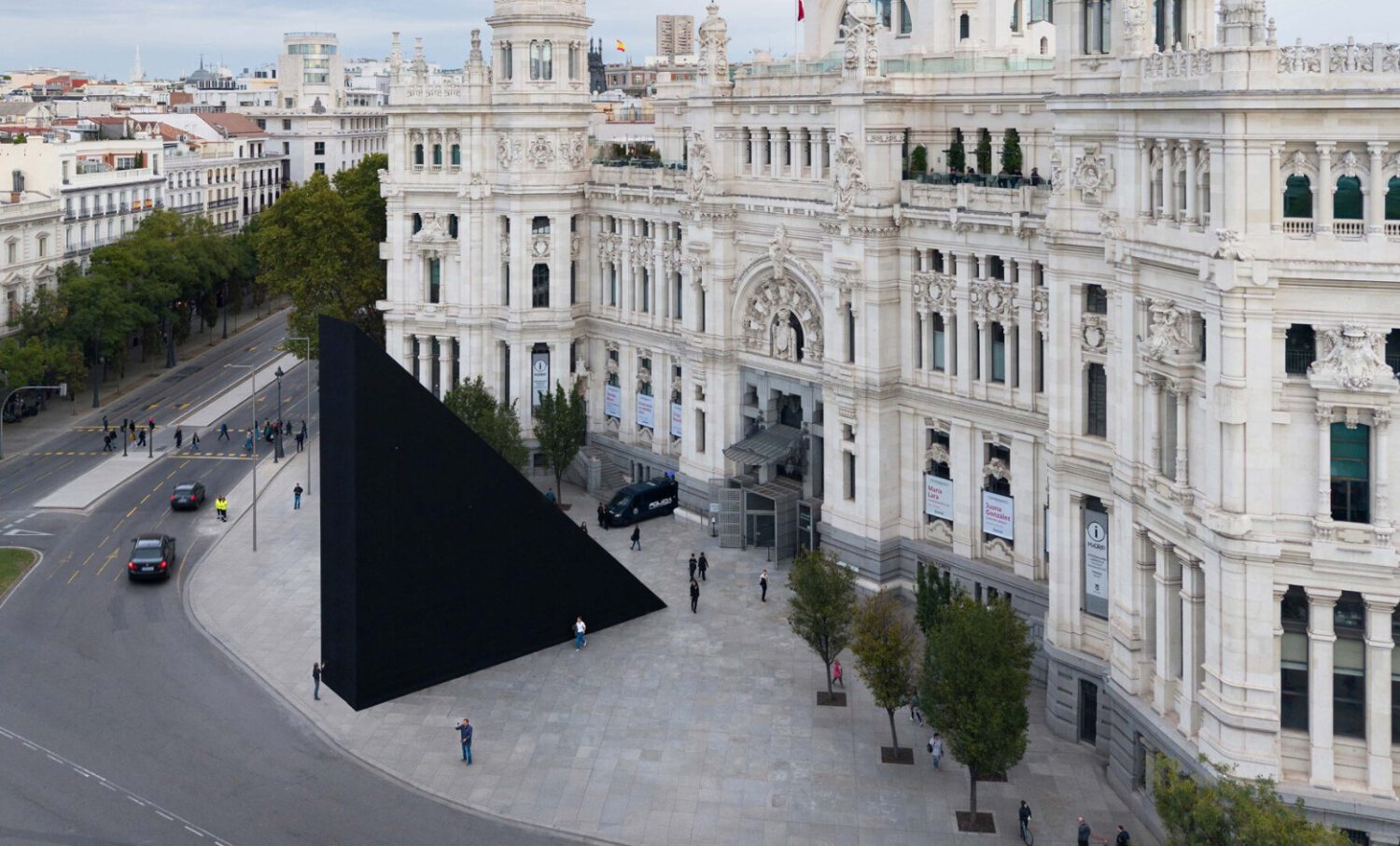
For five days in late October 2026, a massive black triangle occupied one of Madrid’s most recognizable civic spaces. Spanish urban artist SpY installed the work, titled Panóptico, in Plaza de Cibeles as part of the city’s Madrid es Paisaje public art program, positioning it directly in front of the Palacio de Cibeles and CentroCentro.
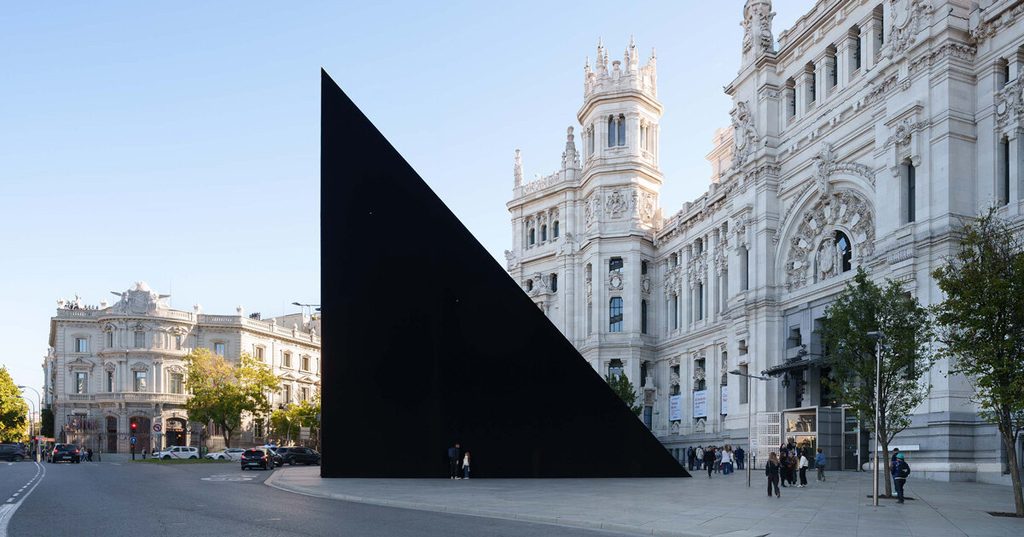
The structure is an opaque equilateral triangle measuring approximately 20 meters, roughly 65 feet, per side. Its scale and stark geometry interrupted the plaza’s established sightlines and sat in deliberate contrast with the historic architecture surrounding it, according to official project documentation.
Apertures and a Reframed View
Small openings in the triangle’s surface redirected attention, replacing the plaza’s panoramic sweep with isolated, reframed fragments of the same environment.
Small openings interrupt the triangle’s otherwise sealed surface at points around the perimeter. Visitors were invited to physically approach the structure, move around it, and locate a viewpoint rather than simply observe it from across the square.
Each aperture isolated specific fragments of the surrounding environment, presenting them from unexpected perspectives. The structure blocked the ordinary panoramic view of the plaza and replaced it with partial, reframed glimpses of the same space, according to official project documentation.
What the Panopticon Reference Actually Means
The title points directly to an 18th-century model of observation and uses it to recast the visitor’s relationship to the city around them.
The title is the concept, stated plainly. The panopticon was an 18th-century prison model associated with philosopher Jeremy Bentham. Its design placed a central observation tower inside a circular facility; any inmate could be watched at any moment, and no inmate could ever confirm when observation was actually occurring.
The design made the possibility of being watched a constant condition, regardless of whether anyone was actually watching. Panóptico draws on that logic by temporarily repositioning visitors: rather than moving through the plaza as ordinary passersby, they approached a structure built around the act of directed looking.
That repositioning is real but incomplete. The apertures still determined what could be seen, from which angle, and through which frame. Approaching the installation did not place visitors outside the system of observation; it placed them within a structure that controlled the terms of what they could see.
Why Plaza de Cibeles and Why Only Five Days
The choice of location gave the work’s themes immediate legibility, and the short duration made the disruption feel like a genuine event in the life of the space.
Plaza de Cibeles carries significant civic weight in Madrid, recognizable enough that disrupting its sightlines registers as a deliberate act. Placing a structure themed around observation and concealment in one of the city’s most emblematic spaces made the work’s subject matter immediate.
The temporary duration was also part of the design. After five days, the triangle was removed and the familiar plaza returned. That brevity gave the period of obstruction a distinct character, making it feel like something that had genuinely happened to the space rather than simply beside it.
Dates and Access
Panóptico was free and open to the public across its five-day run.
Panóptico was open from October 20 through October 24, 2026, running daily from 10:00 a.m. to 8:00 p.m. Admission was free. The installation was produced under Madrid’s municipal Madrid es Paisaje program, which presents temporary public artworks across the city.