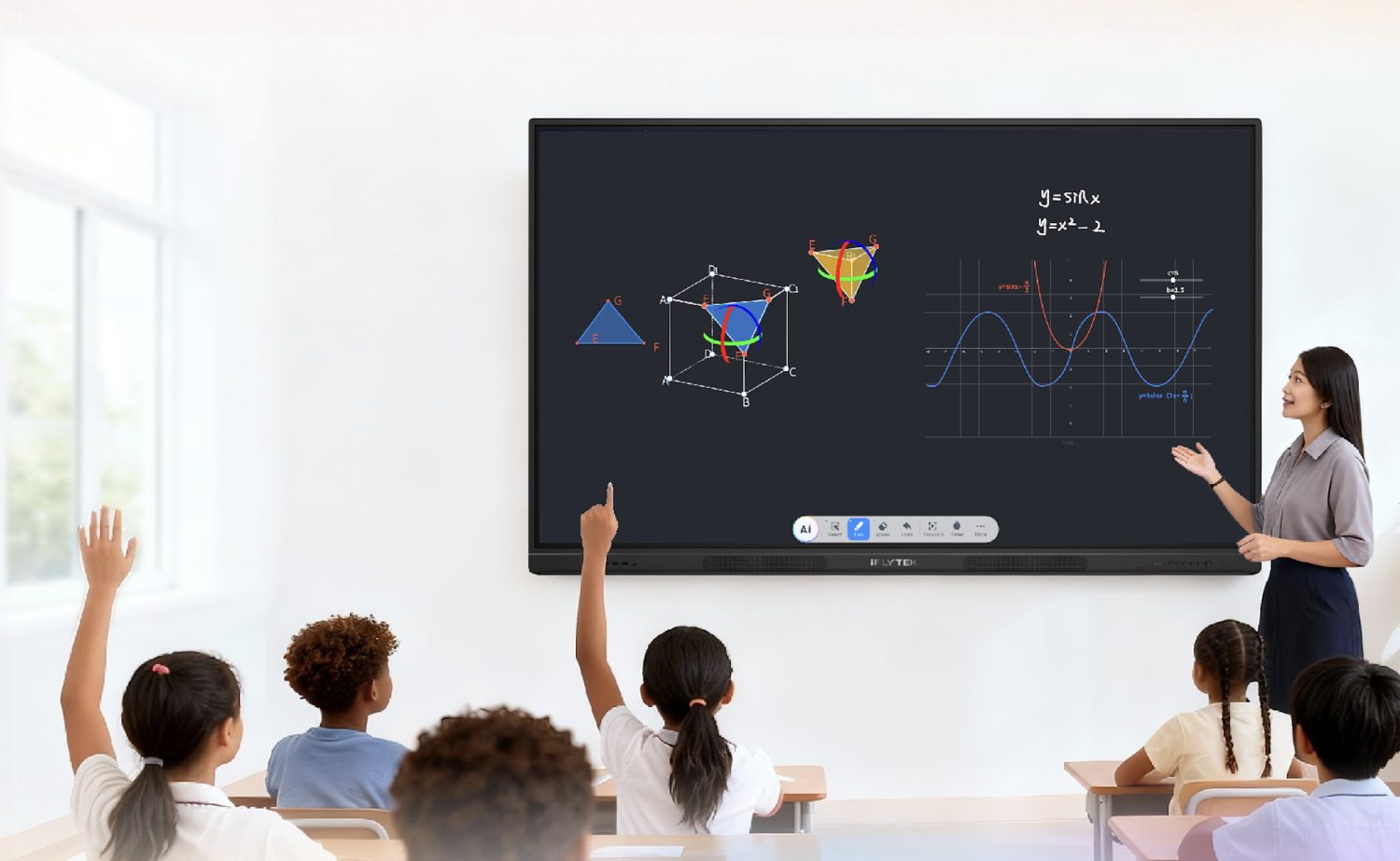
At the 2026 World Artificial Intelligence Conference in Shanghai, a teacher scrawls a rough geometric shape on a blackboard. The board converts it into a rotatable 3D model mid-lesson. No app switch. No separate screen. The surface itself does the thinking. iFLYTEK’s AI Blackboard isn’t a monitor bolted to a wall — it’s the wall. According to company materials, the system is now active in more than 60,000 schools, reaching 160 million teachers and students across China.
From Chalk to Algorithm
The interface teachers already know how to use just got a processor.
iFLYTEK’s SPARK Smart Blackboard recognizes handwritten equations and converts them to graphs, cleans up messy handwriting, and turns rough sketches into rotatable geometry models — while logging classroom analytics in real time. Rather than stringing together five staccato steps, the experience collapses into one fluid motion: the teacher writes normally while the board handles the translation, converting equations to graphs and sketches to 3D models without interrupting the lesson. iFLYTEK frames the system as a teaching aid rather than a replacement — the person still holds the marker; the board just makes the content do more.
The deployment reality, according to iFLYTEK:
- Demonstrated at WAIC 2026 in Shanghai
- Active across 33 provincial-level regions and more than 1,400 counties and districts
- Reaching 60,000 schools and 160 million teachers and students
- Features include multimodal interaction, digital boardwork, classroom recording, and real-time analytics
- According to Reuters, Chinese authorities plan to embed AI into textbooks and curricula as part of national education reform (Reuters, 2025)
The company’s official positioning, paraphrased from its WAIC 2026 materials: the board is designed to assist teachers by converting handwritten math into graphs and rough sketches into rotatable 3D models — not to replace the person holding the marker.
The Blackboard Has Always Been a Symbol
China called AI classroom infrastructure. The U.S. is still writing the hall pass.
While Chinese schools run AI-native hardware across 33 provinces, Brookings reports U.S. districts remain split between banning, integrating, or simply reviewing generative AI tools. Reuters reported that OpenAI was exploring how to bring ChatGPT into classrooms — a conversation still centered on access policies rather than physical infrastructure. The contrast isn’t capability. It’s philosophy. The U.S. debate resembles the old calculator panic: endless committee meetings while everyone else just started doing the math.
The blackboard is the oldest visual metaphor for teaching. Making it AI-native doesn’t just change the tool — it changes what a classroom fundamentally is.
The next infrastructure debate won’t be about apps or acceptable-use policies. It’ll be about whether the room itself should have opinions.