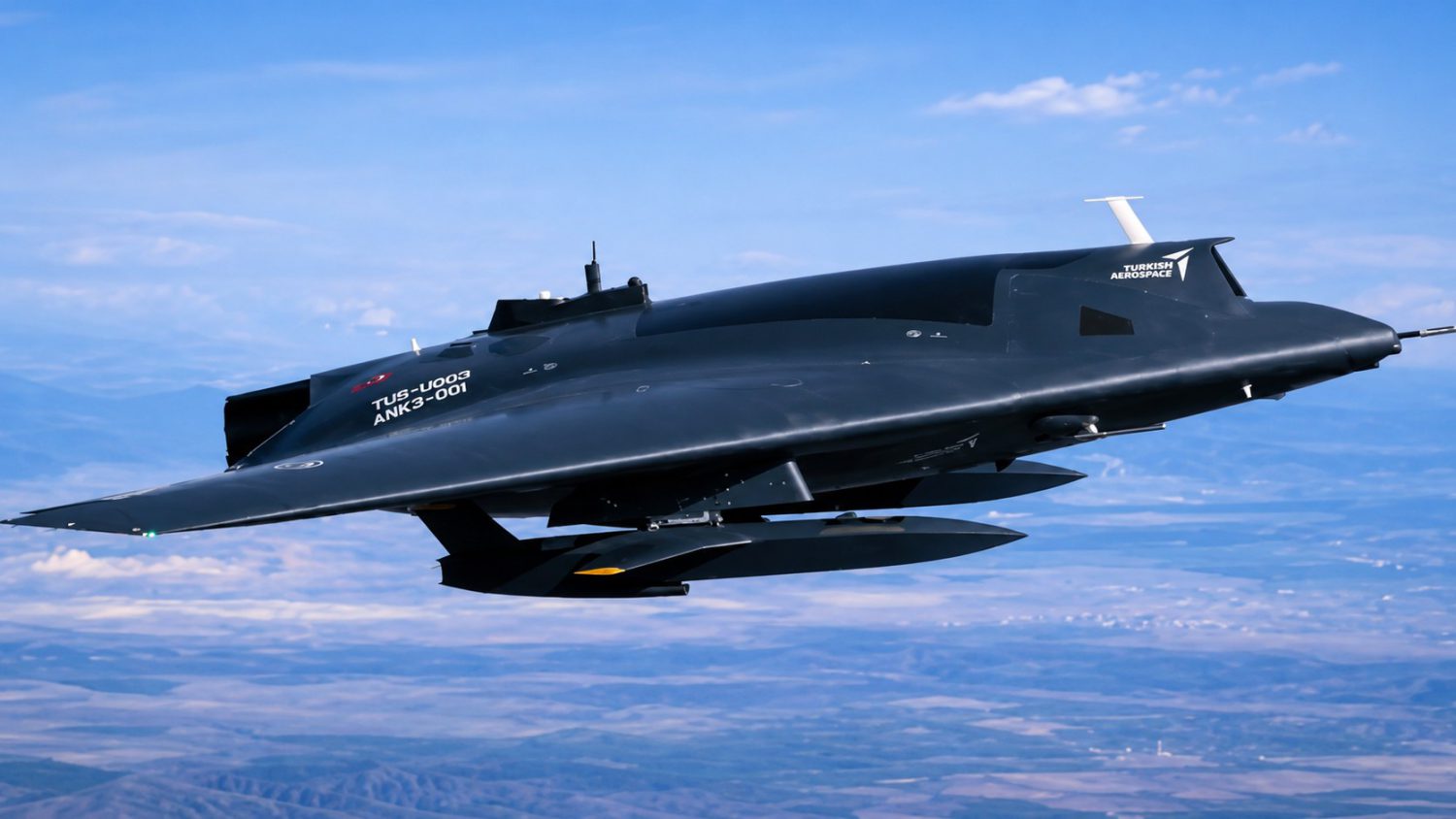
On August 14, 2026, Turkish Aerospace Industries released a video captioned “Gizli Güç!” — Secret Power. The footage shows ANKA III, a flying-wing stealth combat drone, cruising at altitude with two jet-powered autonomous drones slung beneath its wings. This isn’t just a dramatic reveal. It’s a demonstration that a single unmanned aircraft can deploy its own autonomous strike team mid-mission, inside contested airspace, without risking anything human.
From Bomb-Truck to Flying Mothership
The mothership concept just moved from theory to flight footage.
April 2025 established the baseline: ANKA III dropped a single SÜPER ŞİMŞEK drone at 10,130 ft and 150 knots, validating what TUSAŞ calls the OKU concept — airborne launch of expendable autonomous drones from a carrier UCAV (Unmanned Combat Aerial Vehicle). August 2026 doubles it. ANKA III brings serious reach: 489 mph top speed, 40,000 ft service ceiling, 10-hour endurance, and 1,200 kg payload capacity, according to TUSAŞ. Not a delivery vehicle — a deep-penetration platform that carries its own autonomous support network forward.
The SÜPER ŞİMŞEK — roughly 4 meters long, Mach 0.85 top speed, 900 km range, 80-minute endurance — isn’t a prototype. It entered Turkish Air Force service in March 2026. Here’s what it does once released:
- Amplifies its own radar and infrared signature to mimic a fast jet, forcing enemy air defenses to waste interceptors on an expendable drone
- Jams radar and communications, deploys countermeasures, and executes electronic attack missions
- Carries a strike payload — up to roughly 35 kg warhead — for hard kills on radar sites or high-value targets
- Operates autonomously with mid-flight mission retasking via data link, per Air Force Technology
The Three-Layer Kill Chain
One crewed fighter, one stealth drone, two expendable weapons — that’s the architecture.
At World Defense Show 2026, TUSAŞ presented the full vision. The crewed KAAN fighter handles high-level command. ANKA III pushes forward as a stealthy sensor and coordinator. SÜPER ŞİMŞEK units fly into the highest-risk zones. Think of it as a three-tier strike package: a human commander sets the objective, the stealth drone advances as forward coordinator, and expendable units absorb the risk at the sharpest edge of the mission. The full three-tier system hasn’t been demonstrated in a single integrated mission yet — an important qualifier.
According to Interesting Engineering, ANKA III can bring two SÜPER ŞİMŞEK UAVs forward into contested airspace, release them at altitude, and coordinate their missions as autonomous decoys, jammers, sensors, or strike units — all from a single sortie.
The pairing proves tactically potent for SEAD/DEAD operations — Suppression and Destruction of Enemy Air Defenses, the process of exhausting or destroying air-defense systems to open corridors for follow-on aircraft. Some SÜPER ŞİMŞEK units drain interceptor magazines by mimicking fast jets. Others exploit the gap those wasted missiles created. For NATO planners, interoperability questions around data links and rules of engagement remain open, per Army Recognition. The capability, though, is no longer theoretical.
As autonomy matures, ANKA III moves toward mission-level operations — fewer operators, more autonomous decisions in the kill chain. Turkey called this “Secret Power.” For anyone tracking where air combat is heading, it stopped being a secret the moment that video went live.