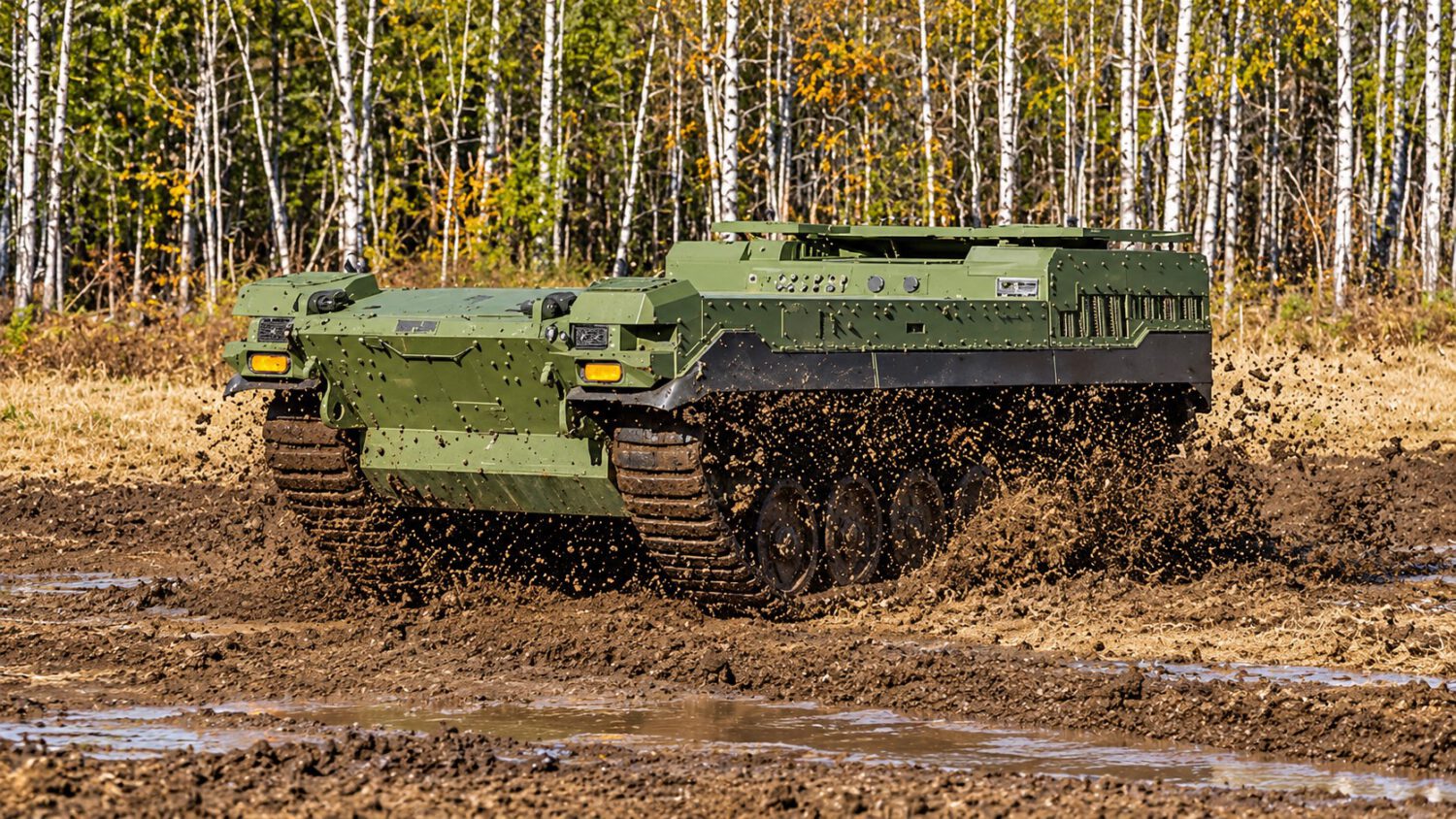
The U.S. Marine Corps will acquire two RIPSAW M3 uncrewed ground vehicles for the Marine Corps Warfighting Laboratory at Quantico, Virginia, Textron Systems and subsidiary Howe & Howe announced. These vehicles are not headed to a frontline unit; their job is experimentation.
The Warfighting Laboratory will use the M3s to integrate different payloads and sensors, demonstrate mission concepts, and identify what future robotic systems need to be useful in the field. This is capability development before broader procurement, and that distinction matters.
What Textron Says the M3 Can Do
According to Textron Systems, the M3 combines high payload capacity with a modular design intended to support diverse mission configurations.
According to Textron Systems, the M3 carries more than 5,000 pounds of payload and reaches speeds exceeding 30 miles per hour on its tracked platform. A flat-deck design allows the same vehicle to carry different sensor packages, communications equipment, logistics loads, or other mission systems across separate trials.
The platform uses a modular open systems architecture, which Textron says allows equipment configurations to change without requiring an entirely new vehicle. Specific payload configurations the Marine Corps plans to test have not been publicly disclosed.
The Testbed Role, Explained
The Marine Corps Warfighting Laboratory will use the M3s to compare equipment setups and generate data that could shape future robotic-force requirements.
Sara Willett, vice president of programs at Textron Systems, described the acquisition’s intent directly. “Pairing the M3’s proven capability and reliability with the MCWL mission to drive future operational concepts and capabilities will enable the Marine Corps to advance uncrewed force design and battlefield utility,” she said.
In practical terms, the Marine Corps gains a reusable ground platform for comparing different equipment setups across varied mission scenarios. Test results could inform later decisions about autonomy levels, human control requirements, communications architecture, and logistics demands for future robotic systems. Those are analytical possibilities, not guaranteed outcomes.
Two Decades of Off-Road Development Behind the Platform
Howe & Howe brings more than twenty years of experience building tracked platforms for demanding off-road environments.
Howe & Howe, a Textron Systems subsidiary, says it has spent more than two decades building off-road platforms designed for durability and extreme conditions. Michael Howe, senior vice president at Howe & Howe, said the M3 would suit the service’s operational environment. “The M3 will be a great fit for the Marine Corps and its demanding environmental requirements,” he said.
Textron Systems says the company draws on more than 60 years of multidomain uncrewed-technology experience across air, land, and sea domains. That figure comes from the company and has not been independently verified.
What This Acquisition Does Not Settle
The Marine Corps is gathering operational data well before any commitment on force structure or broad battlefield integration of robotic ground systems.
Two vehicles assigned to a warfighting laboratory do not constitute a fielding decision. The Marine Corps is gathering operational data before making broader commitments about force structure or battlefield integration of robotic ground systems.
Publicly available material also leaves significant gaps. Endurance, operational range, autonomy architecture, and performance in communications-contested environments are not detailed in the cited public sources. Uncrewed systems reduce direct personnel exposure, but they introduce dependencies on software reliability and communications links. Maintenance access and recovery procedures are also vulnerable to stress that battlefield conditions can quickly introduce.
The M3 acquisition gives the Marine Corps a platform to start answering those questions. The answers themselves are still ahead.