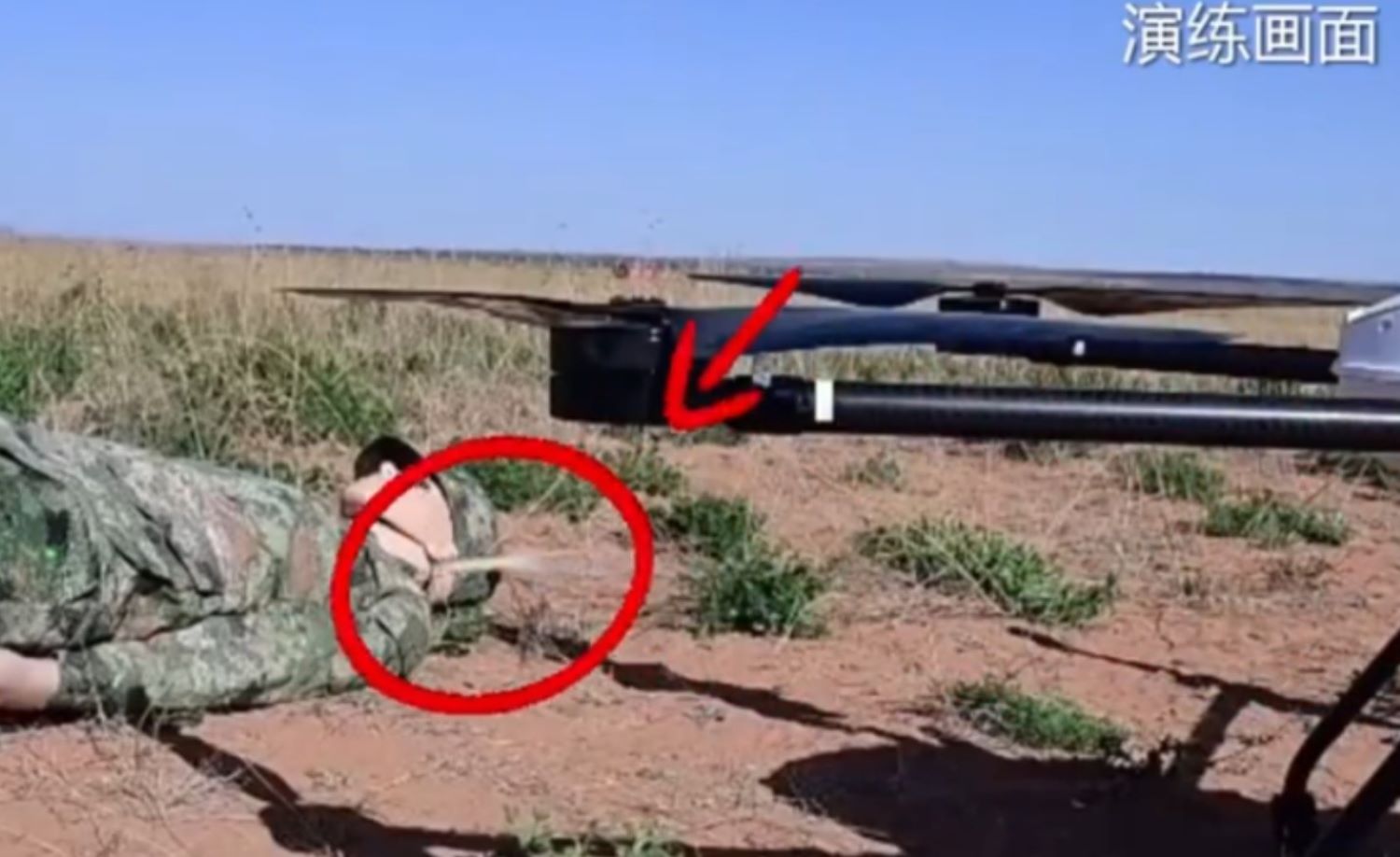
Reaching a wounded soldier in a contested zone can get the rescuer killed. China’s Air Force Medical University has developed an experimental drone intended to bridge that gap, using a dart-like projectile to deliver intramuscular medication to a casualty before a medic can safely approach. Wang Jianqi, a university representative, described the system as the Chinese military’s first casualty-search UAV, according to Chinese state media outlet Global Times.
Demonstration footage showed the drone releasing a dart toward a prone soldier on the ground. Wang said the system is designed to buy time for additional treatment before a rescue team arrives.
The Battlefield Logic Behind It
Song Zhongping explains why modern conflicts make conventional casualty evacuation increasingly dangerous.
Military commentator Song Zhongping told Global Times that modern conflicts complicate evacuation because attacks now reach areas well beyond defined front lines. A drone can cover contested ground without exposing personnel to that risk.
The intended role is stabilization, not a replacement for medics or evacuation teams. The drone likely delivers unspecified emergency medication to hold a casualty’s condition until human teams can safely enter the area. The reporting describes this as an extension of existing drone-resupply doctrine applied directly to medical intervention, though the available sources do not establish that this is the first such application anywhere.
What the Footage Does Not Confirm
The demonstration shows a concept; it does not establish battlefield performance.
The drug type, dosage, injection range, accuracy rate, casualty-identification method, and clinical outcomes were not provided in the available reporting. The demonstration shows the concept works in controlled conditions. It does not establish reliability under combat stress, adverse weather, or electronic interference.
The system also cannot currently solve the harder problem. Wang’s team acknowledges that recovering casualties and loading them onto unmanned platforms for evacuation remains unresolved, by their own account.
A Layered Robotic Approach
Separate PLA exercises suggest a broader framework, though these systems have not been confirmed as one integrated capability.
Exercises attributed to the PLA Joint Logistic Support Force’s 967th Hospital illustrated a broader framework. Thermal-imaging drones searched for simulated casualties, smaller cargo UAVs delivered medical supplies to zones conventional vehicles could not reach, and robotic dogs entered confined or unstable spaces to locate personnel and transmit hazard data before human rescuers moved in.
These systems were demonstrated separately and do not currently operate as one integrated field capability. That description is an editorial synthesis of the individual demonstrations, not a confirmed operational reality.
Disaster Response and Its Open Questions
The same logic that applies on a battlefield could extend to civilian disaster zones, but critical prerequisites remain unmet.
The technology could hypothetically support rescue operations after landslides, floods, or collapsed infrastructure that isolate survivors. The logic is straightforward, but the prerequisites are not.
Civilian deployment would require validated safety data, medical regulatory approval, and reliable targeting. Clear protocols for consent and correct identification of the recipient would also be necessary. None of that information was present in the available reporting.
How Much Weight to Give This
Independent technical validation is absent, and the gap between a demonstration and a battlefield-ready system remains wide.
The primary source for this development is Chinese state media; independent technical validation is not evident in the supplied reporting. No manufacturer, aircraft specifications, operating range, or payload data were disclosed.
The most defensible characterization of what China has shown is an experimental demonstrated capability. The gap between a successful controlled demonstration and a proven battlefield medical system is wide, and by the researchers’ own account, it has not been closed.