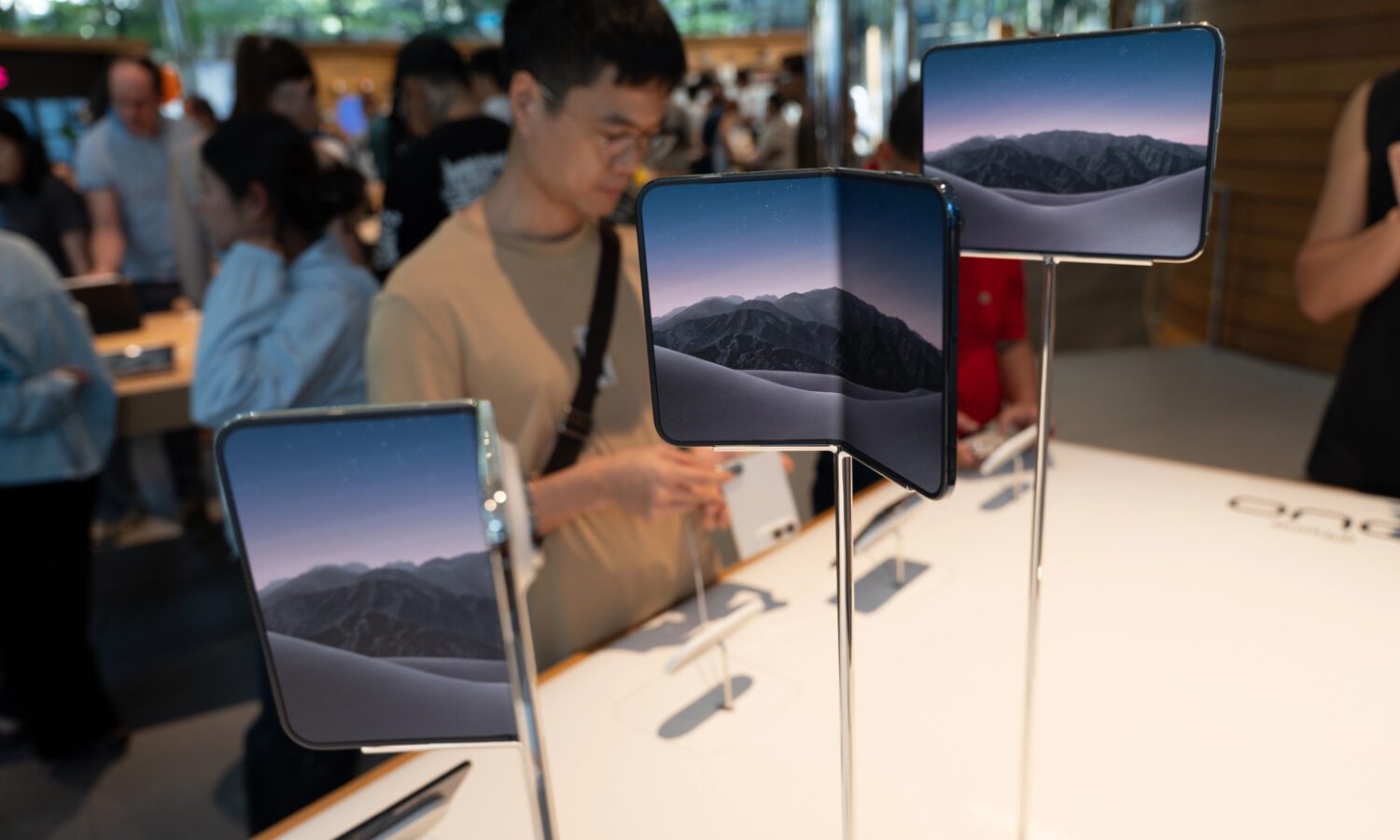
Everyone is debating the iPhone Duo‘s $2,000 starting price and its dual main and ultra-wide camera system. Those are the visible compromises. The ones that actually matter are buried in teardown reports, early-adopter forums, and storage claims that have not been independently confirmed. Buyers evaluating the full cost of ownership should also consider the iPhone accessories ecosystem before committing.
A Hinge Problem With a Four-Figure Repair Bill
Multiple users report inner-display failures after minimal use, and Apple has acknowledged the issue without quantifying its scale.
Shortly after launch, reports surfaced across Reddit and technology forums describing inner displays developing cracks, bright lines, and dead-pixel bands along the hinge crease after only a few folding cycles. An Apple representative confirmed to CNBC that a “small number” of iPhone Duo units are affected and directed customers to AppleCare for replacement.
Apple has also published hinge troubleshooting guidance, though the company has not established the scale or cause of the problem.
iFixit’s teardown identified a vulnerable region near the transition between the display’s flex-cable gap and the hinge’s central support. Possible explanations include a support bar failing to retract fully, hinge pressure, trapped debris, or a manufacturing defect. These are hypotheses informed by hardware analysis, not a confirmed root cause.
The failure rate has not been established. Forum reports are firsthand accounts, not a statistical sample, and other owners report no problems.
What is confirmed is the financial exposure. Apple has reportedly quoted $999 for an out-of-warranty inner-screen repair, according to CNBC. For a buyer without coverage, that converts a $1,999 device into a potential $2,998 liability.
AppleCare terms are not a footnote here. They are a material part of the purchase decision.
The Storage Configuration Deserves Scrutiny
Unverified claims about NAND type in the higher-capacity models remain unconfirmed by Apple’s published specifications.
The iPhone Duo ships in 256GB, 512GB, 1TB, and 2TB configurations, confirmed by Apple’s technical specifications. Unverified reports suggest the higher-capacity tiers use QLC NAND flash rather than TLC NAND, but Apple’s specifications do not identify the NAND type.
QLC stores four bits per cell versus TLC’s three. That architecture generally produces greater write-management demands and lower rated endurance under comparable workloads.
Actual longevity depends on the NAND generation, controller design, firmware, and usage pattern, not solely on cell type. Prospective buyers concerned about battery life and long-term reliability at the 1TB or 2TB tier should press Apple for clarification before purchasing.
The Pro-Camera Claims Need a Primary-Source Check
Prospective buyers who depend on ProRes or manual controls should verify support directly against Apple’s published specifications.
The A20 Pro chip powering the iPhone Duo is confirmed, and Apple custom silicon developments provide useful context on its broader silicon roadmap. Whether the device supports ProRes, ProRAW, manual shutter speed, or manual white-balance controls is not established by the available reporting.
Buyers who need those workflows should confirm directly with Apple’s technical specifications or user guide before purchasing.
Software Friction on a First-Generation Device
Ergonomic and multitasking limitations are reported but unconfirmed, and software often catches up to hardware across subsequent updates.
Unverified hands-on reports describe a dock locked to the right side of the display and absent Stage Manager support. Fixed volume-button behavior during rotation and inconsistent handling of third-party applications not yet optimized for the folding form factor are also reported to behave inconsistently. Details on software behavior remain unverified pending broader hands-on testing and Apple documentation.
The defensible read on the iPhone Duo right now is not that it is a failed product. The downside risk at $2,000 is nonetheless significant: a single early-life display failure can cost $999 outside of coverage, and several core claims about storage and camera capability lack primary-source confirmation.
Waiting for longer-term reliability data and confirming warranty coverage before purchase are the prudent steps for anyone deciding whether this device earns its price. Resisting the pull of forum posts as statistical evidence matters equally, since no verified failure rate exists for the affected units.