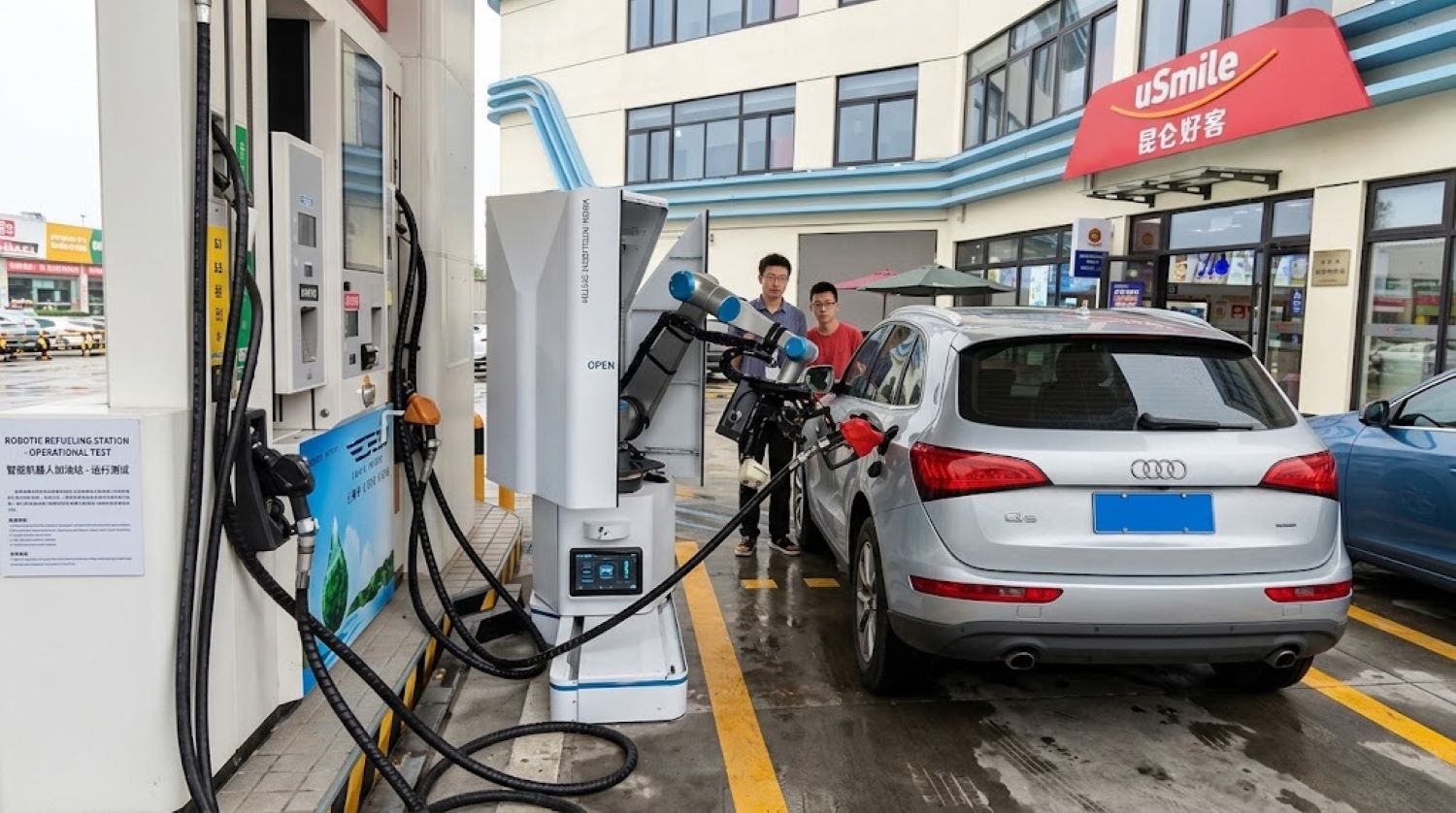
Park in the designated bay, open the app, and a robotic arm takes it from there. No getting out, no handling a nozzle, no waiting in the rain while the pump beeps at you.
Sinopec and CNPC have been running this kind of system at selected Chinese stations since September 2021, with later deployments reported at additional locations.
How the System Works
App to nozzle, the robot handles every step between parking and a full tank.
After a driver books through a smartphone app and pulls into the designated bay, cameras scan the vehicle and locate the fuel-filler door. From there, the robotic arm opens it, dispenses fuel, removes the nozzle, and closes the door again.
Sinopec’s early trial at the Nanning Nanzhan West station completed that sequence in roughly 180 seconds, according to the company. Developed with Kunlun Digital Technology and Hangzhou Helios Innovation, CNPC’s reported system cuts that to around 120 seconds and supports 92-, 95-, and CN98-grade gasoline.
Fuel doors are not standardized across vehicle models. Position, shape, size, color, and opening mechanism all vary, which makes reliable recognition a genuine engineering problem.
To handle that variation, the systems use 3D vision, deep-learning algorithms, computer vision, servo motors, and solenoid valves (the electronic switches that control fuel flow). CNPC’s reported system incorporates 147 major component types. Over 93 percent of those are domestic, according to CNPC-related reporting.
Sinopec’s early version also used BeiDou satellite positioning and a cloud-based maintenance platform. The result is the machine equivalent of a technician who has studied every vehicle model and knows exactly how each fuel door opens.
Safety, Scale, and What’s Still Unknown
Explosion-proof certification is claimed; independent long-term data is not yet available.
Fueling involves flammable vapor, which means a robot handling a nozzle requires safety engineering well beyond a standard warehouse arm. Sinopec’s systems include explosion-protection features, intrusion alarms, emergency-stop interlocks, and dynamic monitoring that responds if a vehicle moves unexpectedly during fueling.
According to Sinopec-affiliated reporting, the company claims IIB T4 explosion-proof certification for its components and equipment. That claim has not been independently verified in the available evidence.
Confirmed deployments include Sinopec stations in Nanning, Changsha (Hunan), and Wuhu (Anhui). In January 2024, Sinopec presented its Changsha Binjiang integrated energy station as its first smart-energy site combining robotic fueling with digital-twin station management.
These are station-level pilots at specific locations. The available evidence does not establish a nationwide network, universal vehicle compatibility, independent safety comparisons, throughput figures, or confirmed labor replacement at any scale.
What Comes Next
Broader adoption hinges on variables the current pilots have not yet answered.
At its core, the system connects robotic manipulation, gasoline payments, and smart-station infrastructure in a public-facing environment. That combination carries real significance regardless of how the rollout eventually scales.
Wider adoption will depend on how reliably the systems handle the full range of vehicle designs and how they perform across varying weather and lighting conditions. Independent regulatory assessments of the safety claims Sinopec and CNPC have made in their own announcements have not yet appeared in the available evidence.