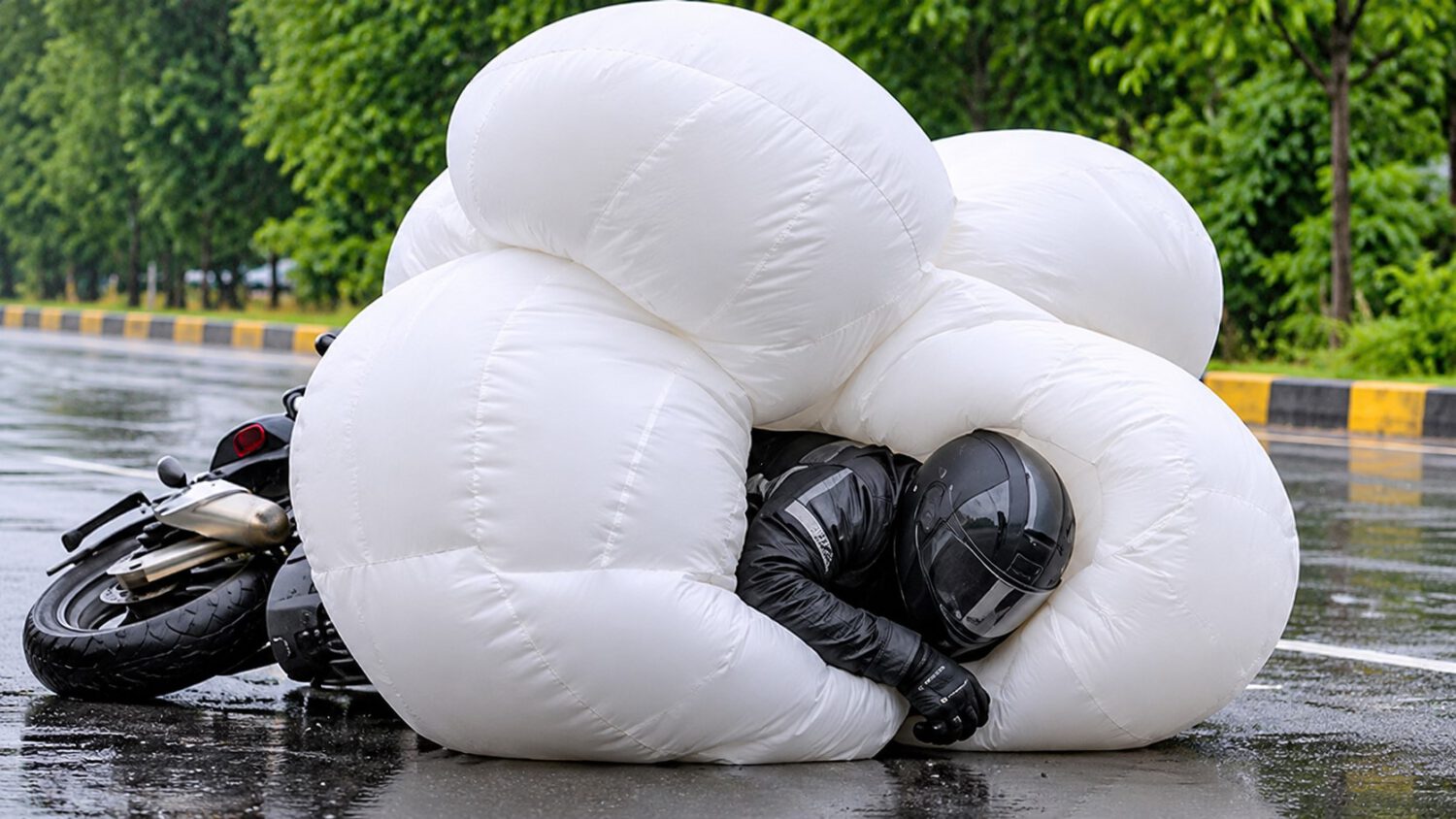
The idea is linked to Lanxi Yema Motorcycle Fittings, a helmet manufacturer based in Zhejiang, China. Reports describe a helmet designed to detect a crash, trigger an inflator, and expand a cushioning layer around the head (and potentially the neck) before it contacts the road.
How the System Is Supposed to Work
The reported concept uses crash sensors to activate an inflatable layer fast enough to intervene before a rider’s head strikes the ground.
The window between losing control of a motorcycle and hitting the ground is extremely brief. That gap is precisely what the design reportedly targets.
Most existing motorcycle airbag technology lives in vests and jackets, protecting the torso and spine. This concept would move part of that protection directly into the helmet, covering areas such as the forehead and sides of the head where conventional shells already absorb energy.
What Has Not Been Verified
No certification record, independent crash-test data, or confirmed retail listing has been identified for this specific helmet.
No official product announcement, independently verified manufacturer page, safety certification document, or confirmed retail listing was identified in the available reporting. The concept spread primarily through social media video that has not been independently authenticated.
Lanxi Yema Motorcycle Fittings is repeatedly named in reports connected with the concept. The company’s public product portfolio does not independently confirm the airbag helmet is available for purchase.
The safest description, based on available evidence, is an experimental concept reportedly linked to a Chinese manufacturer, not a proven product already in the market.
Why the Concept Still Deserves Attention
Commuter markets across Asia represent exactly the population a certified, helmet-integrated airbag system would need to serve.
Motorcycles and scooters are central to daily transportation across China and other high-density markets. If the technology clears rigorous independent testing, it represents a logical evolution from jacket-based airbag systems to something riders wear on their heads during every trip. This parallels advances in workplace safety wearables that have gained attention before full certification.
The Questions That Determine Everything
Deployment speed, rotational protection, and sensor reliability remain unresolved for this specific product.
The critical unknowns are not minor footnotes. How quickly does the airbag deploy, and does it reliably inflate before head impact across different crash types and angles? Does the system address rotational forces, which are closely linked to brain injury, or only direct linear impact?
Could the inflation itself create harmful neck loads? What happens if the sensor fails and the airbag does not deploy? None of those questions have publicly available answers for this specific concept, and each one carries real safety consequences.
What Riders Should Do Right Now
Certification against a recognized standard, such as China’s GB 811-2022, and independently witnessed crash testing will determine whether this concept is an advance or a risk.
Until the design passes recognized safety certification and independently witnessed crash testing, riders should stay with established, properly fitted helmets and other proven protective equipment. The concept points toward a potentially significant development in two-wheeler safety. The evidence available so far does not support treating it as one.