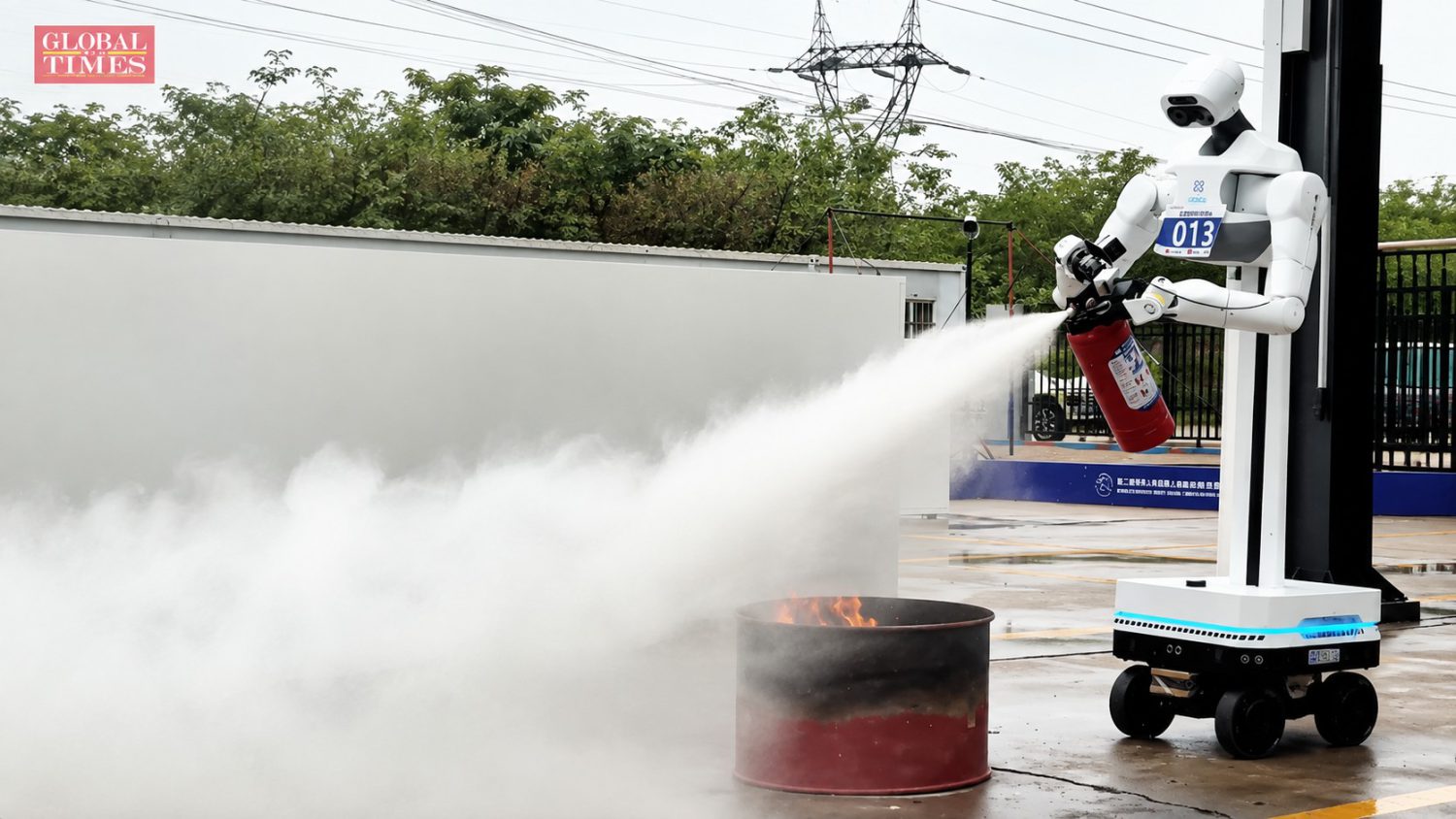
Rain falling on an operational Beijing firehouse. A clock running. Somewhere inside, a real fire waiting for a robot to put it out. That’s the setup the 2nd World Humanoid Robot Games handed 23 humanoid robot teams in the emergency-management category — a scenario designed to measure whether these machines can handle practical, safety-critical work in a complex real-world setting. Most of them couldn’t close the deal. The competition wasn’t staged in a model room or a tidy indoor set. Human firefighters lit the fire themselves and monitored whether each robot used the extinguisher correctly. No controlled lighting. No forgiving surfaces. No second chances.
Each robot had 30 minutes to complete three sequential tasks:
- Identify two randomly placed simulated hazardous substances and transmit images
- Locate and close three randomly selected valves
- Find a fire extinguisher and spray until the fire was out
In the reported run, only 3 of 12 teams completed all three tasks.
Why the Failure Rate Is the Whole Point
That 3-of-12 result isn’t a public-relations problem — it’s the most useful measurement humanoid robotics has produced in years.
You’ve seen the Boston Dynamics demo reels. Atlas doing backflips, Spot trotting across construction sites. They’re genuinely impressive — and they’ve quietly set a ceiling on public expectations that real-world deployment keeps crashing into. Think of those viral clips as the driving simulator. Beijing was the snowstorm highway merge.
The firehouse exposed exactly where that ceiling sits. Rain degraded visual recognition. Shifting outdoor light confused sensors calibrated for indoor conditions. Valve locations were randomized. The environment refused to cooperate, the way real environments always do. Coordinating perception, motion planning, balance, manipulation, and task sequencing — simultaneously, under time pressure, with unpredictable variables — is a fundamentally different challenge than any controlled lab test.
For context on the broader event: the Games run August 22–26, 2026, at Beijing’s National Speed Skating Oval, known as the Ice Ribbon, with 2,056 robots from 666 teams across 16 countries competing across 51 events — 30 competitive and 21 scenario-based. Scenario categories reportedly span households, hotels, industrial settings, logistics, and emergency rescue. The scale is real. So is the ambition.
But the firehouse told the truth. Most robots showed up, worked hard, and fell short. That 3-of-12 completion rate isn’t embarrassing — it’s a precise, observable measurement of how much engineering work remains before humanoids belong anywhere near a real emergency. The 2026 full Games at the Ice Ribbon will offer a wider benchmark across all 51 events, but this firefighting result is already the clearest signal the field has sent: promising in the lab, fragile in the rain. Progress looks exactly like this — unglamorous, specific, and, if you’re paying attention, genuinely useful.