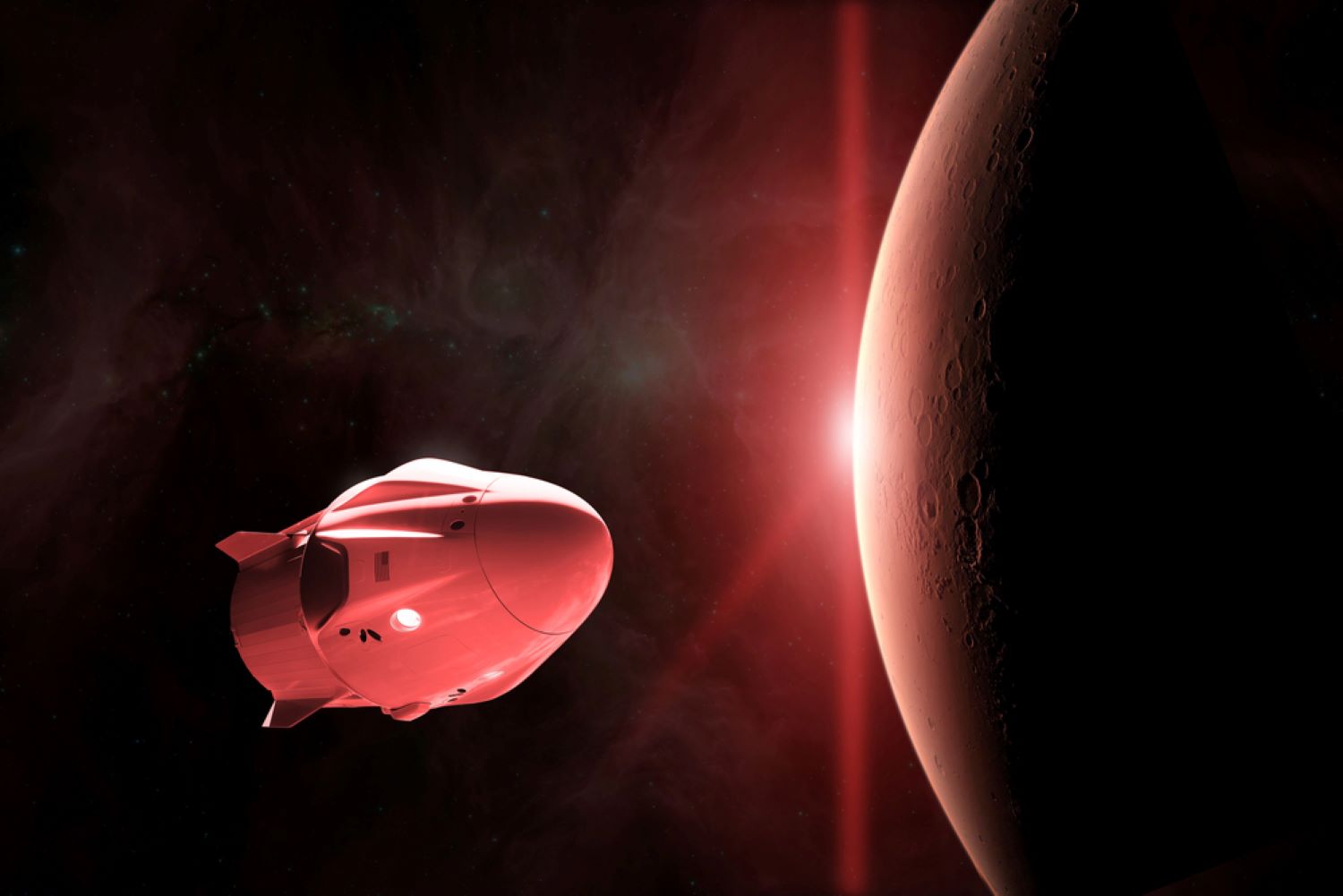
Four tonnes of dead rocket. 8,700 km/h. No atmosphere to slow it down. On August 5, 2026, at roughly 06:35 UTC, a spent Falcon 9 upper stage designated 2025-010D slammed into the lunar surface near Einstein crater — a large, heavily cratered formation on the Moon’s western limb. NASA modeling predicts a fresh crater roughly 18 metres wide and 4 metres deep, with energy equivalent to about three tons of TNT released on impact. This wasn’t a meteorite. It was hardware from a January 2025 commercial mission, drifting uncontrolled for 19 months because no one planned for what came after payload delivery.
What Actually Happened
The crash was predictable — which makes the lack of a disposal plan harder to explain.
The January 15, 2025 Falcon 9 launch carried two commercial lunar landers: Firefly Aerospace’s Blue Ghost and ispace’s Hakuto-R. Once delivered, the upper stage had no fuel left for a controlled deorbit or escape burn. Earth-Moon gravitational dynamics did the rest, slowly bending its path until trajectory became destiny. Astronomer Bill Gray, using Project Pluto tracking software, and NASA’s Center for Near Earth Object Studies both converged on the same conclusion: 100% impact probability, confirmed August 5, 2026.
The object — roughly 4,000–4,900 kg and approximately 12–14 metres long — struck near Einstein crater at approximately 19°N, 93–94°W lunar longitude, hitting at roughly Mach 7 equivalent speed. Because the Moon has no atmosphere, the stage stayed fully intact until contact. Full kinetic energy transfer. No gradual burn-up like you’d see with debris reentering Earth’s skies.
The Science They’re Salvaging
An accident with known variables is as close to a controlled experiment as planetary scientists are going to get.
Most meteorite impacts are random and poorly characterized — like trying to reconstruct a car crash with no dashcam footage. This one arrived with known mass, velocity, and trajectory. Planetary scientists are now comparing before-and-after imagery from US and South Korean lunar orbiters, studying ejecta plumes for clues about subsurface composition. NASA’s 2009 LCROSS mission proved intentional lunar impacts yield real science, including evidence of water ice. Researchers hope to salvage something similar here. As planetary scientists told Time, though, the consensus is blunt: “It is not a good thing to be randomly sending debris into the moon.”
The Accountability Gap
Commercial space is moving faster than the rules designed to govern it.
NASA and ESA missions require end-of-life planning — fuel reserves, a disposal trajectory, a non-hazardous final orbit — under agency and international guidelines. Commercial launches currently face no equivalent universal mandate. This Falcon 9 stage broke no rules. That’s the problem. Think of it as the terms-of-service agreement nobody reads until something breaks, except here the consequences land on the Moon.
Experts, including space-policy analysts cited by Time and CGTN, warn that without stricter disposal requirements for commercial missions, the question isn’t whether another uncontrolled lunar impact occurs — it’s where it hits next time, and whether that’s near an Apollo heritage site or a future crewed outpost. Discussions are underway at bodies including the UN Committee on the Peaceful Uses of Outer Space, but specific rules for lunar-bound stages remain unfinished business.
The Moon hasn’t been pristine since 1969. But there’s a meaningful difference between flags and footprints and a 4-tonne chunk of hardware nobody bothered to steer home. The rules need to exist before the next impact — not after.