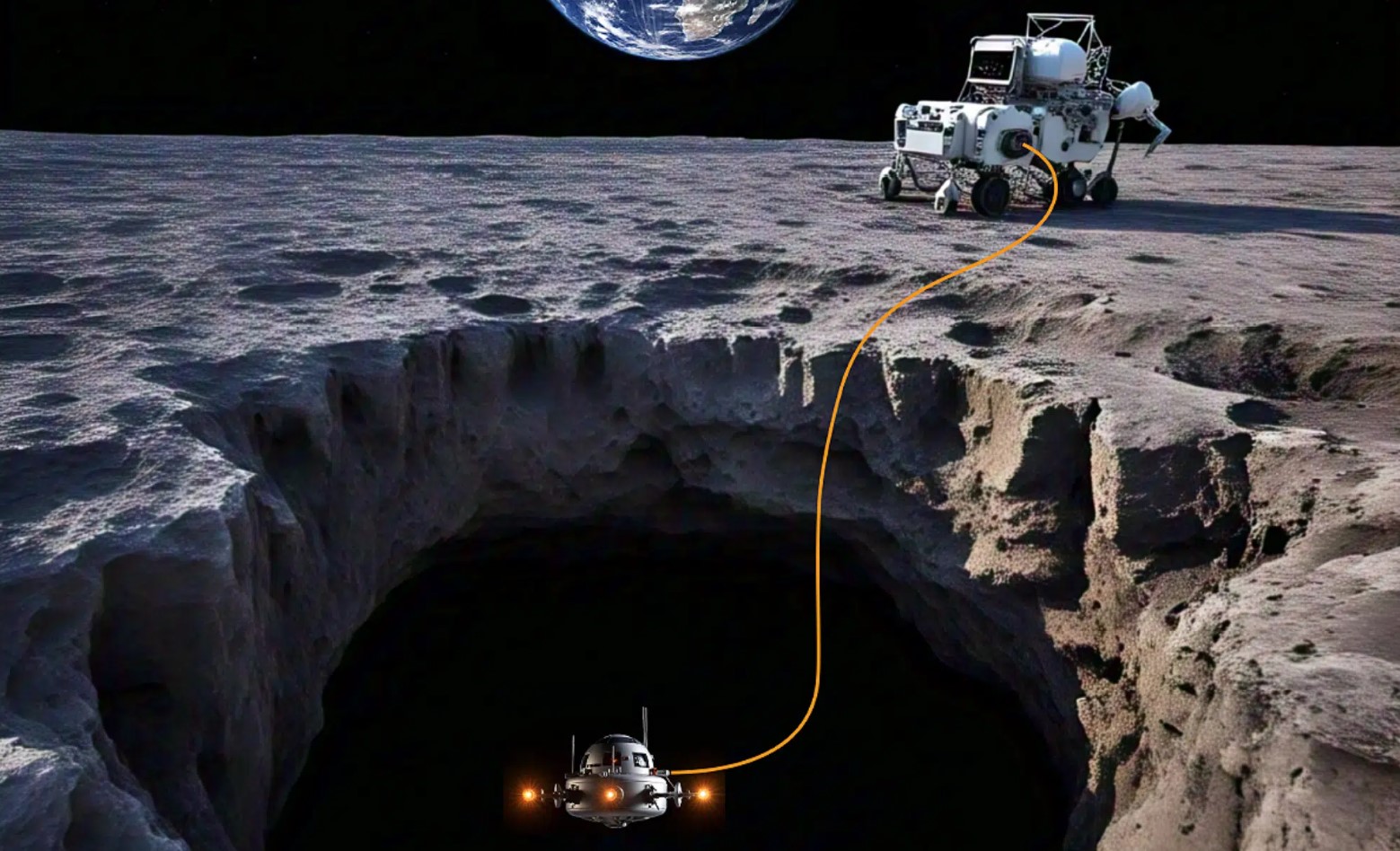
Somewhere beneath the Moon’s surface, a hole the size of two football fields drops 133 meters into absolute darkness. No sunlight. No GPS. No map. NASA has awarded an Austin robotics firm $175,000 to determine whether a hover drone — powered by a laser beam traveling through a single optical fiber — can descend into that void and return the first images of what may become humanity’s first off-world shelter.
The Cave Worth Going Into
Ancient lunar lava tubes offer natural radiation shielding and stable temperatures, making them prime candidates for the first off-world human shelters.
Lunar lava tubes are volcanic tunnels formed billions of years ago, some stretching hundreds of meters wide — vastly larger than anything comparable on Earth. Research published in 2024 confirmed that the Mare Tranquillitatis Pit, located roughly 400 km from the Apollo 11 landing site, likely opens into a network of these caverns. The appeal is immediate: rock ceilings block cosmic radiation and micrometeorites, while interior temperatures reportedly hold steady near 17°C (63°F). Compare that to surface swings between scorching daylight and deep-freeze shadow. For any future Moon base, these caves function as pre-built bunkers with built-in climate control.
What Makes LUX Different
- A thin optical fiber spools out as the drone descends, simultaneously delivering laser power, high-speed data, and feeding a cold-gas propulsion system — one tether, three jobs
- Navigation relies on onboard LiDAR and SLAM algorithms for 3D mapping in a completely GPS-denied environment
- Cold-gas thrust keeps the cave pristine, avoiding combustion byproducts that would contaminate scientific readings
- The target entry point: Mare Tranquillitatis Pit, roughly 133 meters deep
Think of it like a vintage console game where the controller cord is still attached — except that cord is simultaneously your power source, your internet connection, and your engine fuel. The fiber isn’t a limitation. It’s the entire infrastructure.
“NASA has outlined an ambitious vision for the future of space exploration, we’re returning the Moon to stay, advancing to Mars, and pushing to deepen our understanding of space.” — Greg Stover, Director, NASA Advanced Research and Technology Division
Beyond the Moon
Power-over-fiber technology could enable terrestrial applications from disaster response to deep-sea exploration if the lunar concept proves viable.
Stone Aerospace physics lead Gilly Elor describes LUX as potentially enabling “the first off-world cave exploration,” with dual-use potential for terrestrial platforms — disaster-response drones navigating collapsed structures, deep-mine inspection robots, underwater vehicles freed from bulky battery packs. ESA’s DAEDALUS spherical roller and DLR’s Scout rover represent competing cave-exploration approaches, but LUX’s hover-drone-plus-fiber combination is the genuinely novel variable.
This is Phase I funding — a $175,000 feasibility study, not a launch date. But the question LUX is asking matters well beyond its budget. Before anyone lives underground on the Moon, something needs to go down there first. A laser-powered drone on a fiber leash might be exactly strange enough to work.