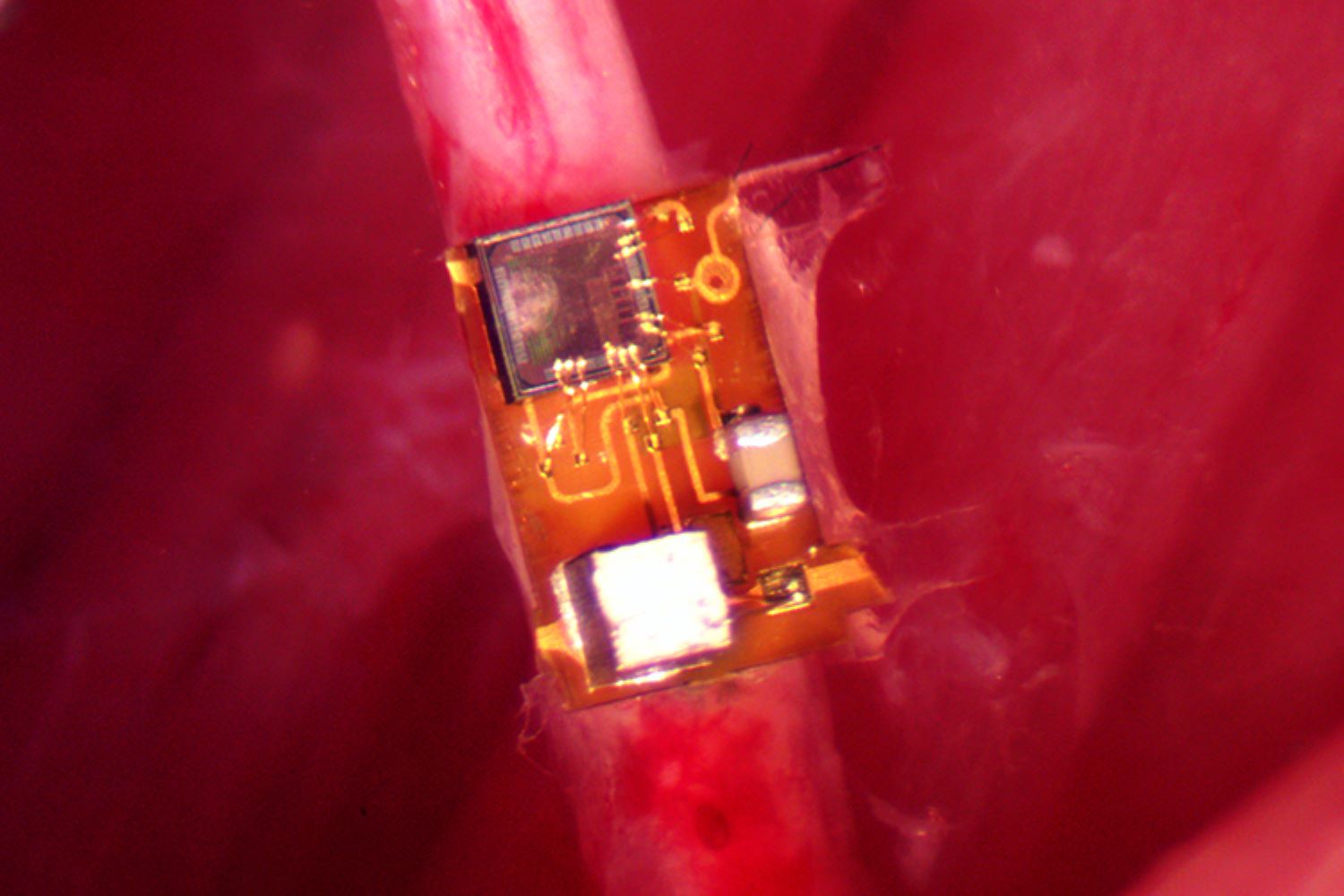
You’ve probably seen the video. Some version of it has been circulating on TikTok and X for months: smart dust floating through the air, invisible sensors drifting like dandelion seeds, shadowy operators controlling your body like a PlayStation character. Here’s the thing — the underlying science isn’t fiction. Berkeley engineers really did build a grain-of-sand-sized implant called StimDust, really did place it on a rat’s sciatic nerve, and really did control the rat’s hind leg remotely using ultrasound. That happened. The question worth asking isn’t whether StimDust exists. It’s what it can actually do — and what it cannot.
A Mote the Size of a Sand Grain That Moves Legs
The documented results are precise, controlled, and confined entirely to an animal lab.
Berkeley’s StimDust device measures roughly 6.5 cubic millimeters and converts ultrasound energy into electrical nerve stimulation at about 82% efficiency, according to the university’s press release and a published paper on arXiv. Researchers implanted it on an anesthetized rat’s sciatic nerve using a surgical cuff, then directed a precisely aligned ultrasound beam at it. The rat’s hind leg moved on command. They mapped how different stimulation levels recruited muscle fibers — the kind of precision required for medical-grade devices.
The Berkeley team frames this explicitly as medical technology, targeting:
- chronic pain
- heart arrhythmias
- epilepsy
- asthma
No human trials have been documented. The device only functions when an external ultrasound system is positioned at close range with controlled parameters. Nobody is sprinkling this into fog.
Smart Dust, Conspiracy Claims, and What the Evidence Shows
Kris Pister’s DARPA-linked Berkeley project coined “Smart Dust” in the late 1990s — and the gap between that real research and the conspiracy version is enormous.
Smart Dust originated as a genuine engineering concept: real millimeter-scale sensor nodes combining computing and wireless communication. Lab prototypes exist. Specialized MEMS sensors have been deployed industrially for years. But the vision of invisible, autonomous particles drifting through air? Power, antenna, and communication constraints at that scale remain unsolved engineering problems, not regulatory delays. As Science Insights put it, smart dust “exists as a research field, a set of working prototypes, and a direction of travel. It does not yet exist as actual dust.”
The fears aren’t entirely irrational — DARPA’s involvement is documented, and dual-use technology has a long and complicated history. GPS-dust chemtrail claims, however, carry no evidentiary weight, according to Full Fact and Harvard’s Salata Institute.
The Real Thing to Watch
The governance conversation is already overdue, even if the technology is still early.
The concerns worth your attention aren’t airborne mind-control clouds. They’re:
- dense sensor networks expanding into cities and workplaces without transparent consent
- neural implants potentially deployed in coercive medical or correctional settings without patient autonomy
The technology is early. The oversight conversation is not.