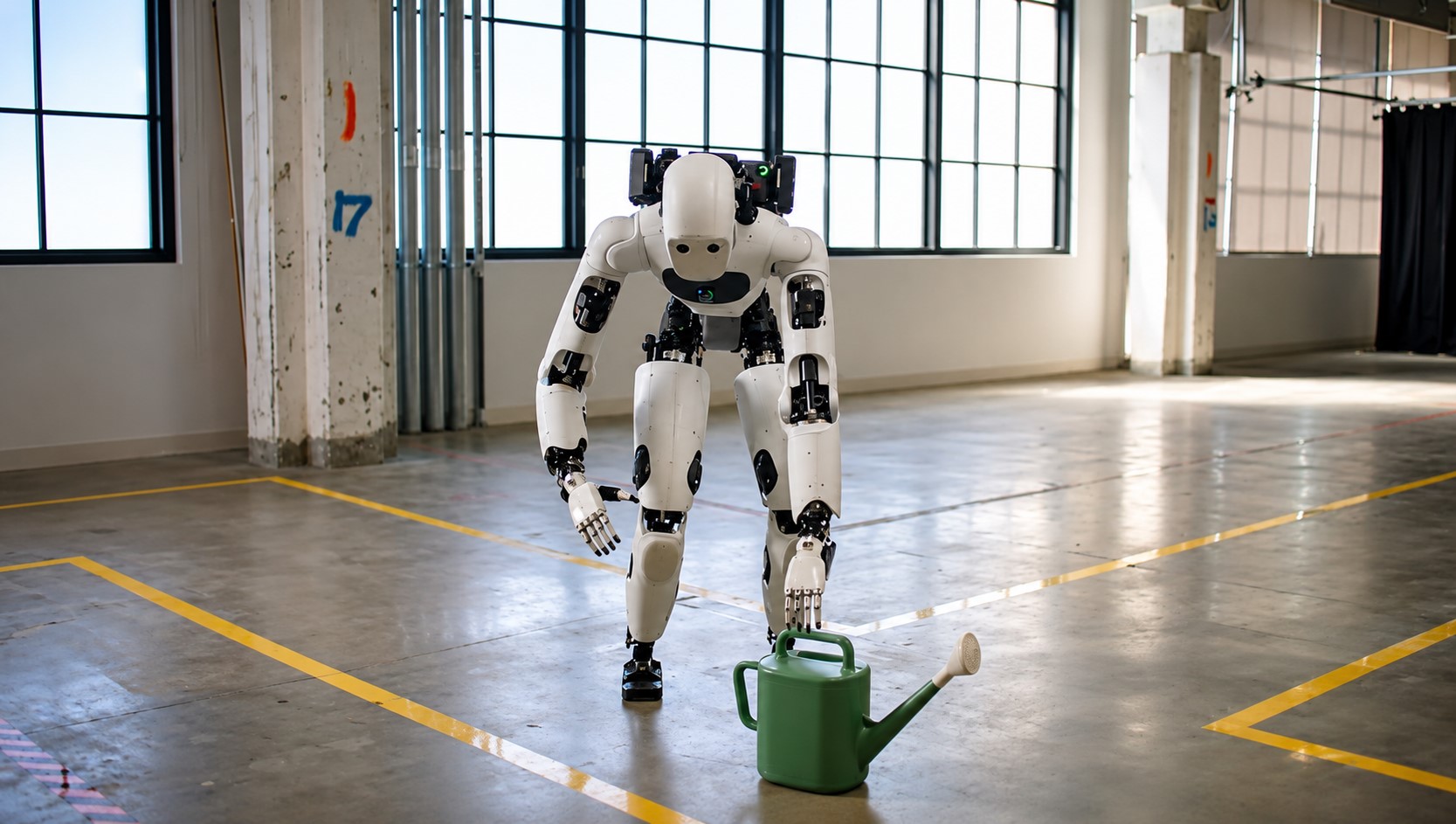
A humanoid robot bends at the waist, grabs a watering can off the floor, then scans a shelf to find a specific item — all from a spoken command. That’s Apptronik’s Apollo 2 running Google DeepMind’s Gemini Robotics 2, a vision-language-action (VLA) model that converts camera feeds and natural language into motor commands. Previous versions could only control a robot’s upper body — think of a video game character that could wave its arms but was bolted to the floor. Now the whole skeleton moves. Before the hype gets ahead of the hardware, though, the success rates tell a more complicated story, and access remains locked behind a waitlist.
Feet to Fingertips – What the System Actually Does
Three AI models work together to give robots whole-body coordination, planning ability, and the option to run without cloud connectivity.
Gemini Robotics 2 coordinates walking, crouching, stretching, and five-finger dexterity. Demo tasks include sealing Ziploc bags, unscrewing lightbulbs, and tying knots — the kind of fine motor work that has historically humbled even sophisticated robotic hands. The system runs as a three-model stack:
- Gemini Robotics 2 (VLA): Direct whole-body motor control, feet to fingertips.
- Gemini Robotics ER 2: The planning layer — handles multi-step task reasoning, coordinates robot teams, and serves as what DeepMind calls its “safest robotics model to date.”
- Gemini Robotics On-Device 2: Runs locally on robot hardware with no cloud dependency. Adapts to entirely new robot bodies in a matter of hours.
DeepMind describes the leap as moving “from table-top manipulation into whole body control, five finger dexterity and multi robot teamwork.” Launch partners include Apptronik, Boston Dynamics, and Agile Robots.
Temper expectations accordingly. Benchmark success rates range from 45.7% to 76.3% on whole-body tasks, per published DeepMind data. Multi-finger dexterity scores swing considerably — 32% to 92% depending on the task. Parallel gripper tasks land between 74.2% and 89.6%. DeepMind itself acknowledges movement speed still needs improvement. Access remains gated behind a Trusted Tester waitlist, meaning deployment on proprietary hardware is not available to most developers today.
Robots That Know When to Stop
Built-in human detection reflects the practical reality that humanoids will soon share factory floors with people.
ER 2 includes safety behaviors that detect nearby humans and halt robot motion when someone gets too close. This isn’t a reassuring footnote — it’s an engineering prerequisite. The low-grade anxiety many people feel about autonomous vehicles sharing the road transfers directly to humanoid robots navigating warehouse aisles beside human workers. DeepMind appears to understand that trust, not just capability, determines real-world adoption.
Gemini Robotics 2 represents a credible step toward a universal AI control layer for industrial humanoids. Home robots that follow spoken instructions without incident? Still a ways off. The gap between a polished demo and an actual factory floor, however, just got noticeably smaller.