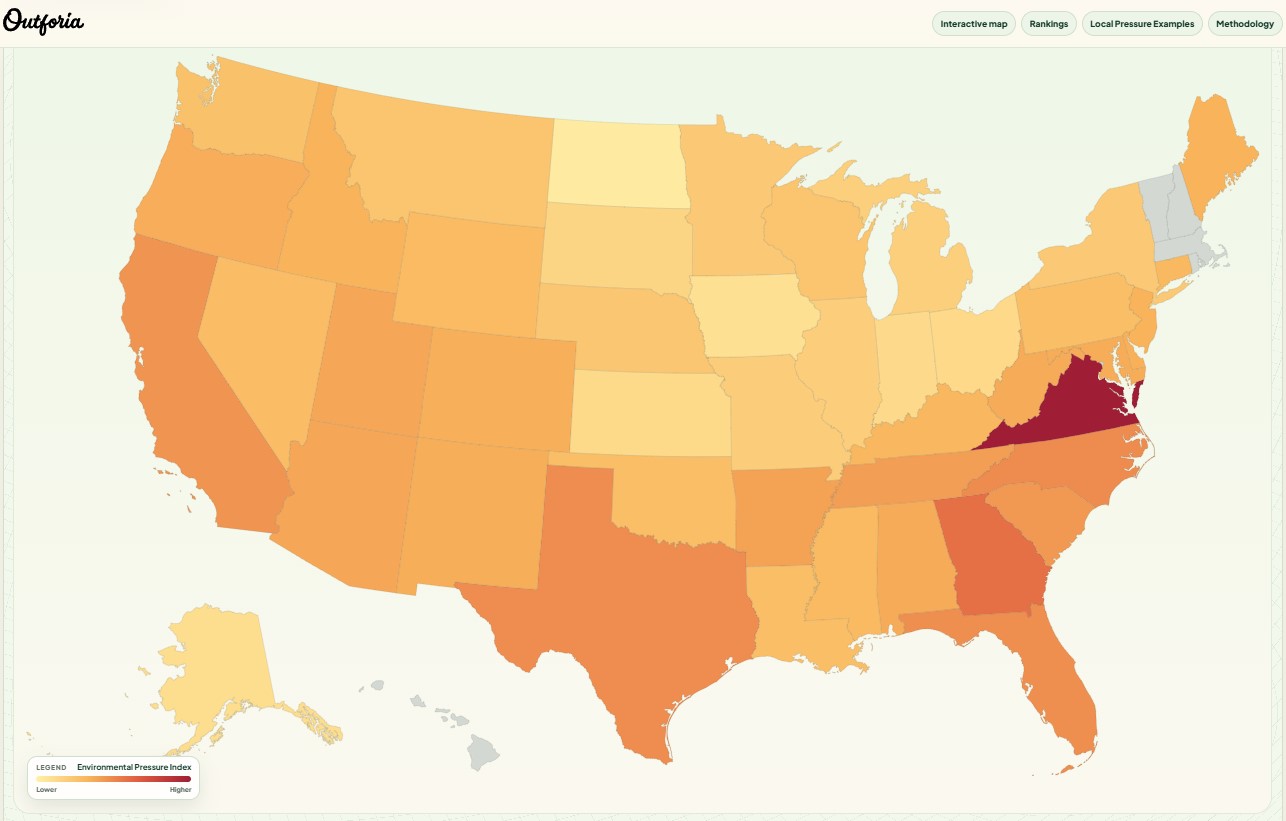
Every chatbot query, every AI-generated image, every cloud backup lives somewhere physical. That somewhere increasingly overlaps with forests, drought-stressed watersheds, and the habitats of federally listed endangered species. Outforia’s new environmental pressure index scores each U.S. state from 0 to 100 by combining data center project counts, endangered species tallies from U.S. Fish and Wildlife Service data, USDA forest cover percentages, and drought severity from the USDA Drought Monitor. It puts a hard number on what conservation groups have warned about for years. This isn’t a technology problem. It’s a siting problem — and the rise of AI Data Centers is increasingly colliding with protected lands and ecosystems.
Where the Pressure Is Highest
Virginia tops the index with a perfect score of 100, but Georgia, Texas, and several others aren’t far behind.
Virginia earns the maximum score with roughly 283 data center projects crowding a state that hosts 79 federally listed endangered species, significant forest cover, and rising drought risk. Water-planning researchers at the University of Illinois flag “critical gaps” in Virginia’s permitting process, noting that facilities with similar IT loads can have “radically different water impacts” depending on cooling technology. The number 100 isn’t abstract — it’s a pressure cooker.
- Georgia ranks second (65.46): approximately 134 projects and 77 endangered species, with 128 additional data centers planned
- North Carolina ranks third, driven by high drought risk and extensive forest cover
- Texas ranks fourth: 202 data center projects overlapping with roughly 120 endangered species
- Florida rounds out the top five; California, South Carolina, Tennessee, Arkansas, and Utah follow
Three pathways connect server farms to species loss. Land clearing fragments habitat corridors — think cutting a highway through a national park. Water-intensive evaporative cooling competes directly with rivers and wetlands already running low. Fine-particle air pollution (PM2.5) from associated power infrastructure spreads well beyond facility fences; a Piedmont Environmental Council analysis of a Loudoun County facility showed pollution reaching across Northern Virginia and the broader DC region.
“The AI boom can sound like something happening entirely in the cloud, but the AI infrastructure behind it is firmly on the ground,” according to Carl Borg of Outforia.
Policy Is Starting to Catch Up
New York imposed the first state-level moratorium on hyperscale data centers, shifting the debate toward smarter siting rather than an outright construction halt.
New York became the first state to formally pause new hyperscale data center permits — for one year — while regulators develop updated environmental and energy standards. Pro-growth critics call it a “terrible decision” for U.S. competitiveness. Researchers counter with a middle path: regional-scale siting evaluation, mandatory Water Use Effectiveness disclosure, and low-water or water-free cooling technologies as standard practice. Borg frames it plainly — the goal is ensuring infrastructure gets planned “carefully, openly and with local environmental conditions in mind.”
Land where an endangered salamander breeds and land where a hyperscale facility needs to cool its servers are often the same parcel. Outforia’s index doesn’t resolve that tension — but it names it, maps it, and hands the argument to every regulator still pretending the choice doesn’t exist.