Moonshot AI’s Kimi K2.7 Code shows a 21.8% improvement on its internal Kimi Code Bench v2, a substantial leap for developer tools. These advanced AI coding models promise to untangle complex codebases, acting like skilled junior developers on your team. Anyone who has stared at a cryptic error message for hours knows the value of truly smart assistance. Independent evaluations (like those done by AI Coding Daily) put new models like K2.7 Code through rigorous real-world benchmarks to see if its deeper thinking lives up to the marketing hype, or if it is merely another flashy trailer for a mediocre film.
10. Kimi K2.7 Code
This open-weight, agentic large language model functions as a digital software engineer with a 256K token context window.
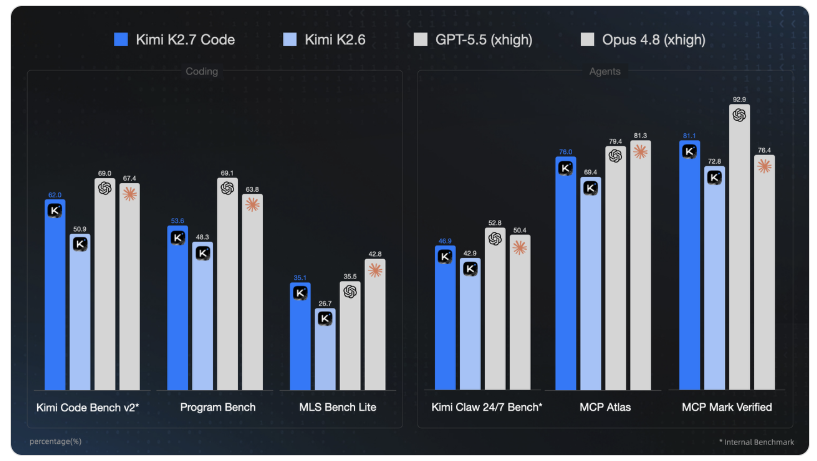
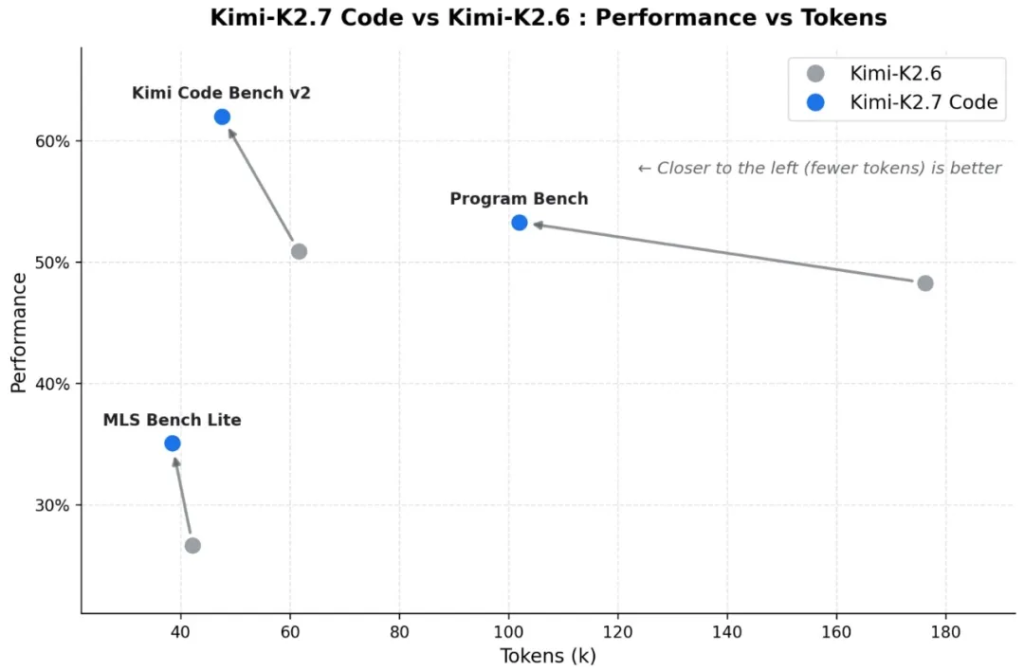
Moonshot AI reports Kimi K2.7 Code shows a +21.8% improvement on Kimi Code Bench v2 and a +31.5% gain on MLS Bench Lite over its predecessor, Kimi K2.6. Its 256K token context window handles vast codebases. Moonshot also claims 30% fewer reasoning tokens, aiming for a leaner process.
Despite Moonshot’s claims of efficiency, OpenCode Go’s independent tests show a different reality. Expect 78¢ per prompt in their tests for custom PHP and 13¢ per prompt for React JS, with tasks often taking 5 minutes. However, K2.7 Code secured 7th place with 17 out of 20 points on the AI Coding Daily leaderboard, delivering zero failures and rectifying errors K2.6 missed, proving its value.
9. Kimi K2.6
Moonshot AI’s baseline coding model set the foundation with solid mid-tier performance for developers.
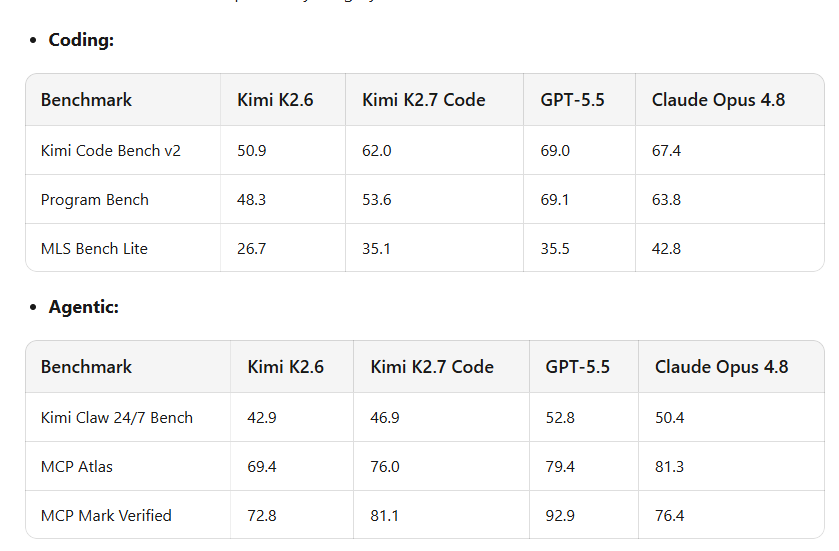
Kimi K2.6 scored 50.9 on Kimi Code Bench v2, setting Moonshot AI’s baseline for coding-oriented models. It also achieved 48.3 on Program Bench, making it a capable open-weight option. These metrics foreshadowed advanced capabilities.
During practical evaluations, Kimi K2.6 cost 16¢ per prompt for Laravel API tasks, according to independent testing. It logged two failures on a custom PHP package. Its lower tool-use success and higher reasoning token usage versus Kimi K2.7 Code highlighted areas ripe for improvement.
8. Moonshot AI
This Chinese AI company positions its Kimi K2.7 Code model as a serious contender against industry titans.
The model aims to reduce “thinking” overhead, reportedly using ~30% fewer reasoning tokens compared to Kimi K2.6, according to company analyses. The Kimi family of large language models, with their agentic capabilities (meaning they can act autonomously and use tools), focuses sharply on long-context reasoning for complex coding. Anyone who has debugged an entire codebase knows the value of a system that can see the whole picture.
K2.7 Code also supports an immense 256K token context window, allowing developers to manage colossal codebases. This Mixture-of-Experts (MoE) architecture forms the backbone of its performance. Moonshot AI champions open-weight releases under a modified MIT license, promoting integration into developer platforms and IDE copilots.
7. OpenCode Go
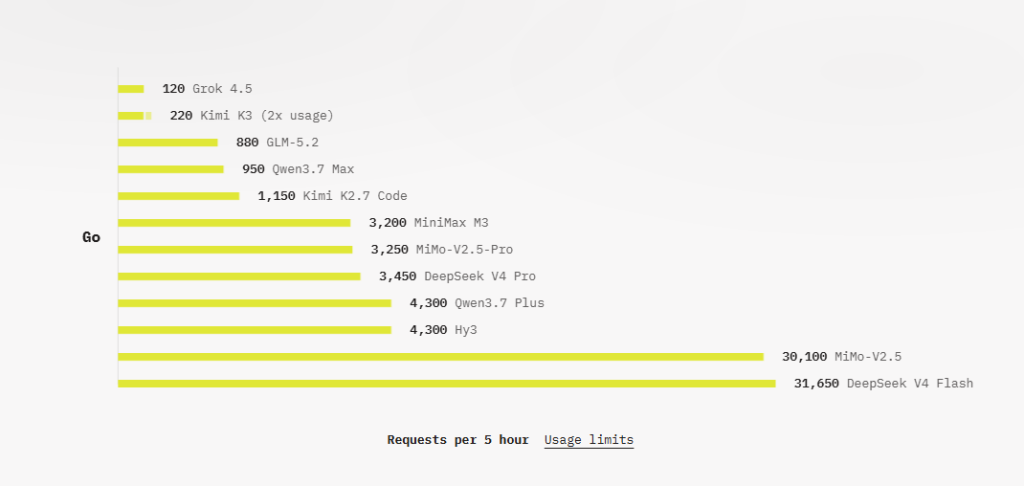
This unified interface sidesteps individual subscriptions and allows crucial side-by-side evaluations without vendor lock-in.
OpenCode Go aggregates access to multiple large language models (LLMs), including Chinese offerings like Kimi K2.6 and Kimi K2.7 Code. It acts like a universal remote for all your AI brainpower.
While Moonshot AI claimed Kimi K2.7 Code used 30% fewer reasoning tokens, OpenCode Go revealed its deeper thinking cycles often led to higher effective costs and longer average times in their tests. Laravel API tasks, for example, could take up to 4 minutes. This concrete data cuts through theoretical benchmarks, offering tangible insights for budgeting.
6. Laravel
This open-source PHP framework, with its Model-View-Controller architecture, streamlines complex coding tasks with surgical precision.
Laravel’s widely-used PHP web application framework provides expressive syntax and built-in features, from routing to authentication, minimizing boilerplate. Laravel excels at building robust HTTP and JSON APIs, providing a reliable backbone for modern web services.
Evaluating large language models’ coding prowess often tests frameworks like Laravel. On a Laravel API task, Kimi K2.7 Code generated functional code, but took an average of 4 minutes for a full response. Laravel’s extensive ecosystem and “convention-over-configuration” mean LLMs familiar with its idioms produce production-ready code.
5. Filament

This Laravel admin panel and form builder’s reliance on PHP enums and interfaces presents a distinct challenge for large language models.
Specialized packages often reveal the true depth of an AI coding model’s understanding. Filament provides a modern interface built on Laravel and Livewire. In an evaluation, Moonshot AI’s Kimi K2.7 Code made two mistakes by not properly using Filament’s enum interfaces, despite its advanced capabilities.
This task averaged 4 minutes 49 seconds to complete, costing 41¢ per prompt according to AI Coding Daily. Mastering niche ecosystem tools requires more than raw processing power; it demands a nuanced grasp of intricate package interactions.
4. React
Successfully implementing seven React components without a hitch demands more than basic coding proficiency.
React, a JavaScript library primarily maintained by Meta, builds user interfaces through a component-based architecture, letting developers compose complex UIs from reusable parts. Concepts like JSX, state management, props for data flow, and hooks are essential for production-ready frontend code.
In a recent evaluation, the Kimi K2.7 Code model successfully implemented these components. It achieved zero failures across all five projects, passing all 12 tests as rigorously evaluated by Playwright. Each task averaged 5 minutes to complete and cost 13¢ per prompt. This model clearly understands modern JavaScript frameworks, delivering functional frontend code without the usual debugging headaches.
3. Playwright
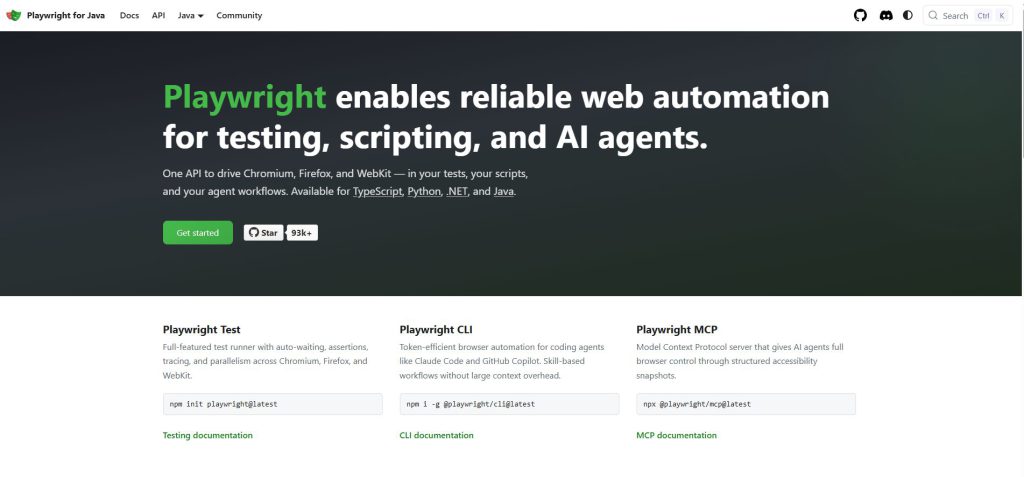
Microsoft’s open-source browser automation tool ensures web UIs function precisely across Chromium, Firefox, and WebKit.
This precision makes it critical for evaluating AI-generated code, especially from models like Moonshot AI’s Kimi K2.7 Code. Playwright acts as the digital bouncer, checking every line of AI output against real-world browser behavior. The necessity for robust end-to-end testing means Playwright serves as quality control for AI’s code creations.
When assessing Kimi K2.7 Code’s React components, Playwright confirmed 12 passed tests across five projects with zero failures. This validation ensures coding models produce functionally sound applications, not just plausible-looking yet flawed solutions. Anyone who has debugged AI code that “looked fine” on GitHub knows this reality check is vital for quality.
2. Program Bench
Moonshot AI’s internal benchmark assesses AI coding capabilities far beyond basic unit tests.
Moonshot AI’s Kimi K2.7 Code model scored 53.6 on Program Bench. This unique benchmark evaluates a model’s ability to grasp complex requirements, write correct code, and integrate with existing libraries. Kimi K2.6, the previous model, scored 48.3, while K2.7 Code showed an 11.0% relative improvement.
Program Bench measures a model’s utility in actual development, prioritizing practical application over theoretical correctness. K2.7 Code’s improved results position it among top open-weight models, indicating its potential as a reliable partner for crafting real-world software solutions.
1. MLS Bench Lite
This multi-language coding benchmark assesses cross-linguistic fluency across Python, Rust, and Go.
Moonshot AI’s Kimi K2.7 Code scored a remarkable 35.1 on the MLS Bench Lite benchmark. This represents a 31.5% relative improvement over the Kimi K2.6 model. If managing projects that juggle Python, Rust, and Go, this cross-linguistic proficiency matters.
K2.7 Code’s performance nearly matches GPT-5.5’s 35.5 score, placing it as a leader among open-weight models. This adaptability brings order to the kind of digital chaos that ensues when debugging a project with code from several different contributors.