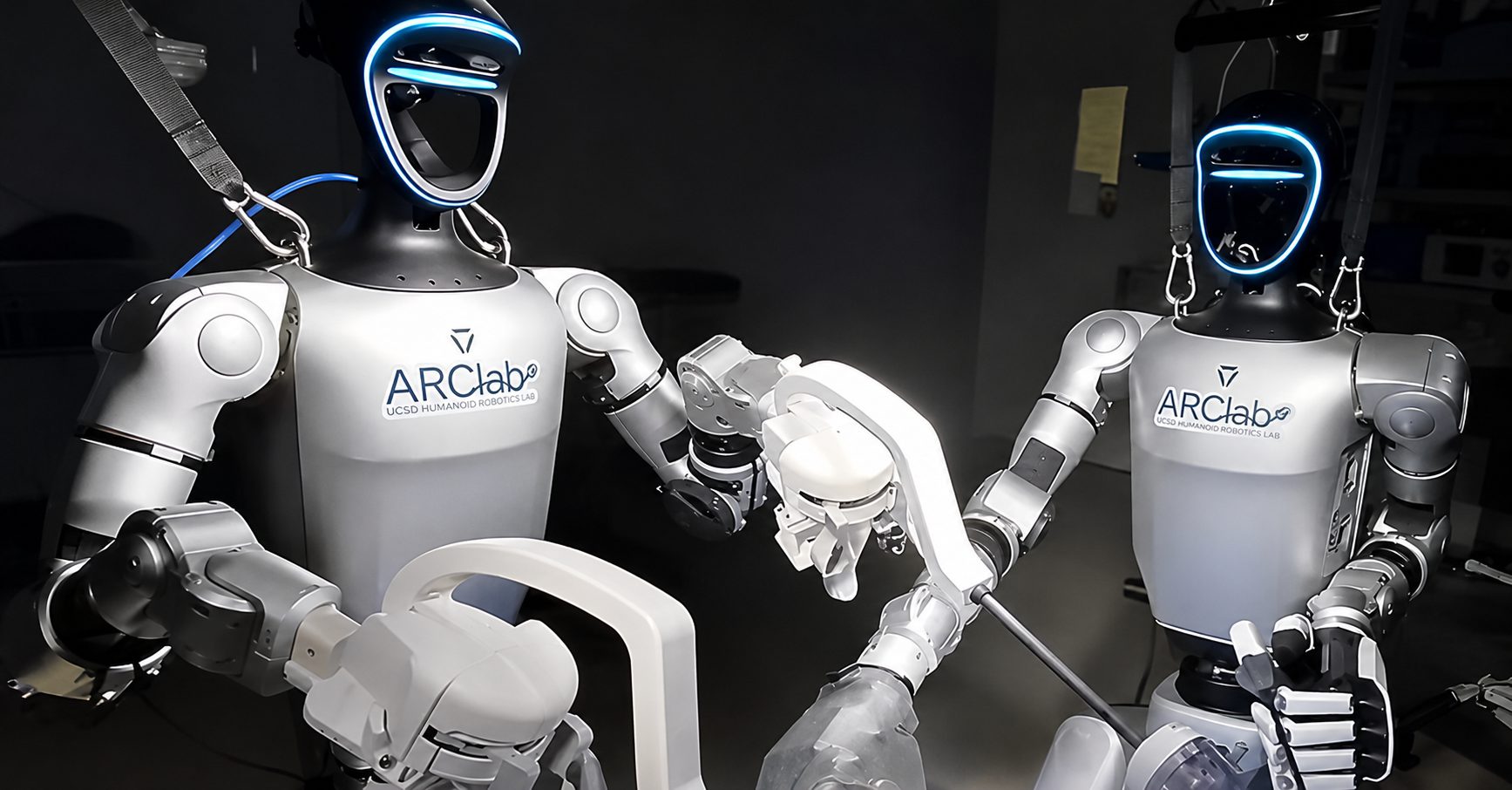
Somewhere in a UCSD operating room, a five-foot-tall, 60-pound humanoid robot named Surgie gripped a standard laparoscopic instrument and helped remove a gallbladder. A surgeon controlled every move via teleoperation. The patient was a large nonprimate mammal—not a human. But the milestone, published in Nature‘s July 8 issue, marks the first time teleoperated humanoid robots performed live surgery. That distinction matters enormously, even with the caveats.
What Actually Happened in the OR
Two preclinical surgeries proved humanoid robots can handle real surgical tasks alongside—and without—human hands in the field.
The UCSD team ran two procedures:
- A surgeon-robot team completed a laparoscopic cholecystectomy—gallbladder removal.
- Two Surgie robots worked together to finish a procedure with no human hands touching the patient.
Both succeeded on large nonprimate mammals, the standard preclinical step before anyone considers human trials.
The contrast with existing technology is stark. Think film crane versus travel tripod. A da Vinci surgical system weighs roughly 1,800 pounds, demands a dedicated suite, proprietary instruments, and specialized staff. Surgie walks into any existing OR, picks up standard tools through custom adapters, and gets to work. No renovations required.
“Remotely operated and autonomous humanoid robots have real potential for amplifying access to critical surgeries,” said Michael Yip, the UCSD faculty member who led the research, as reported by Medical Xpress. “This can help address the healthcare crisis not only in the United States, but also worldwide.”
A few fast facts worth knowing:
- Surgie matched surgical precision comparable to established robotic platforms, per the UCSD team.
- Multiple recalibrations extended operating time—a limitation the researchers compare to early da Vinci procedures, which once took hours before dropping to around 30 minutes with refinement.
- Communication latency remains a critical barrier for long-distance teleoperation.
- Separately, Johns Hopkins demonstrated a robot completing a gallbladder surgery phase without any human help, suggesting two parallel tracks are converging toward autonomous surgery.
Why a Human-Shaped Robot Changes the Equation
The humanoid form factor means one platform can scrub in, fetch instruments, hold an ultrasound probe, and clean up after—no specialized hardware swap required.
If you live in a rural county served by one overworked surgeon, this matters. Surgie’s human-like control mapping reportedly felt more intuitive to operators than conventional surgical consoles, letting specialists translate familiar hand movements directly into robotic action. A surgeon in Chicago could theoretically teleoperate a Surgie in a field hospital or remote clinic. UCSD even frames future space missions as a plausible deployment scenario.
“Our goal is an operating theater of the future, where humanoid robots and humans work side by side as an integrated team,” Yip stated, according to Medical Xpress, “in traditional hospital settings as well as in nontraditional, field medicine scenarios.”
The road ahead remains long. Force output and sensor sensitivity need significant hardware improvement. Human trials, FDA approval, and reliable low-latency networks all stand between Surgie and your local hospital. Early robotic surgery once consumed several hours per procedure—refinement brought that down to roughly 30 minutes. Surgie’s current limitations fit that same adoption curve. The trajectory is established; the only real question is timing.