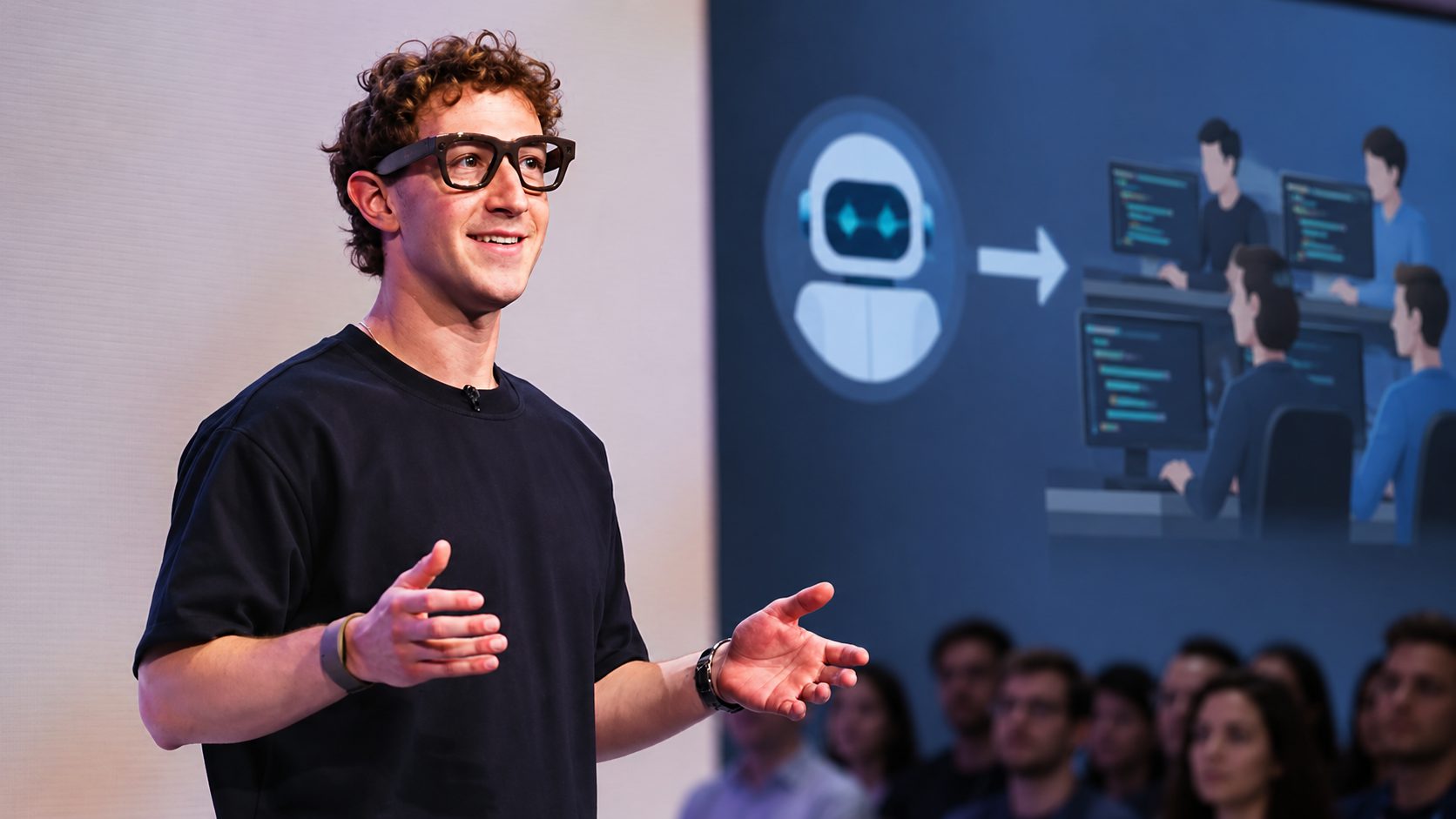
Mark Zuckerberg spent the better part of two years declaring that AI would write most of Meta‘s code and replace mid-level engineers by 2025. That prediction just aged terribly. At a recent internal town hall captured by Reuters and reported by Mashable, Zuckerberg admitted that “the trajectory of the agentic development over at least the last four months hasn’t really accelerated in the way that we expected.” Behind that careful phrasing sits a $145 billion infrastructure bet and roughly 8,000 jobs eliminated — about 10% of the workforce, according to Wired. A freshly built Applied AI division was assembled from the wreckage. This isn’t just a Meta stumble. It’s a live stress test of the thesis that AI replaces human workers on a CEO’s preferred timeline.
The Plan That Wasn’t Clean
Meta’s AI restructuring combined mass layoffs with forced reassignments, and leadership is now openly admitting neither went well.
Meta built its Applied AI division like an algorithm hijacking your carefully curated Spotify playlist — pushing thousands of employees into AI roles regardless of fit or preference, much like a humanoid robot displacing workers with little regard for individual readiness. Zuckerberg himself called the reorganization “not clean” and acknowledged the plan had yet to “come to fruition,” according to Mashable’s reporting on the Reuters recording.
- Zuckerberg told staff that AI agent development had stalled over four months, per Reuters
- Meta CTO Andrew Bosworth admitted in an internal memo that leadership did “an atrocious job explaining the vision,” according to HR Executive
- Roughly 8,000 employees were cut as part of the AI pivot, per Wired
- An employee-tracking program designed to gather AI training data leaked internally; Bosworth later said any future version would be opt-in only, per HR Executive
Morale sits at record lows. Employees are resisting AI-related tasks, internal petitions have surfaced, and Wired described the internal situation as “a total mess.” Despite all of it, Zuckerberg remains publicly optimistic — suggesting meaningful benefits could arrive within three to six months. That canyon between executive confidence and operational ground truth is where this story actually lives.
Not Just a Meta Problem
Across big tech, the promise of fully autonomous AI agents is running headlong into stubborn operational reality.
Meta’s situation isn’t unique. Industry commentary places it alongside OpenAI, Microsoft, and Google — all quietly acknowledging that autonomous AI agents still require human oversight for high-stakes work. The $500 Billion Stargate project is one example of the industry’s enormous infrastructure bets, yet the promise of fully autonomous coding bots in 2025 is aging about as gracefully as every “metaverse will change everything” headline from 2022. Academic and market research cited in broader coverage finds no statistically significant economy-wide labor disruption since ChatGPT launched, and only a small fraction of organizations report transformational strategic change from AI so far.
For tech workers watching this unfold, the uncomfortable reality is plain: the engineers Zuckerberg said AI would replace still have their jobs. Their CEO is the one walking back the timeline — and what that means for the next round of layoff justifications is still being written. In the meantime, AI-Powered Websites continue to offer practical productivity gains that enterprise-level AI agents have so far failed to match at scale.