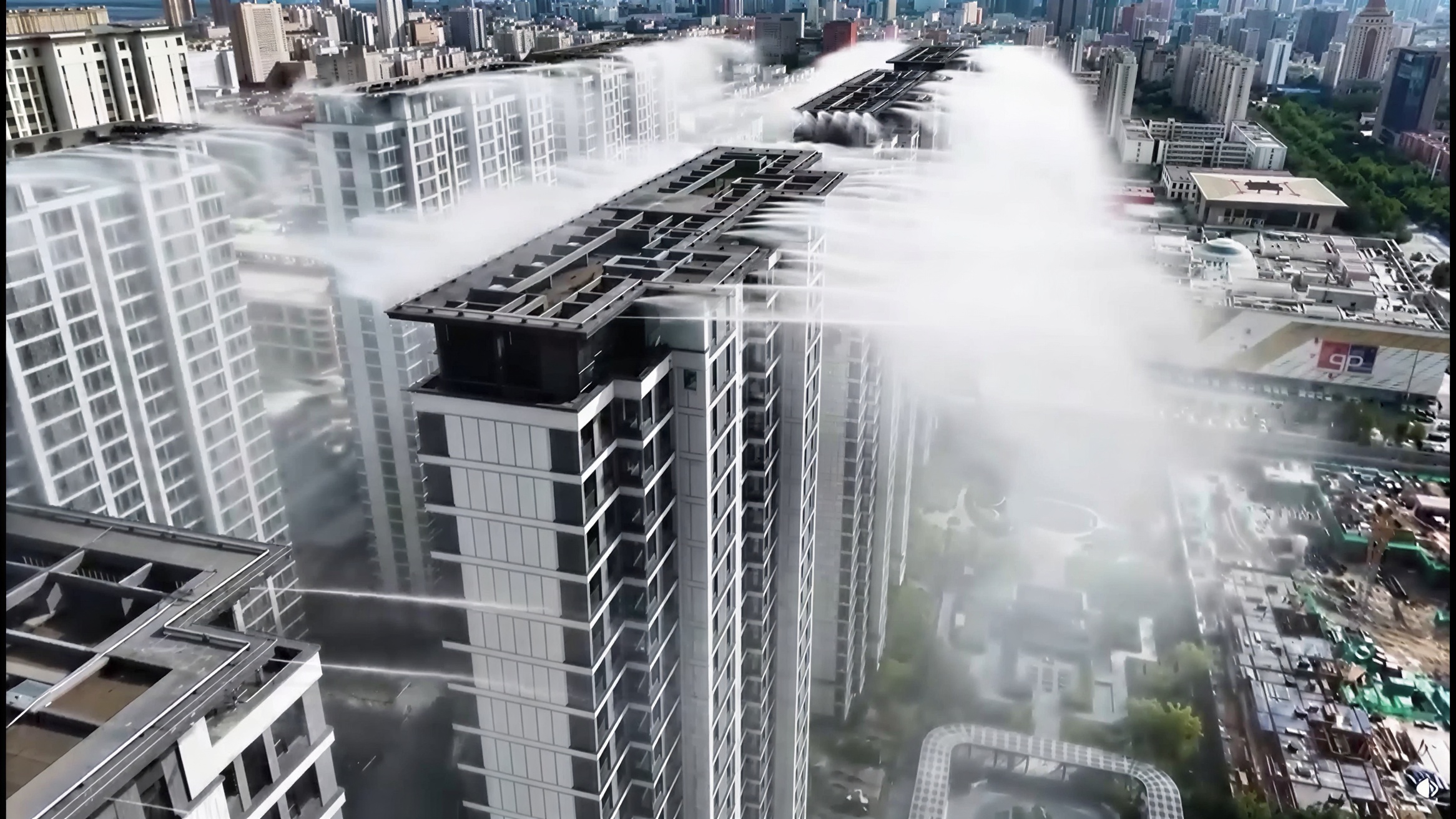
When ambient temperatures hit 38°C in Yuncheng, Shanxi Province, residents of one high-rise neighborhood don’t just crank the AC. They watch artificial rain pour from their rooftops. A sensor-controlled misting system fires ultra-fine water droplets from rooftop nozzles, cooling surrounding air and surfaces by 5–8°C within minutes, according to Chinese media reports cited by India Today. The effect — sheets of mist cascading down building facades — went predictably viral on Reddit’s r/interestingasfuck and Instagram. This isn’t just content. It’s working climate infrastructure.
How Rooftop Rain Actually Works
Think of it as a smart thermostat for an entire neighborhood — except instead of adjusting a furnace, it triggers artificial weather.
The physics are straightforward: evaporative cooling. High-pressure nozzles along the rooftop perimeter spray water into droplets so fine they evaporate before reaching pedestrians below. As those droplets evaporate, they absorb heat from the surrounding air — the same mechanism as human sweat, scaled to a building. India Today reported roof surface temperatures dropping from 32.6°C to 31.0°C in short test intervals. Sensors handle activation automatically when temperature thresholds are exceeded, requiring no manual operation. The underlying principle aligns with established evaporative-cooling science, the same physics the US EPA cites when explaining how evapotranspiration drives cooling in green roof systems.
- Temperature reduction: 5–8°C in minutes at ~38°C ambient heat
- Mechanism: evaporative cooling via high-pressure rooftop nozzles
- Energy use: significantly lower than conventional AC — pumps and nozzles replace compressors and refrigerants
- Automation: sensor-triggered, no manual operation required
- Precedent: similar misting already deployed at Chinese parks, plazas, and bus stops – this scales it to residential high-rises
“High-pressure nozzles installed on rooftops spray extremely fine droplets of water into the air. As the droplets evaporate, they absorb heat from the surrounding air.” – India Today
The Bigger Picture – and the Honest Gaps
Why aren’t cities elsewhere already doing this — and what’s actually stopping them?
European and global audiences watching Instagram reels are asking exactly that question. The underlying science holds up: the US EPA notes green roofs can reduce nearby air temperatures by up to 20°F (~11°C) through evapotranspiration, validating the evaporative approach. Mist systems win on speed and on-demand activation. Green roofs deliver passive, long-term benefit. A layered approach combining both is likely where smart urban design eventually lands.
What the viral clips don’t show is worth noting, honestly. Water consumption figures are not publicly detailed, leaving real uncertainty about viability in water-stressed regions. Maintenance costs, mineral buildup in nozzles, and any measured indoor temperature impact remain absent from public reporting. The gap between a striking viral moment and proven scalable infrastructure is real — early autonomous vehicle coverage and actual deployment timelines offer a useful reminder of how wide that gap can run.
Still, the signal matters. If performance and cost data bear out, similar systems could spread across Chinese cities and internationally. Buildings are increasingly being treated as active climate infrastructure — not just the grid, not just your window unit. Your rooftop might eventually do more cooling work than your thermostat.