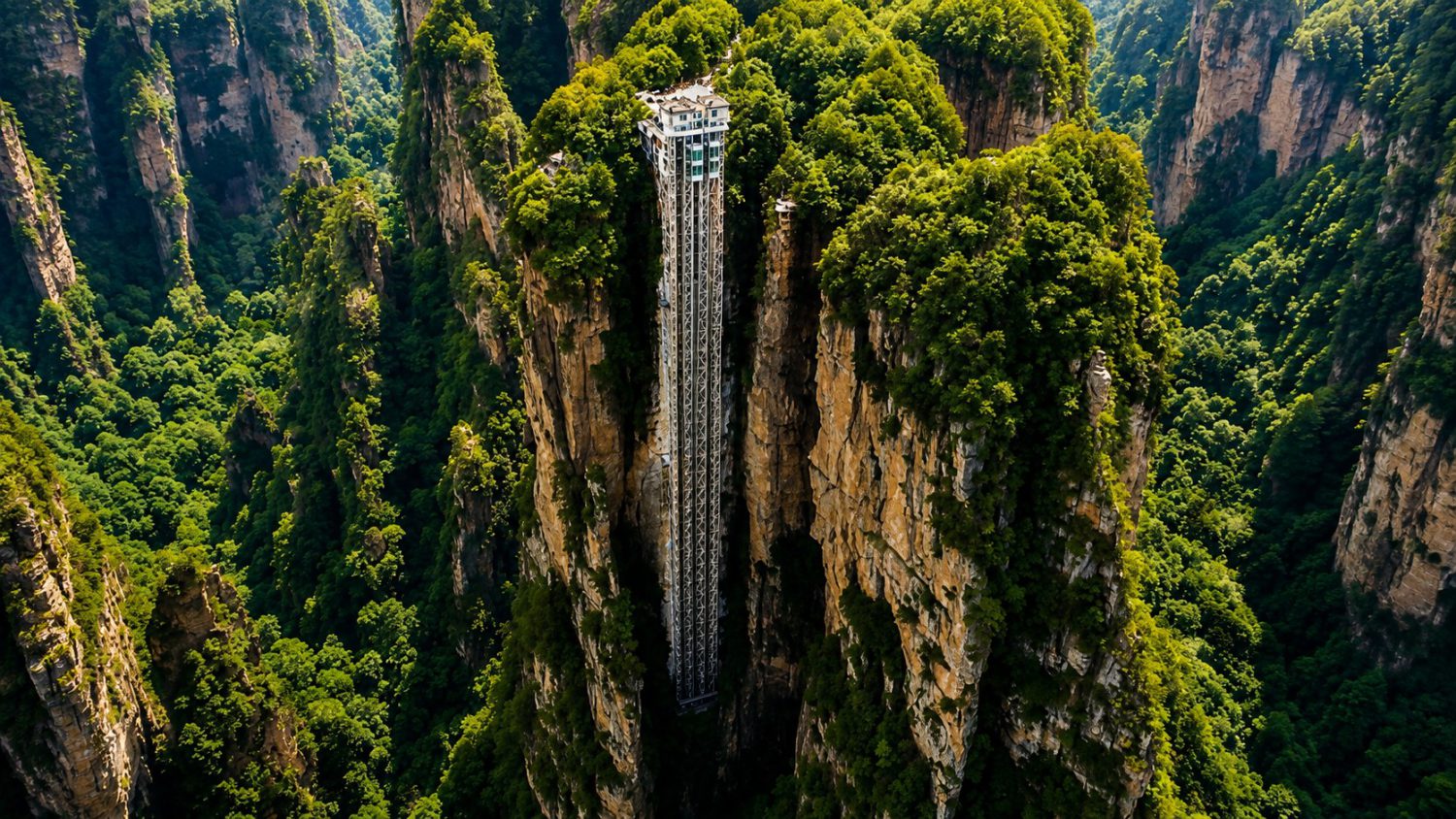
Consider the commute: you’re a primary school kid in Nizhuhe village, more than 500 meters below the canyon rim, facing a three-hour climb up exposed cliff paths just to reach class. Then you do it again on the way home. Six hours of hiking. Per school day. That was the reality until July 31, 2026, when the Fuyao Ladder — a 288-meter glass elevator bolted into the canyon wall — started covering that same vertical distance in roughly 50 seconds.
The Sky School Bus: How the System Actually Works
The full route now runs like a surprisingly elegant transit system, stitching together shuttle vehicles, two cliff elevators, and an aerial cable car.
- Shuttle vehicles carry riders from Nizhuhe village to the elevator base; Fuyao and the earlier Qingyun elevator (268 meters, opened 2022) lift them up the cliff face; an aerial cable car completes the trip to cliff-top Guanzhai Village Primary School — total journey time, about 30 minutes
- Fuyao’s cabin holds 81 passengers and travels at 5 meters per second, reaching the top in roughly 50 seconds; both elevators together move roughly 1,200 passengers per hour, according to New Atlas
- Around 20 local children use the system regularly; villagers and enrolled students ride free on a dedicated route, separate from tourist traffic, with staff acting as guardians along the way
- The Fuyao Ladder cost approximately 68 million yuan to build; daily canyon visitors reportedly jumped from 4,000 to 15,000 after it opened, according to New Atlas
State media describes the combined system as a “cloud shuttle” carrying “the dreams of mountainous children eager to learn,” according to Xinhua. That’s official framing. The commute numbers make the actual argument.
Engineering a Canyon, Not a Ski Resort
Building into a foggy, humidity-soaked cliff face presented engineering constraints that go well beyond anything a typical sightseeing installation demands.
A Ningbo-based elevator company developed Fuyao under conditions that included limited working space, persistent fog, and high humidity — all requiring continuous structural inspection. Redundant power supplies and backup systems were standard requirements before independent safety inspections cleared the elevator for public use, according to Interesting Engineering.
The elevator names carry deliberate weight. Qingyun means “ascending toward opportunity”; Fuyao translates roughly as “a whirlwind that sweeps things upward.” Local student Lei Xin, among the first children to ride Fuyao, described it as faster and more spacious than the original Qingyun, according to Interesting Engineering — about as direct a product review as you’re likely to get.
The system serves two masters: schoolchildren who need reliable transport and tourists chasing canyon views. Those interests happen to align here. Free resident access is confirmed policy across multiple official sources, not just a press release line — and the surge in visitor numbers suggests the tourism side can sustain operations long-term.
A Template, or a One-Off?
The Nizhuhe project raises a straightforward question about what’s possible elsewhere.
Twin glass elevators in a foggy Yunnan canyon, solving a school commute that used to cost six hours a day — the engineering is genuinely impressive. The sharper question is how many other remote communities are still doing the three-hour version, waiting for someone to run the numbers.