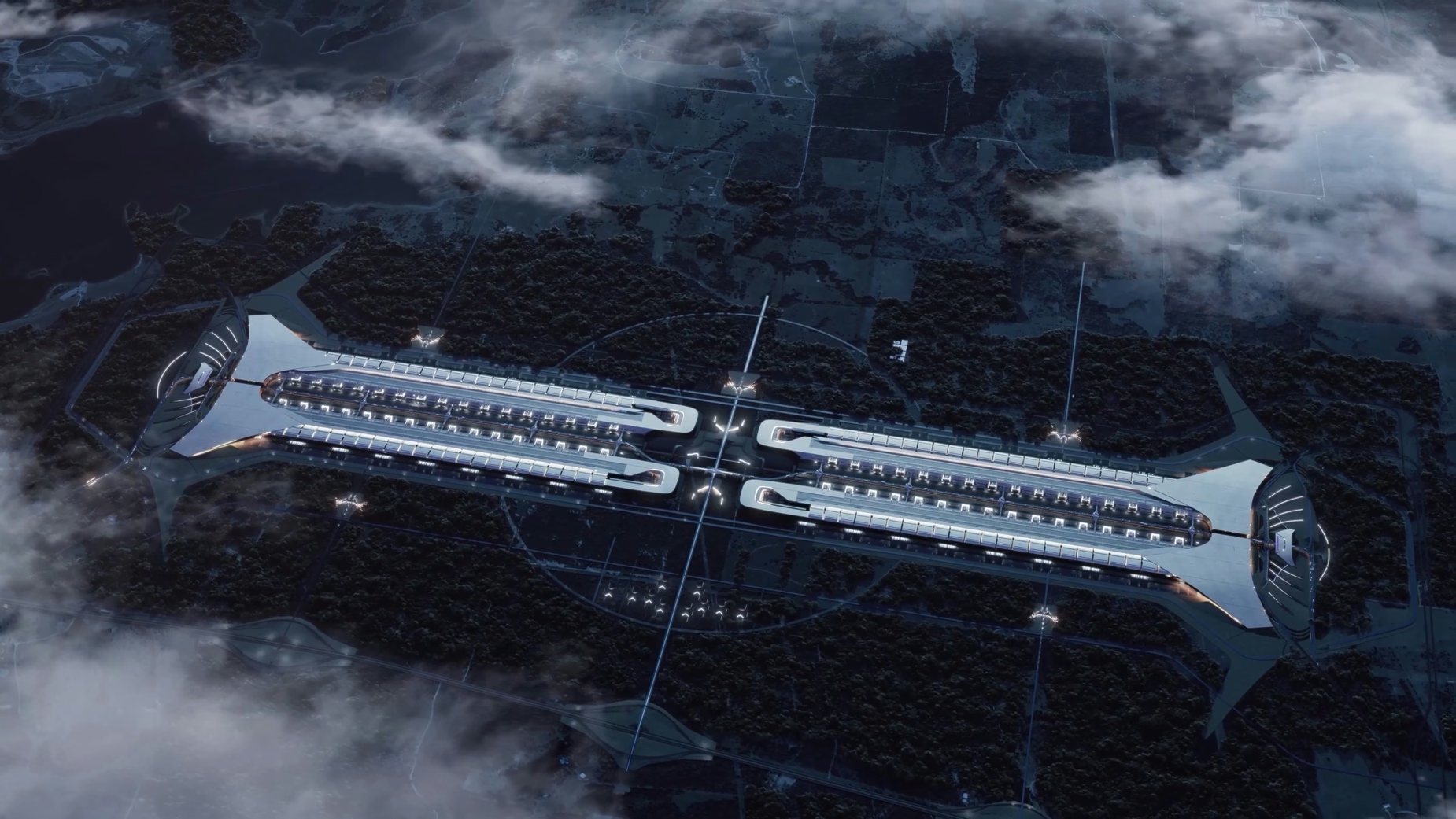
The New Century Global Center in Chengdu — currently the world’s largest building — covers 18.9 million square feet. Terafab’s stated footprint is more than five times that. Roughly 2,300 football fields. More floor space than the Pentagon, Apple Park, and the Mall of America combined. That’s not a factory. That’s a small city whose sole purpose is making chips. Tesla and SpaceX confirmed the site in Grimes County, Texas, on August 6, 2026 — and phase one alone costs $16.8 billion, according to Governor Greg Abbott’s office.
One Roof, Every Step: What Terafab Actually Is
Tesla and SpaceX’s megafactory consolidates the entire chip supply chain — logic, memory, packaging, and testing — under a single roof in rural Texas.
- Location: Grimes County, near College Station, built on the former Gibbons Creek Reservoir site
- Structure: Vertically integrated — logic, memory, packaging, and testing all consolidated in-house, covering the entire chip manufacturing chain from fabrication to finished processor
- Purpose: Chips for Tesla Cybercabs, Optimus humanoid robots, and SpaceX’s proposed space-based data centers
- Target output: Over one terawatt of compute per year — Musk’s stated goal; analysts attribute only tens of gigawatts to the entire existing global AI chip industry
- Partners: Intel is reportedly involved as a technology partner, though the exact role hasn’t been publicly detailed
Current global chip supply reportedly won’t cover Tesla and SpaceX’s projected needs for autonomous vehicles and robotics at scale, according to Reuters. Building in-house means tighter co-design of hardware and software — the same logic Apple used when it ditched Intel for its own custom silicon, except Musk is skipping the middleman at a scale Apple never attempted.
“The largest and most valuable building on Earth by far.” — Elon Musk, on Terafab’s ambition
The money is staggering. Phase one: $16.8 billion, confirmed by Abbott’s office, creating roughly 3,000 jobs. Earlier planning documents tied to Grimes County tax negotiations reference a range of $55 billion to $119 billion for full build-out, according to the Austin American-Statesman and Yahoo Finance. That $119 billion figure is a projected ceiling, not a committed spend — worth keeping in mind before anyone starts drafting the ribbon-cutting invitations.
While Texas officials frame this as an economic triumph, Grimes County residents who showed up to face SpaceX representatives reportedly got one clear message: the site is decided. Questions about noise, water usage, and emergency planning were met with broad reassurances. The county approved a 100% property tax abatement for decades in exchange for a $10 million upfront payment and $20 million annually for 35 years.
The Bigger Gamble Nobody’s Talking About
Chip manufacturing demands precision that took TSMC and Samsung decades to master — and Terafab is betting it can compress that learning curve at an entirely different scale.
Building a chip fab is nothing like building a Gigafactory. Semiconductor manufacturing demands extraordinary yield management and process expertise that established foundries spent decades developing. Industry analysts quoted by Reuters describe Terafab as an “unprecedented bet” — its success hinges on whether Tesla and SpaceX can match the yields that TSMC and Samsung spent decades perfecting. Concentrating this much AI infrastructure in one Texas location also creates a single point of failure for Musk’s entire product ecosystem.
If Terafab delivers on its terawatt compute promise, Tesla’s Cybercabs and Optimus robots could scale faster than any competitor still waiting in TSMC’s queue. If it stumbles, the bill will be historic. Either way, the people of Grimes County have a front-row seat they didn’t exactly ask for.