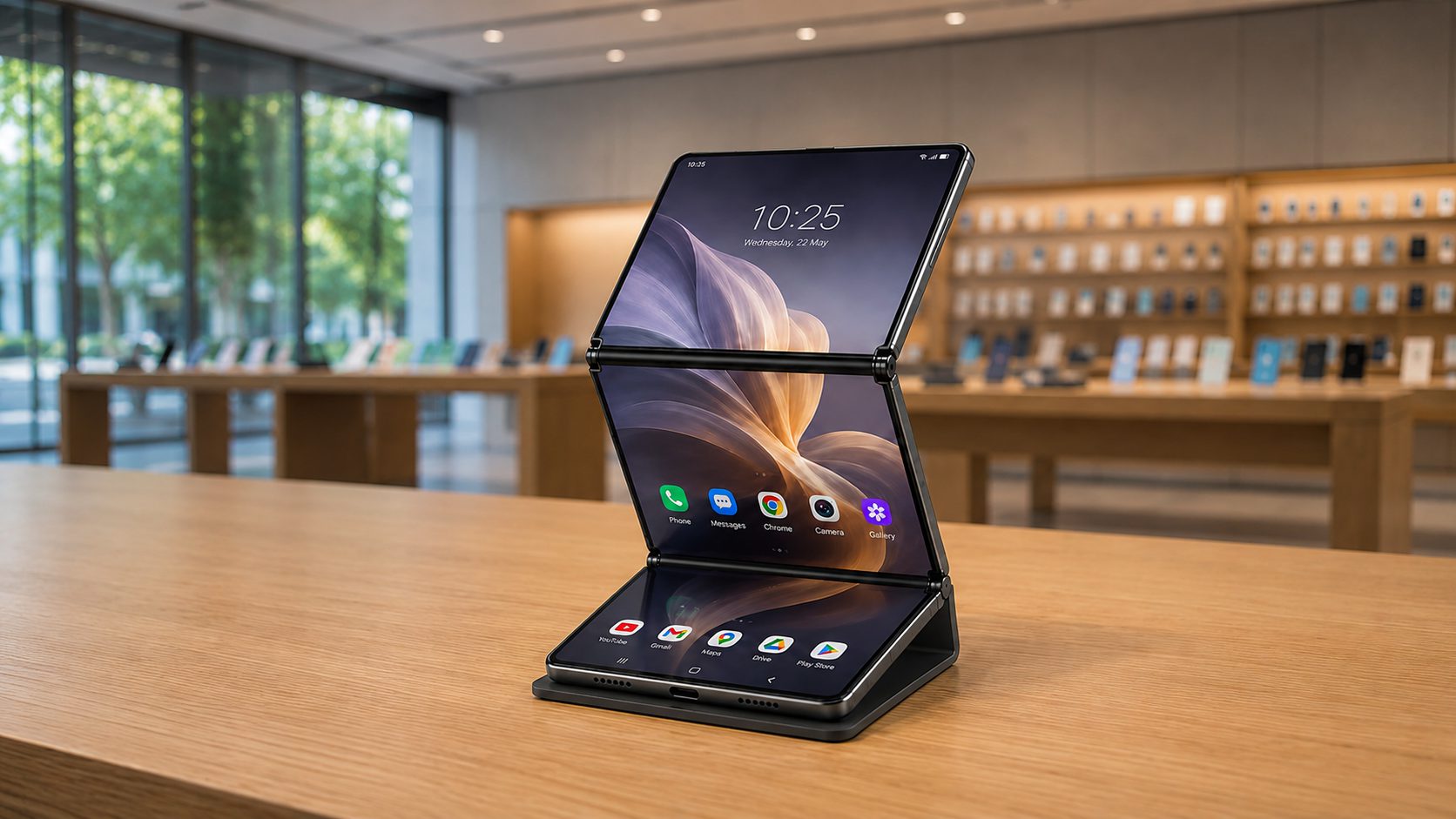
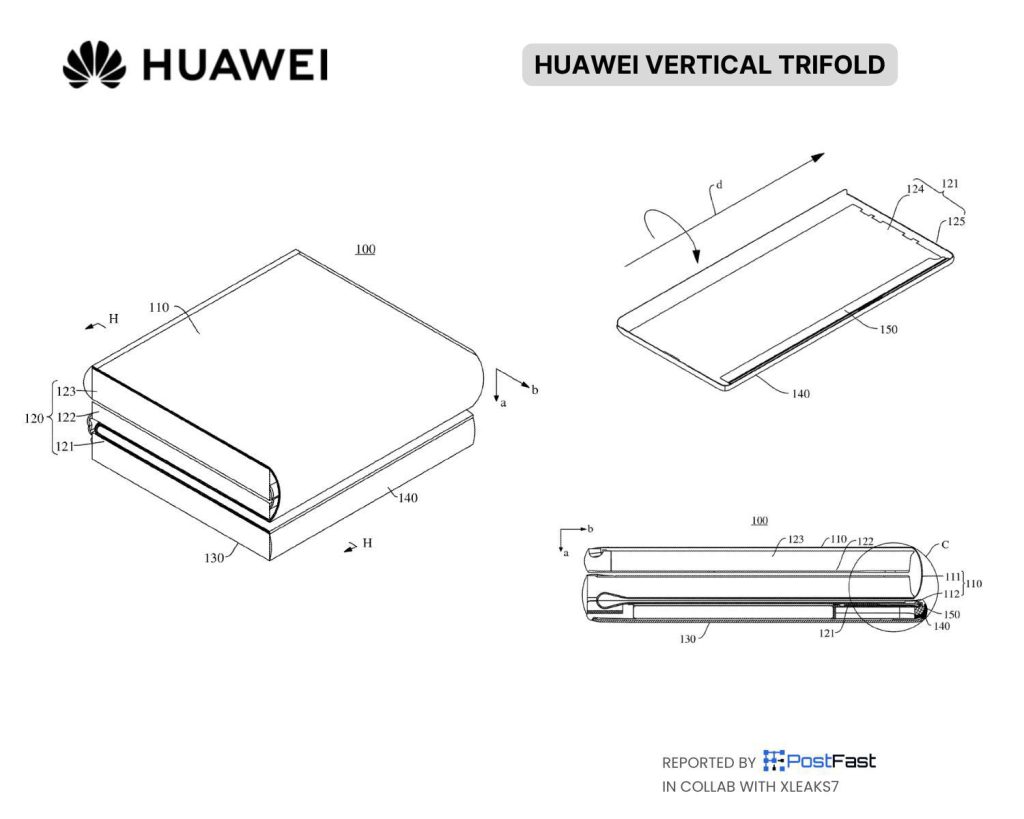
Every tri-fold foldable so far has chased the same dream: become a tablet. Huawei’s newly surfaced patent goes the other direction entirely — stay a phone, just get taller. The patent, uncovered by leaker David @xleaks7 in collaboration with PostFast, describes a device with two horizontally placed hinges that fold in opposite directions, creating a continuous flexible display spanning all three segments. No confirmed specs exist, no product name, and no release date accompany it — this is a blueprint on paper, not a phone on a shelf.
Two Hinges, Three Panels, One Folded Rectangle
Closed, the device resembles a standard smartphone footprint — narrow and tall — but roughly three times as thick.
Each segment reportedly serves a distinct hardware role, according to patent analysis by PostFast:
- Top segment: houses the rear camera system
- Middle segment: processor, battery modules, and primary antenna components — the phone’s engine room
- Bottom segment: extends display area and provides physical balance, with fewer packed electronics
One portion of the flexible display stays exposed even when fully folded. That strip handles notifications and basic controls, eliminating the need for a separate cover screen. Clever cost savings — but also an always-exposed flexible panel begging to meet your car keys.
The contrast with Huawei’s existing Mate XT is sharp. That device unfolds to a 10.2-inch OLED canvas optimized for landscape productivity. Some owners find it about as pocket-friendly as a hardcover novel. The vertical concept stays narrow and simply grows upward when unfolded — built for portrait content. Your TikTok scroll, your Instagram Reels feed, your endless group chat. Not your spreadsheet.
Tech commentators note that tri-folds effectively “transform into several devices,” according to coverage analyzed by CNET and GadgetHacks.
A Patent Is Not a Phone
Two hinges mean two potential failure points, and the durability data for this specific design sits at exactly zero.
Samsung is developing its own tri-fold, reportedly tablet-oriented. Apple’s rumored first foldable supposedly skews wide too. Huawei remains the only manufacturer shipping a commercial tri-fold today. Mate XT owners already flag concerns about long-term panel wear and steep repair costs — and that device has only one more hinge than a standard foldable.
A patent is a direction, not a delivery date.
HarmonyOS already manages three screen sizes across the Mate XT’s folding states. Adapting that to multiple portrait aspect ratios is theoretically within reach. If this form factor ever ships, it could pressure Samsung and others to rethink clamshell designs still handcuffed to tiny cover screens. Pricing, specifications, and timeline remain entirely unconfirmed.