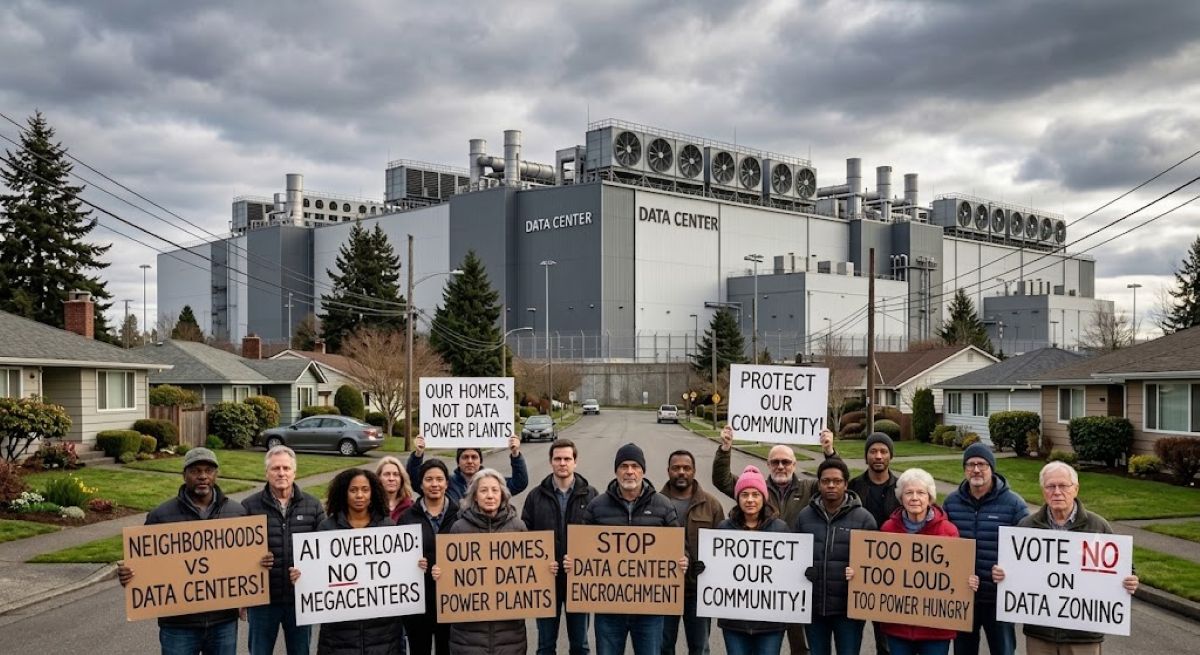
The poorest neighborhoods resist data centers at nearly five times the rate of the wealthiest: 19.0% vs. 3.8%. That stark finding from data scientist Geoff Holtzman’s new analysis demolishes the myth that wealthy environmentalists drive opposition to AI infrastructure. Instead, working-class communities bear the utility bill increases and noise while tech giants pocket tax breaks.
The Data Reveals a Class War Over AI Infrastructure
New research shows resistance peaks in neighborhoods earning $8,000-$72,000 annually.
Holtzman merged national data center proposals with Census data to map who fights these projects. The highest resistance came from working-class neighborhoods with median household incomes between $8,000 and $72,000. Meanwhile, neighborhoods averaging $133,000 to $250,000 showed “unusually little resistance.”
Even among low-income areas, the poorest and least formally educated neighborhoods resist most aggressively. This pattern challenges every assumption about who leads environmental opposition in America.
Community Pushback Actually Stops Projects
Organized resistance leads to 28.2% cancellation rate versus 5.2% without opposition.
The numbers prove fighting back works. Recent data center proposals facing organized community resistance were canceled, suspended, or shut down at more than five times the rate of unopposed projects.
Holtzman concludes that “the odds of cancellation are six times higher in neighborhoods that fight than in neighborhoods that don’t.” Poor communities aren’t just more likely to resist—they’re more likely to win.
Politicians Are Starting to Listen
Moratoria and suspended tax breaks signal a political shift worth $64 billion.
New York’s legislature passed a one-year construction moratorium awaiting the governor’s signature. Illinois Governor J.B. Pritzker suspended data center tax breaks in Chicago. Utah’s governor reportedly cut Ken O’Leary’s massive AI complex proposal in half following public outcry.
Data Center Watch estimates $64 billion in U.S. projects have been blocked or delayed by this “growing wave of local, bipartisan opposition.” That’s real money tech companies can’t ignore.
The Resistance Has Material Roots
Communities worry about electricity rates, water depletion, and phantom job promises.
Harvard’s Sarah Myers West explains why communities fight: “Rising electricity rates… enormous water use… public handouts in the form of tax breaks… and they’re also aware that data centers don’t bring meaningful economic development, especially in the form of jobs.”
States like Virginia and Georgia have forfeited over $1 billion annually through data center incentives. That’s money that could fund schools and infrastructure instead.
Your smartphone’s AI assistant runs on servers somewhere powered by AI chips. These findings suggest that “somewhere” increasingly faces organized, effective resistance from communities tired of subsidizing Silicon Valley’s electric dreams while paying higher utility bills.