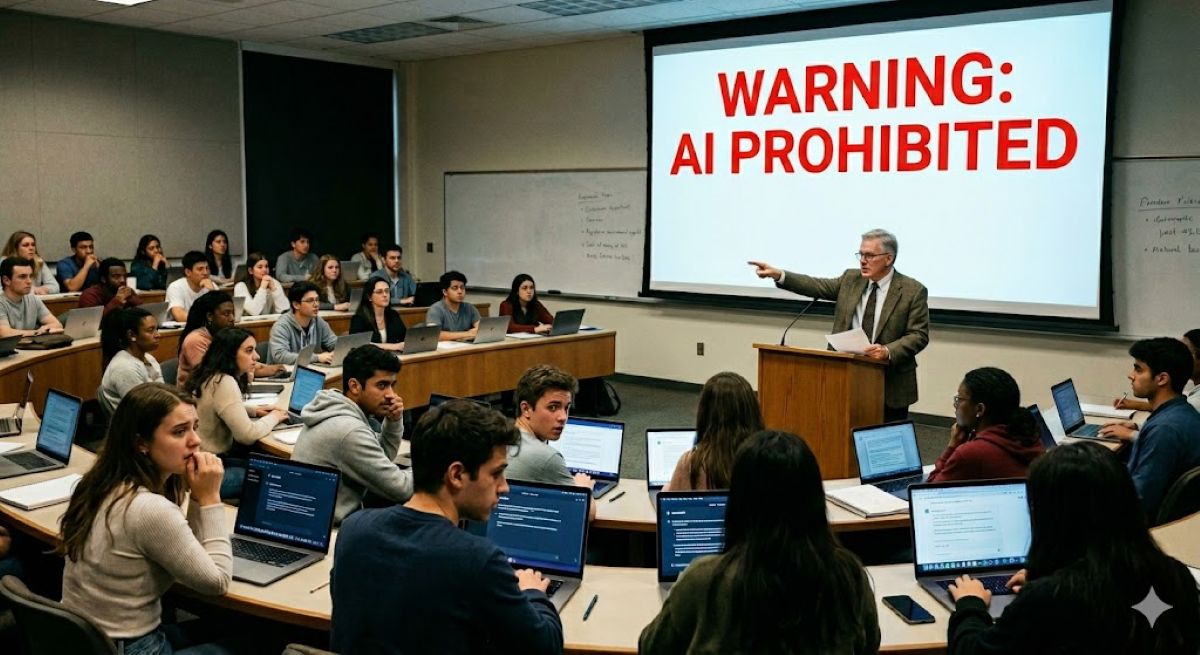
Your college professor just announced that any AI use equals automatic failure. Meanwhile, your economics professor encourages ChatGPT for research but requires citations. Welcome to higher education’s messiest policy disaster since grade inflation.
The academic world has fractured into opposing camps over generative AI. Some educators embrace zero-tolerance policies with harsh penalties, while others experiment with structured integration. This divide reflects a broader institutional struggle as schools improvise AI governance without clear guidelines.
The Great Faculty Divide
Survey data reveals teachers remain deeply split on AI’s classroom role.
The numbers paint a fractured landscape. About 25% of teachers say AI tools do more harm than good in education, according to Pew Research. Students show more nuance: 69% consider AI acceptable for researching topics, but only 20% approve of using it for essay writing. That gap suggests many students already understand the difference between AI as learning aid versus academic crutch.
Meanwhile, 32% of teachers see equal benefits and harms from AI tools, with 35% remaining uncertain about their educational impact. High school teachers express more skepticism than their elementary and middle school counterparts, reflecting concerns about academic integrity in advanced coursework.
Integration vs. Elimination
Two radically different approaches emerge as institutions scramble for policies.
Compare strict prohibition advocates with professors who use AI as a teaching tool. Those favoring integration design assignments that require:
- Critical prompting
- Comparison between AI and human reasoning
- Explicit reflection on appropriate usage boundaries
They often penalize misuse but allow corrections through one-on-one discussions rather than automatic failure.
These educators treat AI literacy as a skill worth developing, requiring students to explain their collaboration strategies and defend their technological choices. Their approach acknowledges that AI tools will remain permanent features of professional environments.
Policy Chaos Across Campus
Students navigate contradictory rules as institutions improvise responses.
You’re essentially playing classroom roulette. Professor A threatens expulsion for any AI contact. Professor B requires AI citations. Professor C hasn’t mentioned it at all, leaving you guessing whether silence means permission or trap. Districts are drafting broad principles while teachers improvise daily enforcement, creating an environment where academic survival depends partly on luck.
This inconsistency reflects broader institutional uncertainty. Many schools initially blocked ChatGPT on networks, similar to restrictions on YouTube and social media, but policy analysts recommend moving toward guiding principles and teacher training rather than blanket bans.
This divide will define how the next generation learns to think alongside artificial intelligence. Institutions choosing zero tolerance risk widening the gap between official policy and ubiquitous informal use—especially as AI tools embed deeper into productivity software. Those embracing structured integration might better prepare students for workplaces where AI collaboration isn’t cheating but job requirement.