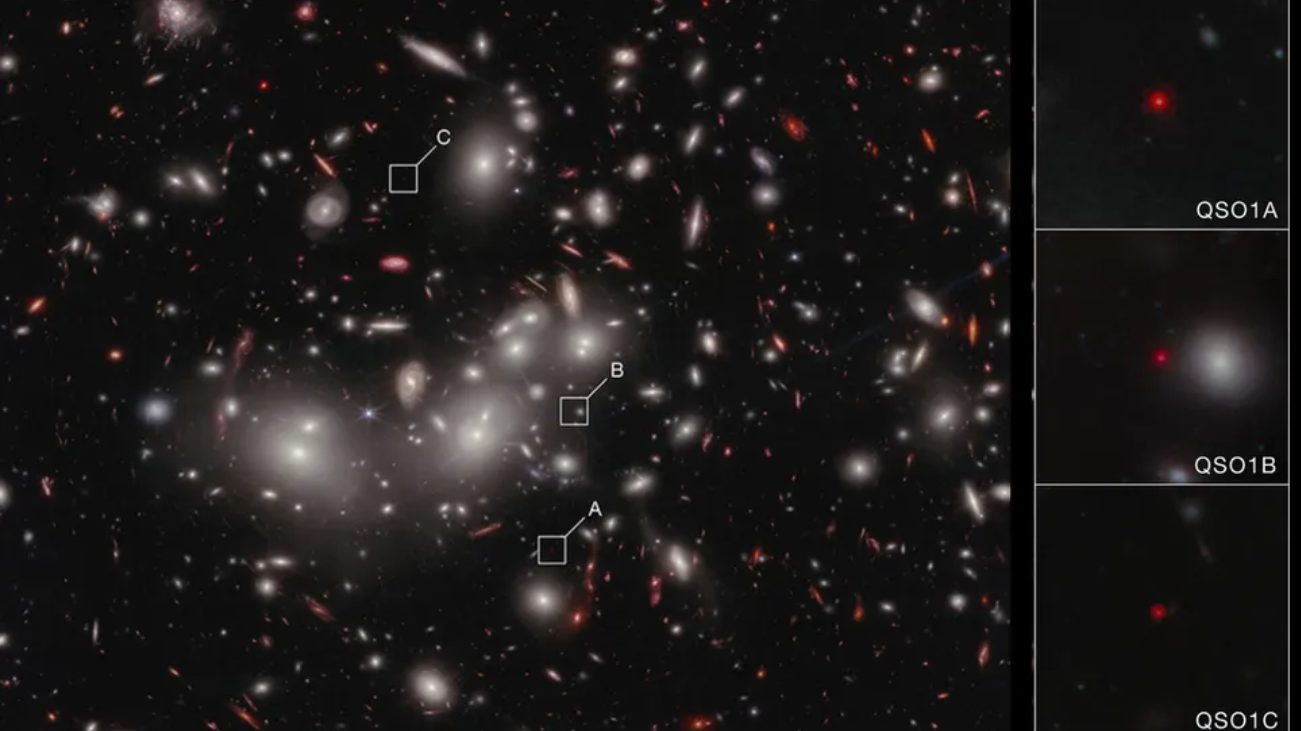
A black hole 50 million times the mass of our Sun sits at the center of a galaxy system barely 1,300 light-years across—like finding a blue whale inside a goldfish bowl. This discovery from NASA’s Webb telescope shatters the conventional wisdom that galaxies form first, then grow central black holes over hundreds of millions of years. Instead, this cosmic heavyweight appears to have reached supermassive status before its host galaxy could even properly form stars.
Ancient Light Reveals Cosmic Surprise
Gravitational lensing helped Webb peer back 13 billion years to witness this astronomical anomaly.
The object, dubbed Abell2744-QSO1, existed when the universe was only 700 million years old—practically cosmic infancy. Webb spotted it using the massive galaxy cluster Abell 2744 as a natural telescope, bending and magnifying light from this distant system like a cosmic magnifying glass. Cambridge researchers led by Ignas Juodžbalis used Webb’s infrared spectrographs to track gas swirling around the black hole’s center, measuring orbital speeds that revealed the monster’s true mass through direct dynamical analysis.
Chemical Fingerprints Tell the Story
The surrounding environment shows almost no heavy elements, proving minimal star formation occurred.
What makes this discovery truly remarkable isn’t just the black hole’s size, but what’s missing around it. The gas contains virtually no elements heavier than hydrogen and helium—the cosmic equivalent of finding an untouched wilderness. Since heavy elements come from stellar explosions, this pristine chemistry proves the black hole dominated before generations of stars could form and die. You’re essentially looking at a supermassive black hole that skipped the usual galaxy-building queue entirely, representing one of the first robust dynamical mass measurements so early in cosmic history.
Rewriting the Cosmic Timeline
Direct-collapse scenarios could explain how black holes grew so massive so fast.
This finding supports theories that some supermassive black holes formed through direct collapse of massive gas clouds rather than growing slowly from stellar remnants. Recent Webb discoveries, including the “Infinity” galaxy showing possible black hole birth, suggest this rapid formation route was more common in the early universe than previously thought. The discovery also reveals a hidden population of early supermassive black holes that traditional detection methods miss—cosmic heavyweights hiding in plain sight during the universe’s most formative era, fundamentally challenging our understanding of how the first cosmic structures assembled.