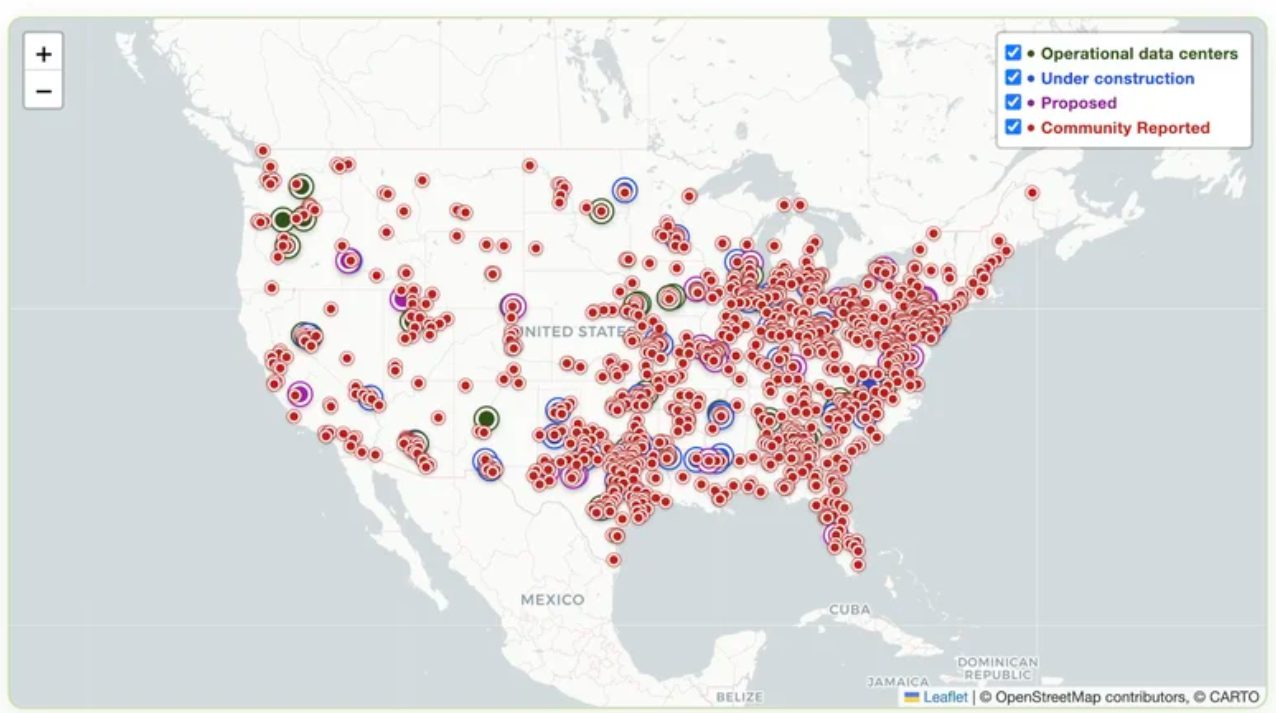
AI data centers consume water like small cities and electricity like industrial districts, yet most communities have no idea these resource-hungry facilities are being built in their backyards. Enter Erin Brockovich, the environmental activist who exposed PG&E’s groundwater contamination in the 1990s, now armed with a crowdsourced map that’s pulling AI infrastructure out of the abstract “cloud” and into sharp local focus.
Community Reports Pour In From Across America
Her Brockovich AI Data Center Reporting platform has already collected 2,716 public reports about AI facilities nationwide.
The interactive map combines publicly announced data centers with community-submitted concerns about existing, proposed, or rumored projects. Texas leads with 612 reports, and nearly half of those—297 reports—come from the small city of Sulfur Springs. That concentration isn’t coincidence; it’s ground zero for what MSB Global claims will be one of the continent’s largest AI data center complexes.
The Sulfur Springs Showdown
MSB Global’s planned 3-gigawatt facility spans 1,600 acres and 30 buildings, triggering lawsuits and local resistance.
The sheer scale makes Sulfur Springs a test case for AI infrastructure expansion. Three gigawatts could power roughly 2.25 million homes, yet this capacity will serve AI training runs and inference workloads instead of residential needs. Local residents have already filed lawsuits against previous landowners and the company itself, revealing the tension between tech industry growth and local quality of life.
Water Bills and Electric Shock
Large data centers consume 5 million gallons daily while forcing utilities to upgrade infrastructure at consumer expense.
According to the Environmental and Energy Study Institute, major facilities use water equivalent to towns of 10,000 to 50,000 people—just for cooling servers. Meanwhile, AI workloads demand so much electricity that utilities must upgrade transmission lines and substations, then pass those costs to ratepayers through higher bills. You’re essentially subsidizing AI’s computational appetite whether you use it or not.
Beyond the Digital Mirage
Brockovich’s platform gives communities “a platform to speak up and voice concerns about AI data centers in their communities.”
The map transforms AI from a sleek software story into a very physical infrastructure reality. Reports cite air pollution from backup generators, noise from industrial cooling systems, and health concerns about living near these sprawling facilities. Like her groundwater work decades ago, Brockovich is betting that organized community voices can hold corporate power accountable.
The AI boom was supposed to happen seamlessly in the cloud. Instead, it’s landing hard in small towns across America, demanding local resources while serving global algorithms. Brockovich’s map ensures those communities won’t be voiceless in that equation.