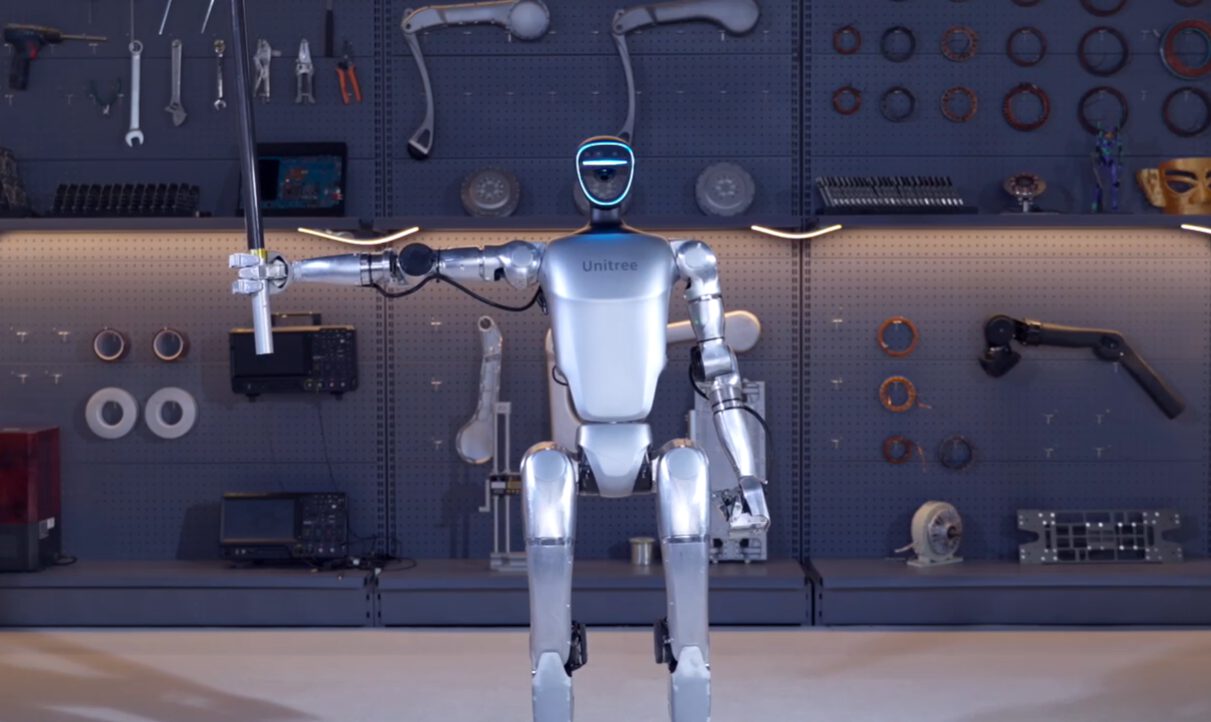
Racing to beat Prime delivery deadlines? While Amazon availability for the Unitree G1 humanoid robot remains unconfirmed through official channels, the consumer robotics milestone feels inevitable as this 35-kilogram walking, dancing machine becomes widely available through mainstream retailers.
This bipedal marvel represents more than clever engineering—it’s proof that humanoid robots have escaped research labs and entered everyday retail. The G1 Base model delivers pre-programmed movements without requiring programming expertise, targeting tech enthusiasts who want robot demonstrations without computer science degrees.
Built for Unboxing, Not Coding
The G1’s 23 degrees of freedom create surprisingly fluid movement in a plug-and-play package.
Standing 1.3 meters tall but folding to suitcase dimensions (690x450x300mm), the G1 balances capability with portability. Those 23 joints break down strategically:
- Six per leg for stable walking
- Five per arm for basic manipulation
- Plus waist rotation
The dummy hands limit fine motor tasks, but 90 N·m knee torque handles stairs and uneven terrain.
Pre-loaded routines include walking, dancing, and self-righting—perfect for TikTok-worthy demonstrations that require zero coding knowledge. Like the Disco-Era Gadgets that paved the way for today’s technology, these robots represent another leap forward.
Sensors That Actually Matter
Intel RealSense cameras and 3D LiDAR provide navigation smarts without overwhelming complexity.
The G1 packs serious perception hardware: Intel’s RealSense D435i depth camera maps surroundings while LIVOX’s MID-360 LiDAR handles precise navigation. WiFi 6 and Bluetooth 5.2 maintain connections, while the handheld remote provides immediate control.
Battery life hits two hours from the quick-release 9000mAh pack—enough for extended demos before needing the included charger.
Entry-Level Reality Check
This base model sacrifices advanced features for accessibility, creating clear upgrade paths.
The “No Secondary Development” designation isn’t marketing speak—it’s a fundamental limitation. While higher-end G1 variants offer expanded capabilities and advanced computing modules, the base model runs basic firmware on an 8-core CPU. You get demonstrations and light service tasks, not custom programming or advanced AI integration.
The 8-month warranty reflects consumer expectations rather than research-grade durability, positioning this as an educational tool rather than development platform.
Consumer robotics finally feels attainable when humanoid companions appear through mainstream retail channels. The G1’s widespread availability signals that robots are transitioning from industrial curiosities to accessible technology, even if current capabilities remain demonstration-focused rather than household-revolutionary.