Japanese researchers just smashed through a critical 6G milestone, achieving 112 Gbps wireless transmission at 560 GHz—the first time anyone’s pushed wireless speeds above 100 Gbps beyond the 420 GHz threshold. That’s roughly 375 times faster than today’s average 5G speeds of 300 Mbps.
But here’s the twist: this isn’t about making your phone faster. This breakthrough targets the invisible infrastructure that connects cell towers to the internet backbone.
Microcomb Technology Shrinks Lab Equipment Into Pocket-Sized Transmitters
Revolutionary photonic chips eliminate alignment headaches that plagued previous terahertz systems.
The Tokushima University team solved a fundamental engineering problem that’s stymied terahertz research for years. Previous attempts at generating clean signals above 350 GHz required bulky laser setups with “microscope-level alignment”—the kind of finicky lab equipment that falls apart if someone slams a door too hard.
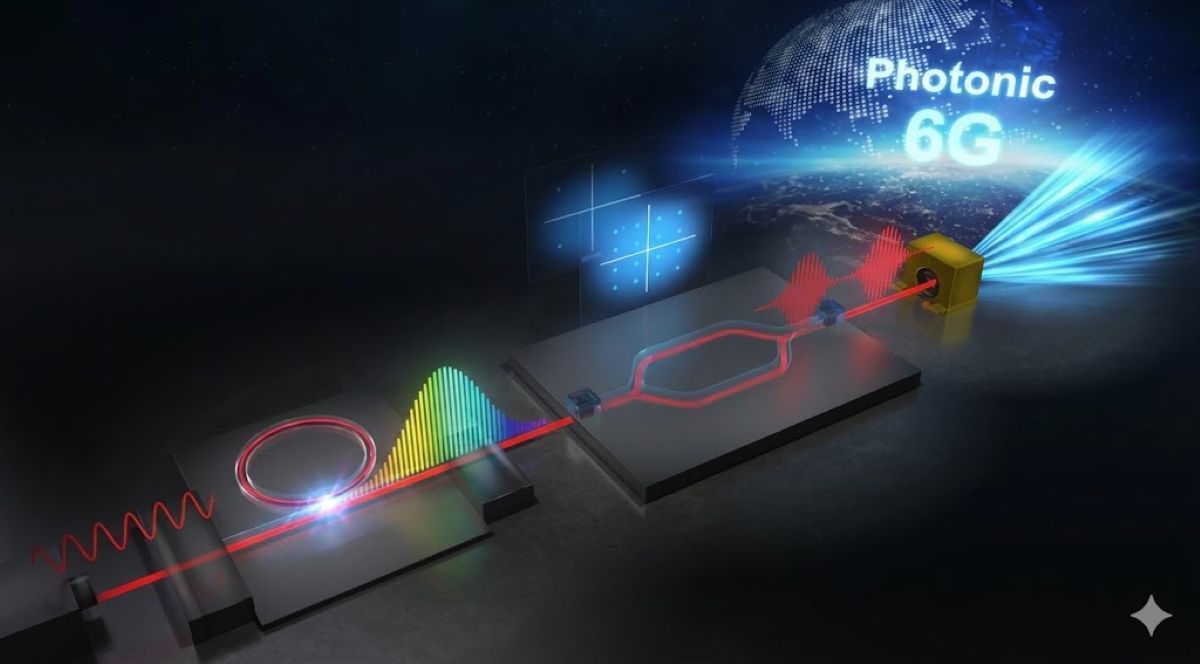
Their solution? Optical microcombs bonded directly to silicon nitride chips. These “optical rulers” generate ultra-stable light frequencies that convert into terahertz waves without the delicate free-space alignment. The result: a transmitter just 5mm wide versus the 450mm monsters that conventional systems require.
The breakthrough, published in Communications Engineering in May, used injection-locked microcombs with QPSK and 16QAM modulation to achieve data rates that previous electronic systems couldn’t approach above 350 GHz.
Why 6G Networks Need Frequencies This High
Lower spectrum bands are already packed with 5G signals, forcing next-generation networks into uncharted terahertz territory.
Think of wireless spectrum like Manhattan real estate—all the good spots below 100 GHz are already taken by 5G, WiFi, and legacy systems. To hit the theoretical 1 Tbps speeds that define 6G’s ambitions, networks need the wide-open bandwidth that exists above 350 GHz.
The problem? Electronic circuits perform terribly at these frequencies, suffering from weak signals and phase noise that scrambles data faster than autocorrect ruins your texts. By using photonics instead of traditional electronics, the Japanese team generated clean terahertz signals with 84 Gbps using basic modulation and 112 Gbps with advanced encoding.
Previous attempts at wireless communication above 350-420 GHz struggled to reach even 1 Gbps due to power limitations and signal instability.
Wireless Backhaul Could Replace Fiber Connections
Ultra-fast terahertz links might eliminate the need for underground cables between cell towers.
This technology targets wireless backhaul—the high-capacity connections that link base stations to core networks. Currently, that means expensive fiber optic cables requiring trenching, permits, and months of construction.
According to co-author Takeshi Yasui, this represents “a major step toward practical 6G wireless systems and ultra-high-speed mobile backhaul.” Imagine deploying 6G small cells as easily as mounting satellite dishes, without waiting for crews to dig up streets.
The 560 GHz frequency band sits in the terahertz region above millimeter waves used by 5G, offering massive bandwidth for backhaul applications where line-of-sight connections between towers are feasible.
With commercial 6G networks expected around 2030, Japan’s terahertz breakthrough positions the technology as more than lab curiosity—it’s foundation work for infrastructure that could make gigabit speeds as common as WiFi.