A viral video claims Flock Safety is “literally” eavesdropping on a private home. That word “literally” is doing a lot of heavy lifting. Flock Safety operates two distinct systems — license plate reader cameras and newer gunshot-detection microphones — and the privacy implications split sharply depending on which product is near your address. The company frames both as public safety tools. The ACLU, EFF, and a growing list of cities frame them as mass surveillance with a safety rebrand.
Two Systems, Two Very Different Threats
Flock runs license plate cameras and newer gunshot microphones — and the privacy implications split sharply between them.
Flock Safety’s flagship product is a network of automated license plate reader (ALPR) cameras — no microphones, no facial recognition, no audio. These devices read plates, log vehicle make, model, and color, then upload everything to a searchable cloud database used by police, HOAs, and landlords. Flock’s own trust page states the cameras are built to “solve crimes, not monitor people.”
That framing conveniently ignores what plate data actually reveals. The ACLU describes this information as “a record of every place you’ve traveled,” including “where you sleep at night,” which doctors you visit, and which political meetings you attend. Cameras mounted at your neighborhood entrance log every vehicle arriving at your address — who visits, when, how long they stay. Default contracts, according to ACLU of Massachusetts findings, allow Flock to share this data with federal agencies even when local departments promise otherwise.
Where the Microphones Enter the Picture
Flock’s gunshot sensors capture short audio clips — and sometimes pick up human voices.
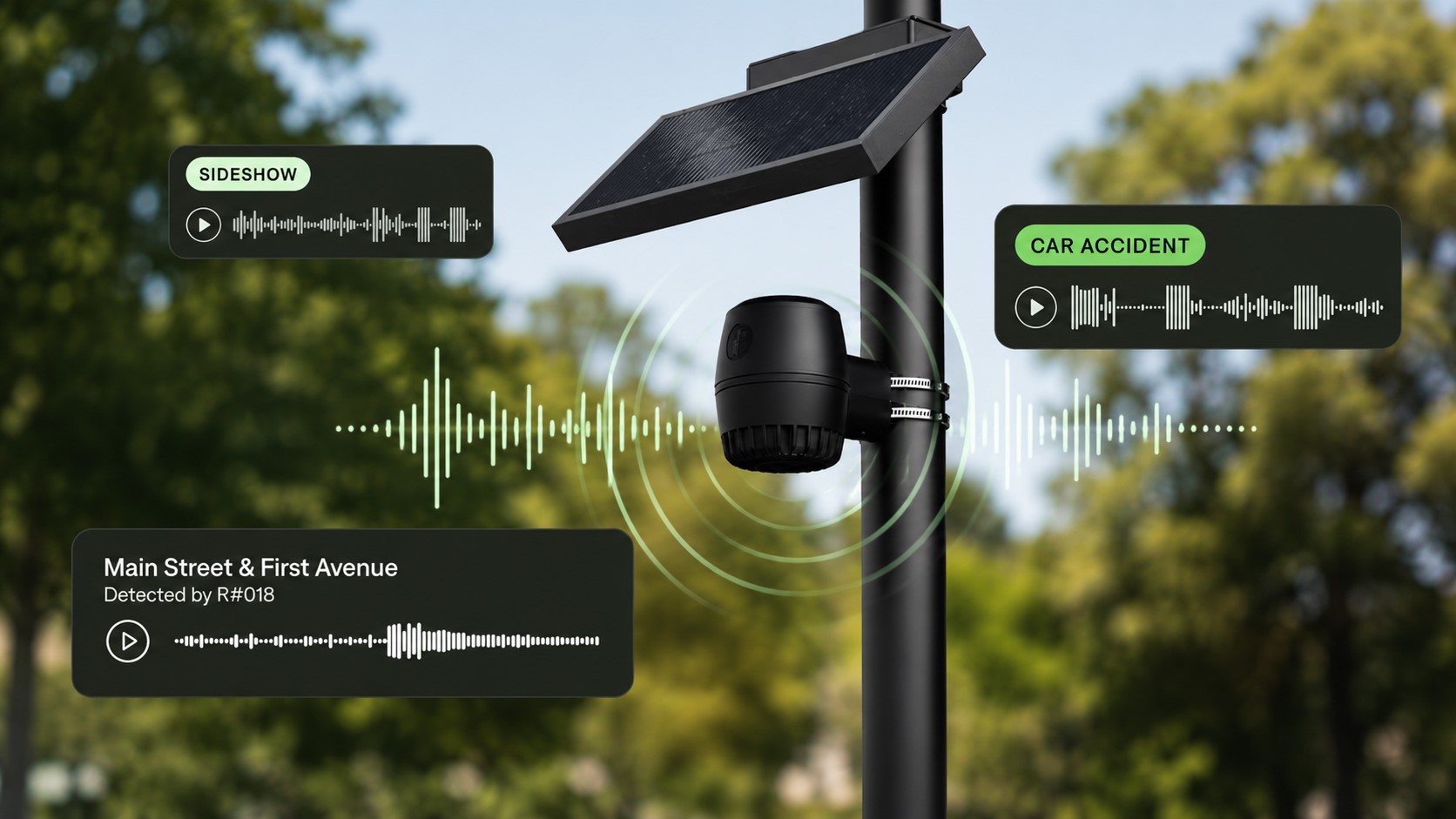
The sharper “eavesdropping” concern comes from Flock’s gunshot detection sensors. These use actual microphones, capturing five-second audio clips, processing them through machine learning, and uploading flagged segments to the cloud. Flock told USA TODAY the sensor is “not a recording device” and compared it to an Amazon Alexa that activates only during a “public safety event.” Notably, Flock’s own privacy documentation does not define what qualifies as a “public safety event” — which makes that reassurance considerably less reassuring.
The EFF warns these microphones “will start listening for human voices“ as Flock expands features to detect “human distress” sounds beyond gunshots. USA TODAY confirmed instances where triggered clips captured conversation snippets — described by experts as “very, very rare.” No evidence supports continuous live audio streaming inside homes. But “rare” and “never” are not synonyms.
“The risk of voice surveillance was extremely low in practice” — York University evaluation of similar gunshot-detection systems, per USA TODAY. Not zero.
When Theory Becomes Reality
Security failures and documented abuse have already turned Flock data into what one investigation called “Netflix for stalkers.”
Several failures have already moved this threat from theoretical to documented:
- At least 60 Flock cameras were found exposed online with zero authentication — live feeds, 30 days of archived footage, including images of unattended children.
- Police officers have abused Flock access for personal surveillance; one documented case involved an officer checking an ex-partner’s plate over 100 times.
- Illinois’ Secretary of State accused Flock of violating state data privacy law.
“Literally eavesdropping” holds up in narrow but documented cases. Gunshot sensors near your home can capture voice fragments. Exposed camera feeds have enabled real-time viewing of private spaces. But the quieter, more routine threat requires no microphone at all — your comings and goings, logged indefinitely and shareable by default. Without stronger regulation, the distance between public safety tool and home security listening post shrinks with every software update.