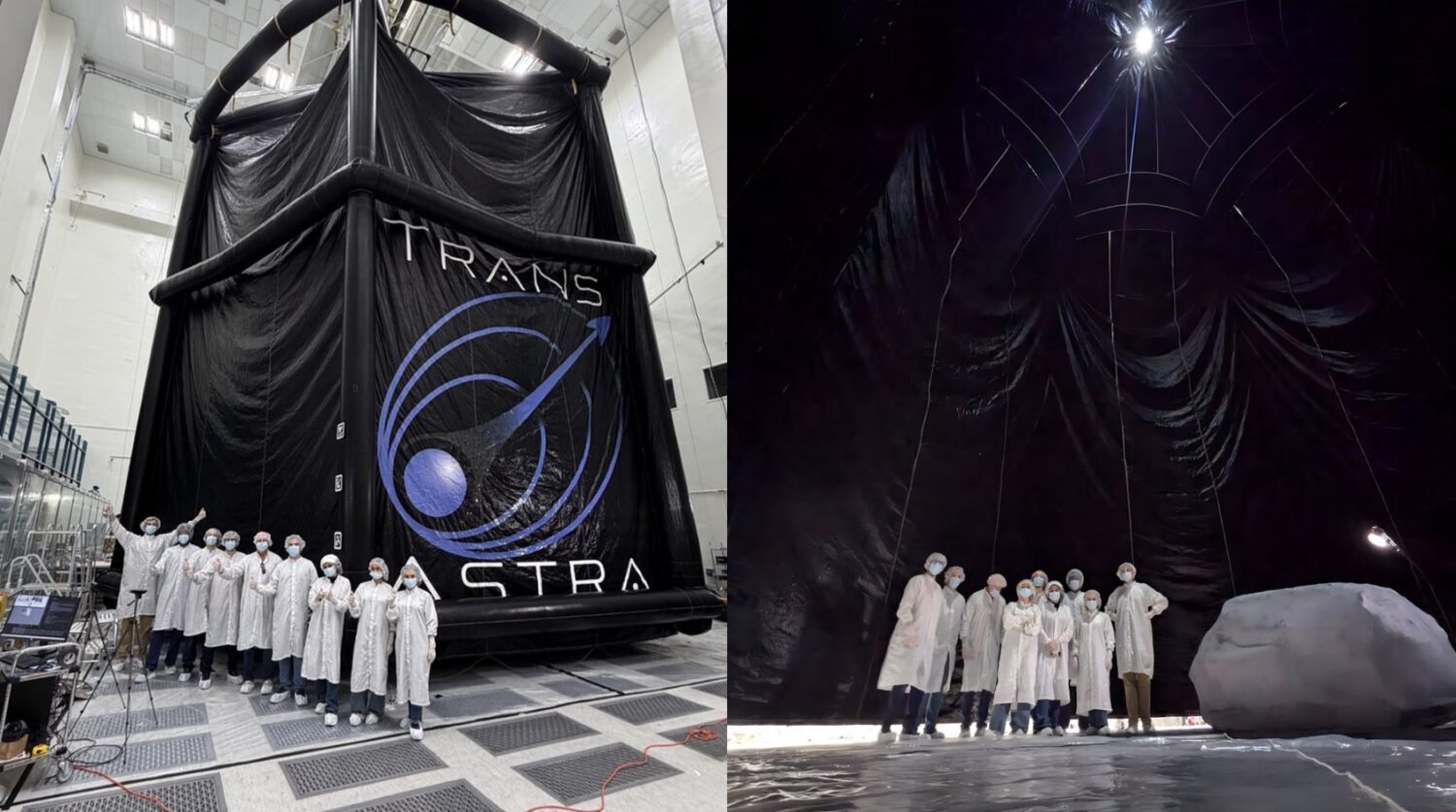
TransAstra completed an initial full-scale validation campaign for its Mantis Capture Bag, a 10-meter inflatable system designed to enclose tumbling satellites, rocket bodies, and asteroids.
The 11-day campaign, announced November 16, 2026, covered four core functions in an initial full-scale effort: inflation, structural response, rendezvous-sensor imaging, and mouth closure. The cited materials report no in-space demonstration of the 10-meter system.
What the Test Actually Covered
Engineers worked through four distinct objectives, each generating data intended to feed directly into the flight system’s design.
Inflation came first. The bag expanded fully, and the team collected rate data intended to inform the flight system’s gas-handling architecture.
After inflation, engineers pressed the bag at multiple points and measured displacement. TransAstra reported that the observed displacement matched its mechanical model predictions, supporting further scaling and flight-system analysis.
Sensor imaging followed. With an asteroid simulator placed inside the bag, an internal camera recorded video under simulated off-axis sunlight conditions, using two lamps while the facility’s main lights were off. TransAstra said that imagery will be used to study rendezvous and proximity-operations sensor performance during approach.
Finally, the drawstring system cinched the bag’s mouth closed, performing as the design models predicted.
One Gear Failed. The Bag Still Closed.
A prototype gear failed during testing, but the system completed closure using three of its four drawstring mechanisms.
TransAstra described the result as an encouraging indication of design robustness and said it will upgrade the prototype gearing before future testing. Closing on three mechanisms is a useful component-level result; it does not establish that the complete flight system is fault tolerant across all mission conditions.
Why an Inflatable Bag Solves a Real Problem
Dead satellites and tumbling rocket bodies do not come with convenient handles.
Conventional grappling and docking systems depend on making precise contact with a specific point on a target. That contact becomes unreliable when the target is rotating unpredictably or when its surface carries fragile protrusions. An enclosing bag reduces that dependence by enveloping the object before cinching it shut, a geometry-tolerant approach that applies equally to orbital debris and small asteroids.
ESA estimates more than 40,000 tracked objects larger than 10 centimeters currently orbit Earth, illustrating the scale of the debris environment that capture systems like this one aim to address.
Prior Work Behind the Full-Scale Test
The 10-meter ground campaign built on earlier work at smaller scale.
TransAstra deployed a smaller, approximately 1-meter Capture Bag aboard the International Space Station in October 2025, giving the program microgravity heritage before the full-scale ground effort.
What Still Has to Happen
Ground validation and flight readiness are separated by a set of engineering challenges that only the space environment can resolve.
Deployment and inflation in microgravity and vacuum remain undemonstrated at this scale, as does direct interaction with a real tumbling target. Long-duration radiation and thermal exposure, cinching-system load behavior during an actual capture, and full actuator reliability under flight conditions have not yet been tested. The structural model agreement reached in this campaign supports continued design analysis, but it does not establish how the system performs in orbit.