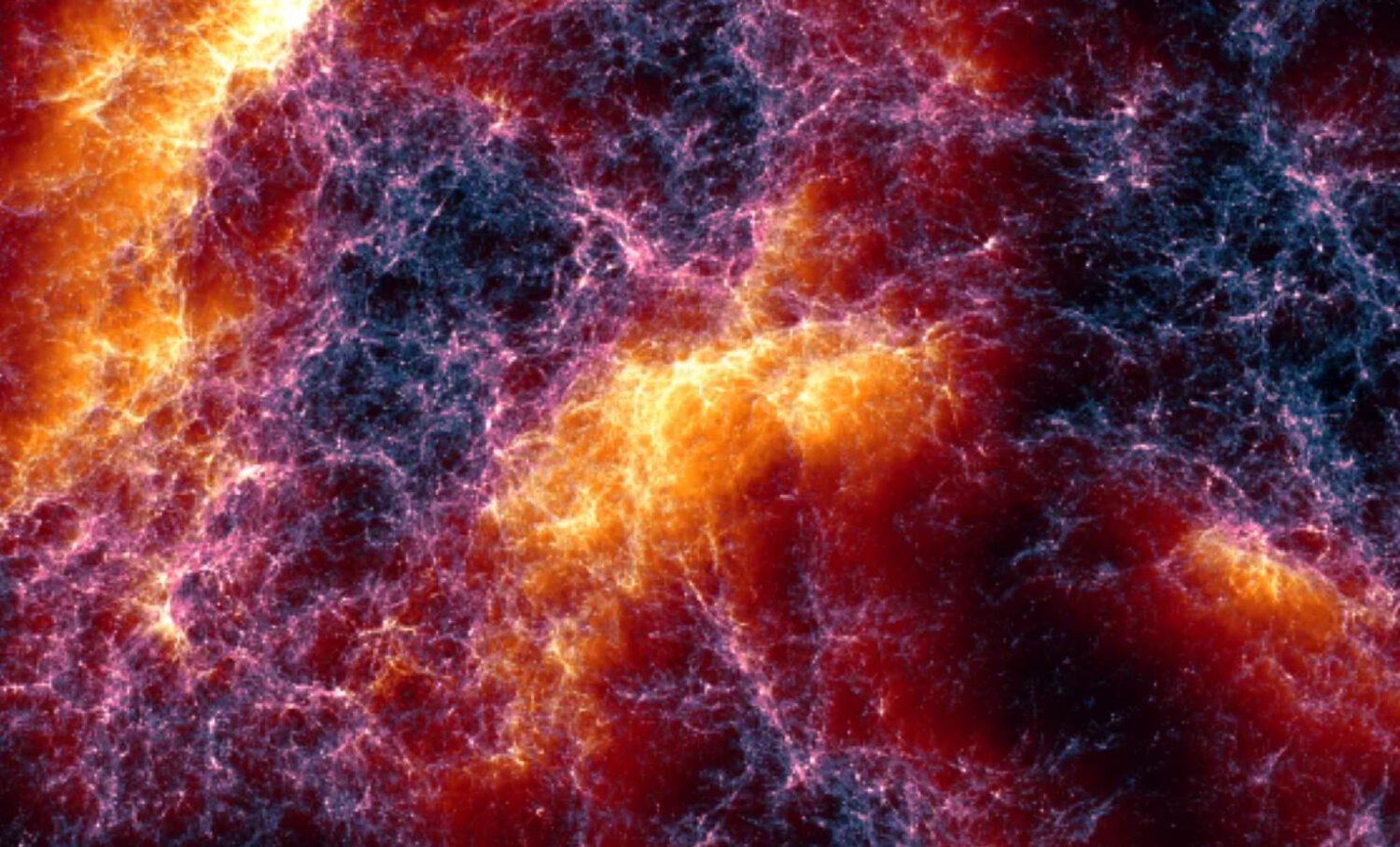
Half a trillion computational elements, thousands of GPUs, and one very old question: how did a dark, neutral universe become filled with galaxies and light? That question drove researchers from MIT, the Center for Astrophysics | Harvard & Smithsonian, and partner institutions to build Lumina. The radiation-hydrodynamics simulation covers approximately 1.6 billion light-years across the first 2 billion years of cosmic history.
The Dark Ages Were Exactly That
Neutral hydrogen once made the young universe opaque, and understanding how that changed remains one of cosmology’s central unsolved problems.
After the Big Bang, neutral hydrogen filled intergalactic space and made it opaque to ultraviolet radiation. The first stars and galaxies eventually emitted enough ultraviolet light to strip electrons from that hydrogen, a process called reionization, allowing radiation to travel more freely through intergalactic space.

What Lumina Actually Models
The simulation tracks every major component of early cosmic structure, starting about 50 million years after the Big Bang.
Lumina begins about 50 million years after the Big Bang and tracks the coupled evolution of dark matter, gas, stars, galaxies, black holes, and radiation through the reionization transition. According to the Smithsonian Institution, it is the first simulation of its type to model helium reionization and let those effects feed back into the developing universe within the same calculation.
The Hardware Behind It
Frontier, the supercomputer at Oak Ridge National Laboratory, provided the computing power the project required.
Lumina ran on the Frontier supercomputer at Oak Ridge National Laboratory. The model contains approximately half a trillion computational sectors and covers more than 100 times the volume of comparable earlier simulations while retaining enough resolution to study individual developing galaxies.

Translating Theory Into Predictions
Scale matters because smaller simulations can miss the rare structures and varied environments where early galaxies formed.
Smaller simulations can miss rare large-scale structures or fail to represent the full range of environments where early galaxies formed. Oliver Zier, lead author and computational astrophysicist at the Center for Astrophysics | Harvard & Smithsonian, stated the core purpose plainly:
“To understand what we are seeing with [these telescopes], we need to translate our theories into detailed predictions.” Oliver Zier, lead author and computational astrophysicist, Center for Astrophysics | Harvard & Smithsonian, via Smithsonian magazine.
Where the James Webb Telescope Enters
Lumina generates predictions that researchers can compare against James Webb Space Telescope observations of the distant universe.
Lumina’s predictions can be compared with observations from NASA’s James Webb Space Telescope, which has been identifying increasingly distant galaxies since its first science data arrived in 2022. When simulated galaxy counts, brightnesses, and radiation patterns match what JWST observes, that agreement supports the model’s underlying assumptions. Where they diverge, researchers gain a specific target: the discrepancy points to missing physics or prescriptions for star formation and black-hole growth that need revision.

A Framework, Not a History
Lumina is a testable theoretical tool, and its results are shaped by the assumptions and approximations built into it.
A simulation depends on the physical laws and formation rules built into it, not to mention its initial conditions and numerical methods. Lumina is a testable theoretical framework, not a confirmed account of what happened.
Why It Becomes a Reference Point
As JWST pushes deeper into cosmic history, Lumina provides a large-scale prediction to test against what the telescope finds.
As JWST continues identifying distant galaxies, Lumina gives researchers a high-resolution prediction to test against those observations. The model could serve as a reference dataset for studying first-galaxy formation, early black-hole growth, and the structure of the intergalactic medium between those ancient galaxies.