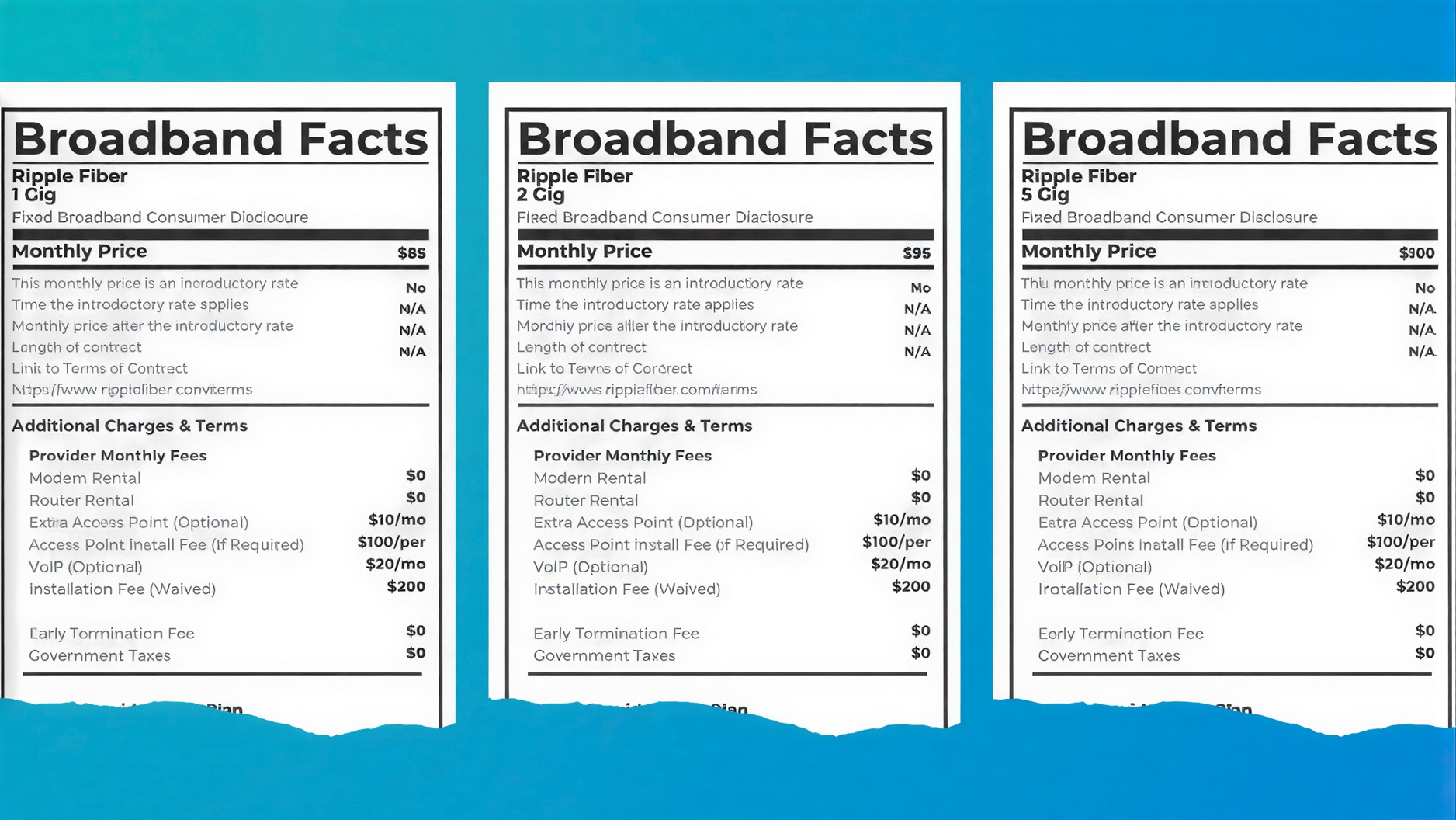
Broadband bills are already confusing — and a July 22 FCC vote could make them far worse. Broadband “nutrition labels” — standardized disclosure forms modeled on food packaging — were supposed to fix that. Mandatory since 2024, they forced ISPs to itemize every fee so you could see the real price before signing up. Now the FCC, under Chair Brendan Carr, wants to gut those requirements. If the draft order passes, your ability to understand your own bill gets substantially worse. You may already be paying too much without realizing it — and this rule change would make it even harder to tell.
What’s Actually Getting Cut
The draft order strips six transparency requirements, replacing itemized clarity with vague aggregates and buried links.
Right now, ISPs must list every passthrough charge — regulatory fees, infrastructure surcharges, network access costs — individually on the label. The draft would let them lump everything into a single “up to $X” line. That’s like an airline rolling baggage fees, seat selection, and fuel surcharges into one mysterious “travel services” charge. You still pay. You just can’t see what for.
Here’s what else disappears:
- Itemized fee breakdowns replaced by a single aggregate “up to” total
- Full labels at checkout swapped for an icon or hyperlink
- Labels removed from customer account portals entirely
- Machine-readable data files eliminated, killing third-party price tracking
- Two-year archival requirements dropped, erasing historical records for watchdogs
The FCC frames this as simplification. The draft claims “disclosures that become overly complex or difficult to navigate end up frustrating or confusing consumers, not empowering them.” USTelecom complained about maintaining “hundreds of different labels” across geographies. Compliance costs something — that’s a real argument. But the telecom industry reportedly spent $114 million on lobbying in 2025 alone, according to Engadget. That buys a lot of label maintenance.
“Disclosures that become overly complex or difficult to navigate end up frustrating or confusing consumers, not empowering them.” — FCC draft order language
Consumer groups see it differently. The National Digital Inclusion Alliance and National Consumer Law Center filed jointly, warning the proposal “would make the problem of junk fees, hidden charges and difficult-to-understand billing worse” — and could widen the digital divide. Senator Mark Warner led a Senate letter arguing that aggregating discretionary fees into vague line items “recreates exactly the kind of billing opaqueness that Congress sought to end.”
What This Means for Your Bill
Without itemized fees, telling a legitimate government tax from an ISP-invented “network maintenance charge” becomes nearly impossible.
Comparison shopping gets harder when labels hide behind links or disappear from your account portal entirely. Non-English speakers and lower-income households — already most vulnerable to bill shock — lose multilingual label requirements too. For researchers and journalists building ISP price-comparison tools, losing machine-readable data is like a mapping app removing street-level detail. The broad outlines remain; the specifics you actually need vanish.
If the order passes on July 22, changes take effect 30 days after Federal Register publication. The broadband label was the closest thing you had to honest, standardized pricing from your ISP — and weakening it means the fine print wins again.