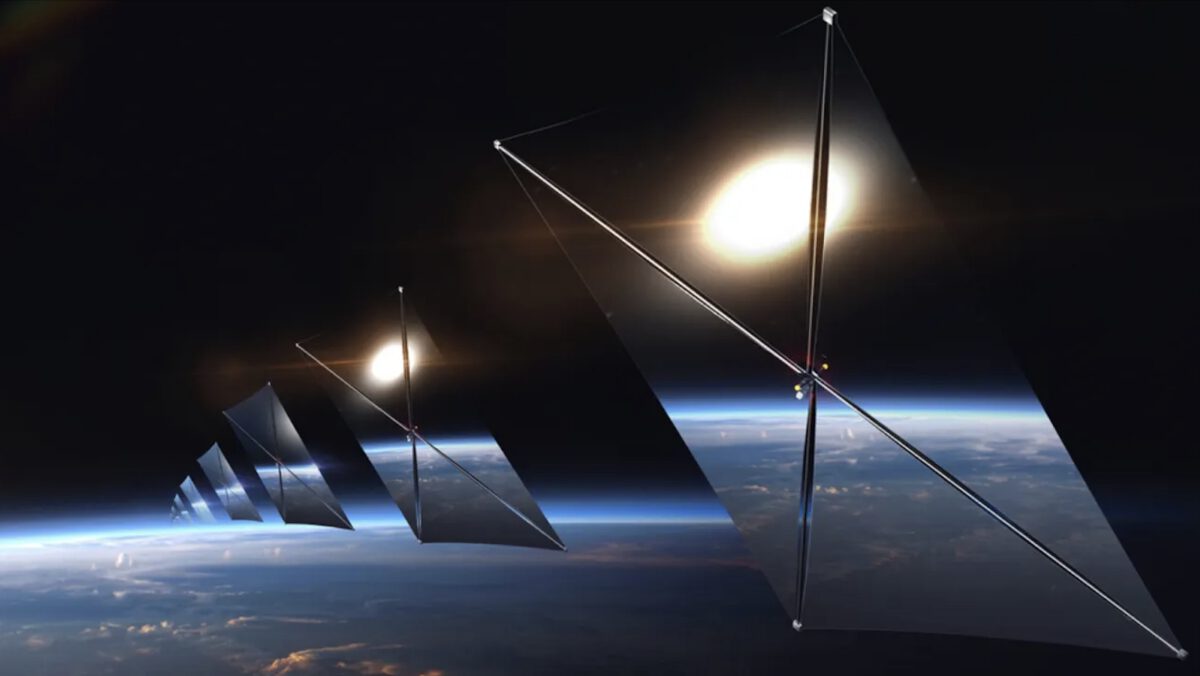
Your phone buzzes with a Starlink update while you’re reading about another space startup that makes Elon Musk’s constellation look modest. Reflect Orbital wants to deploy 50,000 orbital mirrors by 2035, beaming sunlight to Earth’s night side like some cosmic flashlight. The Hawthorne startup has raised $28 million and filed FCC paperwork for its first prototype, but scientists are sounding alarms about what happens when Silicon Valley ambition collides with orbital physics.
The Mirror Math Doesn’t Add Up
Even at massive scale, the energy returns barely justify the infrastructure investment.
EARENDEL-1, the company’s dorm-fridge-sized prototype, unfolds into a 60-foot mirror that illuminates a three-mile patch as bright as the full moon. Sounds impressive until you crunch the numbers. Each 180-foot production mirror delivers just 1/140,000th of midday sunlight across 18 square miles.
You’d need over 3,000 satellites working together to achieve 20% of daytime solar intensity at a single location, according to Monash University research. The company’s $5,000-per-hour pricing suddenly makes more sense—and less.
Historical precedents aren’t encouraging. Russia’s 1993 Znamya-2 experiment managed to briefly illuminate Arctic regions with an 80-foot mirror, but the physics limitations that plagued that mission haven’t magically disappeared. Light scattering means you can’t contain the beam to just your target area, brightening the entire sky beyond your intended recipient.
Astronomers See Catastrophe Coming
The night sky could become permanently polluted with artificial illumination brighter than moonlight.
“From an astronomical perspective, that’s pretty catastrophic,” Robert Massey of the Royal Astronomical Society told Space.com. Fifty thousand mirrors creating streaks across telescope images would essentially end ground-based astronomy. Pilots face distraction risks from sudden bright flashes, while wildlife confronts disrupted circadian rhythms that govern migration, breeding, and hibernation cycles.
The regulatory gap makes matters worse. The FCC reviews radio interference and satellite disposal but ignores environmental impacts entirely. No federal agency currently assesses how orbital mirrors might affect ecosystems or night sky preservation—a stunning oversight for infrastructure visible from space.
Physics Beats Venture Capital
Real-world constraints suggest this technology works better in science fiction than solar farms.
Despite attracting 250,000 service applications and Air Force contracts, Reflect Orbital faces immutable physics. Battery storage and grid-scale solutions already extend solar power more efficiently than orbital infrastructure requiring constant satellite replacement. The company’s mirrors might find niche applications in disaster response or Arctic operations, but transforming global energy? The math simply doesn’t work.
You’re watching space commercialization’s next frontier unfold—where startup optimism meets orbital reality, and the night sky hangs in the balance.