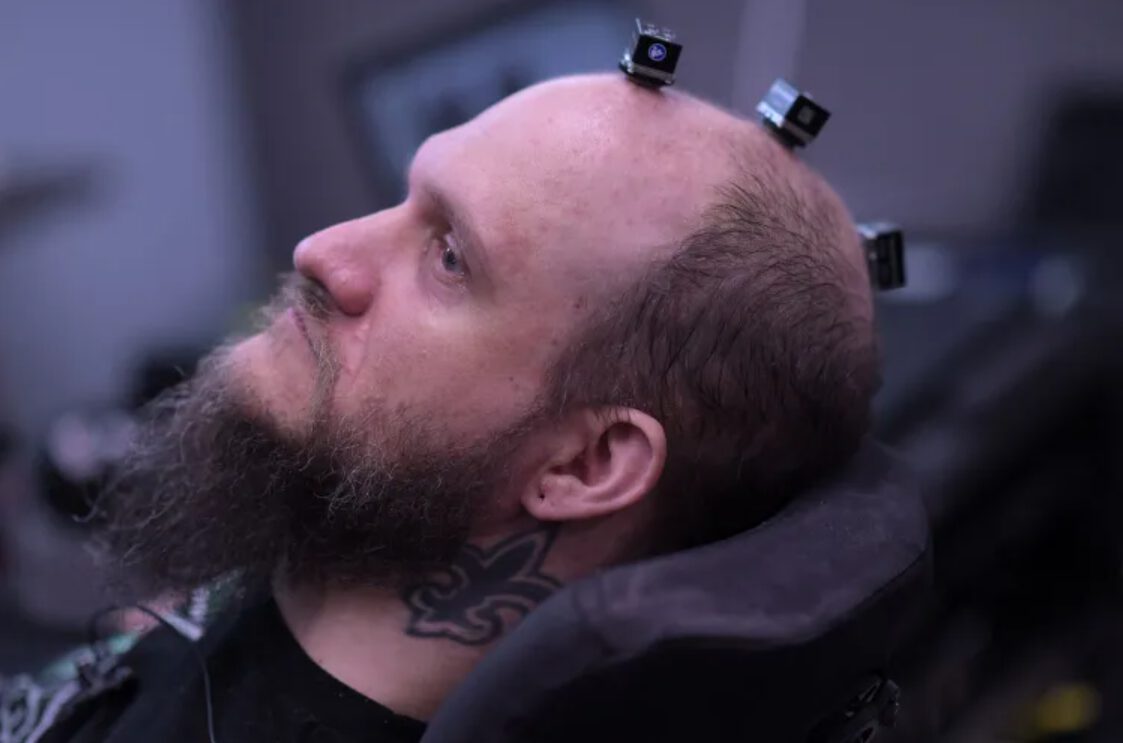
Brandon Patterson can feel his fingers moving again, even though they’re not. The 41-year-old Colorado man became among the first recipients of a brain-computer interface implanted directly in his cortex—the brain’s higher-functioning area responsible for complex sensory and motor processing. Nine years after a Jeep rollover severed his spine, Patterson describes the phantom sensation as “weird” but remarkably precise.
This groundbreaking procedure represents a significant advancement in neurotechnology for paralyzed patients.
In early April 2026, neurosurgeon Dr. Daniel Kramer at UCHealth performed the surgery that installed three ports on Patterson’s skull. These connections allow external computers to record individual neuron activity and translate Patterson’s thoughts into potential actions. The checkup at CU Anschutz on April 10 confirmed what seemed impossible: Patterson could think about holding a ball and feel his fingers responding.
The cortex placement creates bidirectional communication between brain and machine unlike previous trials.
This cortex placement represents significant progress beyond previous brain-computer interfaces. While earlier trials focused on lower brain regions or single-direction control, the AI decoding system interprets brain signals—like the intent to reach left, right, or up—creating a bidirectional communication pathway between mind and machine. The technology builds on established BCI research that demonstrates how neural interfaces can decode motor intentions and provide tactile feedback.
Patterson’s practical goals focus on wheelchair independence rather than walking restoration.
Patterson isn’t dreaming of walking again. His optimism centers on wheelchair independence:
- controlling his fingers
- holding objects
- extending his reach in daily life
That practical focus reflects both realistic expectations and genuine hope for the broader population facing spinal injuries, ALS, or motor function loss. The implications extend far beyond one man’s recovery.
This advancement bridges medical treatment with potential consumer neurotechnology applications.
The cortex-level integration moves brain-computer interfaces closer to seamless human-machine collaboration that’s captivated tech enthusiasts for years. Current BCI research shows steady progress toward more sophisticated motor control and sensory feedback systems. What started as experimental medical treatment is evolving toward assistive devices that could transform how you interact with technology when facing mobility challenges.
Patterson’s phantom finger movements signal more than restored sensation—they represent progress toward neural interfaces that feel as natural as thinking itself. For the millions dealing with paralysis or motor function loss, this breakthrough offers tangible hope that independence isn’t just a distant possibility.