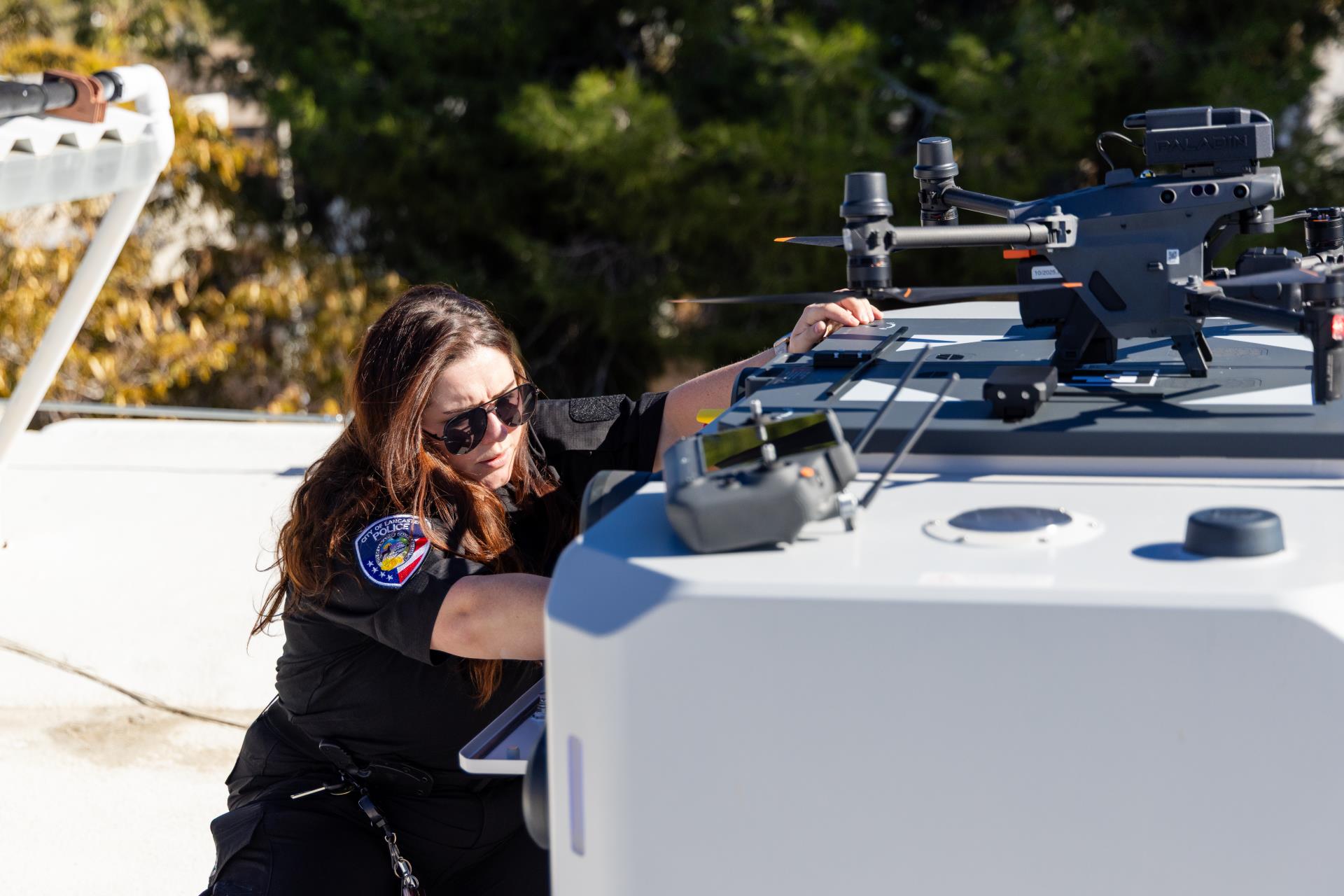
Starting in September, a drone will lift off somewhere in Lancaster, New York, stream live video of your street to police officers, and log the license plate of every vehicle it passes — reportedly before a patrol car leaves the station. Lancaster Police Department is launching a three-month test of Flock Safety’s Drone as First Responder system, dispatching camera-equipped drones to 911 calls and sensor alerts. Fixed Flock cameras already dot roadside poles across Western New York, including in Cheektowaga. Strapping that same technology to something that flies over your backyard is a fundamentally different proposition than deploying a surveillance app against a targeted group.
What the Drones Actually Do
Flock’s system logs plates, vehicle details, and aerial video — and claims an 86-second average response time that the company has not independently verified.
Flock’s fixed cameras scan passing vehicles and record license plates, make, model, color, and even bumper stickers, feeding everything into a searchable database. The drone layer adds aerial situational awareness before officers arrive on scene. Flock’s own marketing materials cite an average arrival time of roughly 86 seconds — a company figure, not independently audited. Supporters say that live overhead video reduces dangerous surprises for responding officers.
Here’s what the Lancaster trial looks like in practice:
- The program runs three months, and Lancaster PD plans a public transparency portal showing flight paths and each drone launch.
- Flock states data retention is typically around 30 days, though local agencies control that window and can adjust it under state and local law.
- Drones are intended to respond to defined incidents — 911 calls or sensor alerts — not continuous neighborhood patrol, per Flock’s own policy language.
- Local agencies, not Flock, own the collected data. Residents weighing their options may also consider home security systems as a complement or alternative to police-managed surveillance.
“What meetings a person attends, what doctors’ offices and religious institutions they visit, who a person associates with, and even where they sleep at night.” — ACLU-OR, on what Flock camera data can reveal about any driver’s life
Flock claims involvement in solving roughly 800,000 to one million crimes annually — a self-reported figure with no independent audit. Supporters argue the system replaces subjective officer judgment with objective flags, such as a stolen vehicle plate or an Amber Alert match. The Electronic Frontier Foundation documented a harder reality in its 2025 review: cases of officers accessing Flock data for personal reasons and conducting surveillance entirely unrelated to active investigations.
A Transparency Portal Can’t Answer Every Question
Lancaster’s oversight promise follows best-practice guidance — but the hardest privacy questions sit well beyond what any portal can resolve.
The transparency portal Lancaster promises aligns with Department of Justice recommendations for drone programs, and that matters. The tougher questions remain open:
- Will flights ever occur outside posted patterns?
- Can other agencies access Lancaster’s recorded data?
- What recourse do you have if your movements get logged without cause?
Some U.S. cities have already canceled Flock contracts after sustained public backlash over exactly these unresolved gaps, according to CNET.
Police call it “a tool for solving crimes.” Critics call it “a nationwide surveillance network.” — PBS NewsHour
If Lancaster’s trial runs without incident, expect neighboring departments across New York State to take notice. If a misuse event or data-sharing controversy surfaces, it could accelerate state-level legislation on drone and ALPR use — the kind of statutory guardrails that legal scholars at Brookings and the Cato Institute have urged lawmakers to adopt before the technology outpaces existing privacy protections. Either way, what happens in Lancaster this September is unlikely to stay in Lancaster.