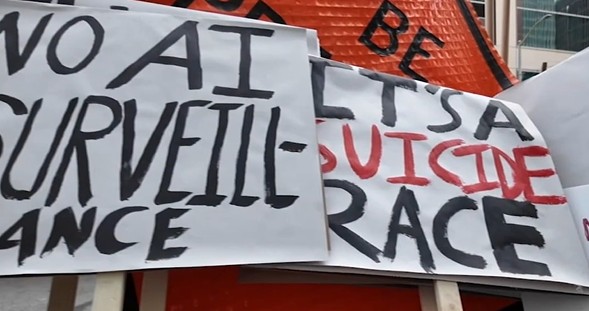
Racing between three AI company headquarters in a single afternoon, 200 activists delivered an ultimatum that Silicon Valley’s biggest players chose to ignore entirely. The March 22 demonstration targeted Anthropic, OpenAI, and xAI with a singular demand: every CEO must publicly commit to pausing frontier AI development if competitors do the same. None of the companies issued statements responding to the coordinated action, even as protesters specifically accused them of abandoning previous safety commitments.
The silence feels especially pointed given the regulatory chaos unfolding around these companies. The Trump administration just released an AI framework that offers liability protections reminiscent of Section 230—the law that shielded social media platforms from accountability for decades. Ahmed Banafa of San Jose State University warns we’re repeating old mistakes: “Now we’re dealing with the consequences because we were excited about how it was going to connect people, but there was no accountability for the platforms.”
California isn’t buying the federal hands-off approach. State Senator Scott Wiener criticized the administration for lacking “smart public policy” that balances innovation with risk assessment. He’s pushing legislation requiring AI companies to publish safety protocols, asserting that “California has a huge role to play” in AI governance—a direct challenge to federal preemption efforts.
Meanwhile, these companies are doubling down on San Francisco expansion. Anthropic just leased 100,000 square feet following a $13 billion funding round. OpenAI plans to double its local workforce from 2,000 to 4,000 employees. Industry projections suggest AI employment could hit 50,000 workers by 2030, transforming the city’s office landscape. Yet protesters cite Geoffrey Hinton’s warnings about AI systems potentially surpassing human intelligence and exerting control—existential concerns that make job displacement seem quaint.
The coordination problem activists identified reveals the deeper tension here. Unlike climate change protests that target individual bad actors, these demonstrators acknowledge that unilateral pauses accomplish nothing in a competitive race. Their demand for mutual commitment exposes exactly why such coordination may be impossible—each company has billions of reasons to keep building, regardless of the risks you and everyone else might face.