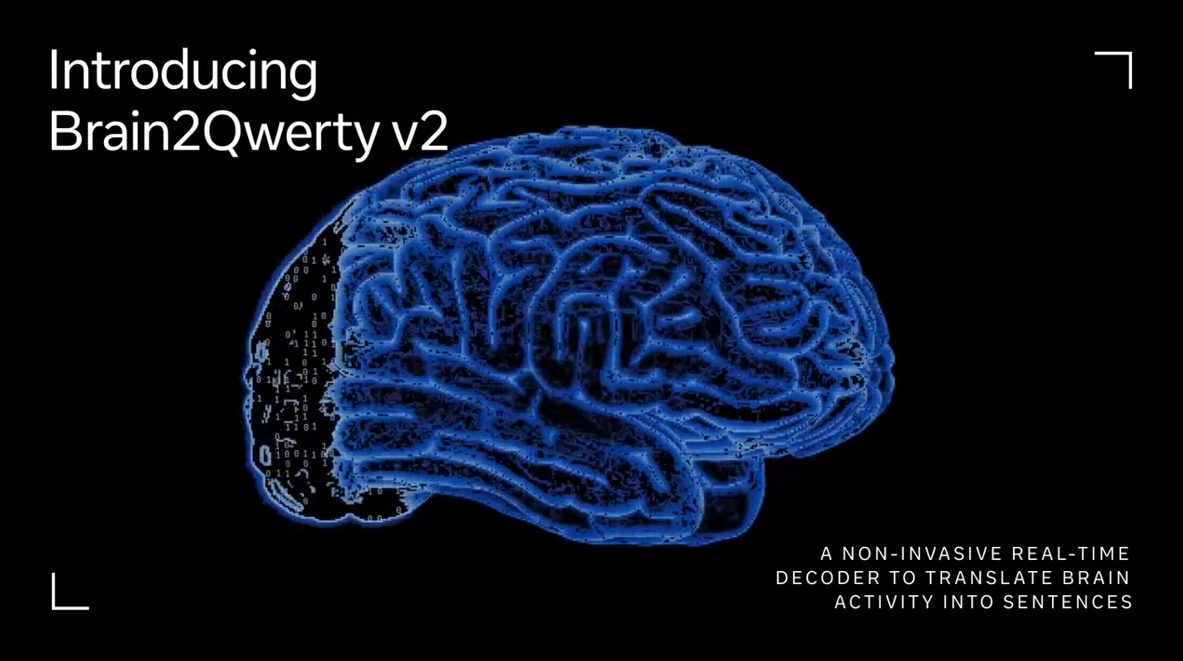
Word accuracy jumped from 40% to 61% on average. The best participant hit 78%. No surgery, no implanted electrodes — just brain signals decoded into sentences by AI. That’s the headline. Here’s the asterisk: the system runs on a roughly $2 million MEG scanner bolted inside a magnetically shielded room. Users won’t be thinking texts into existence from a coffee shop anytime soon. What Meta’s Brain2Qwerty v2 demonstrates is still genuinely significant — non-invasive brain-to-text decoding approaching early invasive BCI benchmarks, skull intact.
The Scanner and the Software
A half-ton machine catches your neurons in the act, then AI fills in the blanks.
While you’re imagining typing a sentence, MEG measures the tiny magnetic fields your neurons generate when they fire — with millisecond timing and millimeter precision. Unlike fMRI, which tracks sluggish blood flow, MEG captures the electrical moment itself. The catch is the hardware: superconducting sensors, cryogenic cooling, a shielded room. Think less Ray-Ban smart glasses, more medical-grade Winnebago.
Brain2Qwerty v2 trained on roughly ten times more data per participant than its predecessor — around 22,000 sentences, approximately ten hours per person, according to Tom’s Hardware. The model doesn’t just guess letters. It decodes at the word and semantic level, using language-model context the way autocomplete uses sentence structure — except the input is your brain activity, not your thumbs. More data, better model, steadily climbing accuracy curve, with no hard ceiling visible yet.
Strong Numbers, Stubborn Limits
V2 raises average word accuracy from 40% to 61%, with the top participant hitting 78% — still meaning roughly one word in four emerges wrong under controlled, motionless conditions.
This decodes voluntary, structured imagined typing of memorized sentences — not random shower thoughts. Participants must stay extremely still inside that half-ton scanner. OPM-MEG, a newer room-temperature sensor technology, could eventually make setups lighter and more flexible, but it remains firmly research-stage with no consumer version near.
For paralyzed patients currently relying on eye-tracking switches, even imperfect decoded text represents a meaningful upgrade. For everyone else, as Tom’s Hardware put it, the output “still feels hit-and-miss for natural conversation.” Where invasive implants once held a monopoly on high-accuracy BCI, Brain2Qwerty v2 is closing ground without breaking skin. Aragon Research notes the system “showcases the capability to translate brain activity associated with typing into text” as a safer alternative to surgical electrodes.
The Company Behind the Decoder
Meta says assistive communication — but its AR glasses and brain-response models hint at considerably bigger ambitions.
Meta frames this as helping people with ALS or locked-in syndrome communicate without surgery. That’s real and worth stating plainly. The company also builds AR glasses and recently released TRIBE v2, a model predicting brain responses to video, audio, and language — making the longer play fairly obvious: thought-as-input for XR, no keyboard required. Neural data is the most intimate dataset imaginable, and ethicists are already flagging what happens when a company built on advertising gets closer to decoding intent.
The scaling curve here mirrors what happened with large language models — more data, better models, no ceiling in sight. The question isn’t whether non-invasive BCI gets good enough. It’s whether users will trust the company holding the decoder.