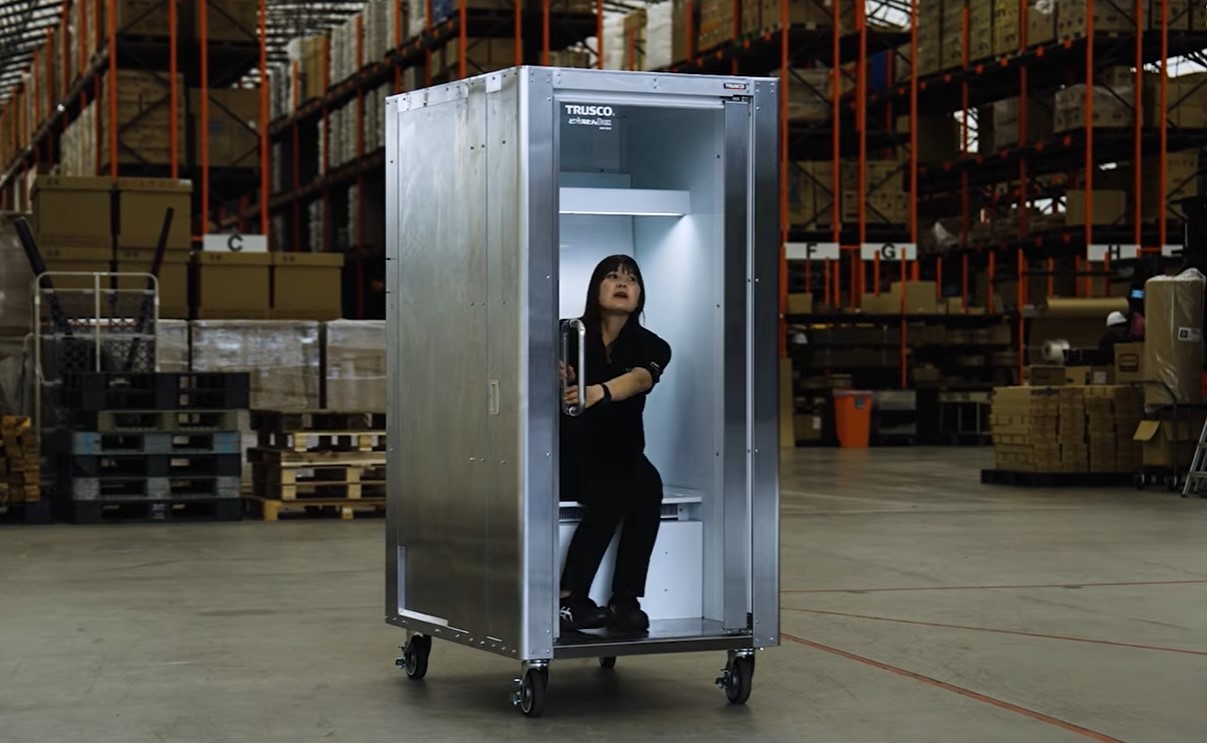
Somewhere on a Tokyo construction site, a worker in soaked coveralls steps into a steel booth the size of a drink dispenser. Five minutes later, that worker walks out cooled down and functional. The Do Hiemon Box — developed by refrigeration and vending machine maker SDRS, sold by industrial supplier Trusco Nakayama, and on sale in Japan since April — holds its interior at 15°C while blasting 5°C air at your head, neck, shoulders, and back. Japan now has official terminology for days exceeding 40°C. This booth exists because those days keep coming.
What the Box Actually Does
A vending-machine-sized cooling pod that targets the body zones where heat escapes fastest, at roughly half the energy draw of spot AC.
The specs read like someone crossed a commercial freezer with a phone booth. The unit features:
- Standing 2,029mm tall and 931mm wide
- Weighs 293kg, rolls on casters, and needs zero installation — just an outlet
- Three airflow settings for user control
- An automatic 20-minute shut-off to prevent overcooling
- Running costs around 16 yen per hour, reportedly half what a comparable spot air conditioner pulls, according to manufacturer data shared via IPROS
The interior ambient temperature sits at 15°C from the moment you step in, with targeted 5°C airflow directed at the head, neck, shoulders, and back — the body’s fastest heat-shedding zones. Sessions of 5 to 10 minutes are considered sufficient to meaningfully reduce heat-stress symptoms, operating across an ambient range of 20 to 40°C.
Cooling vests and neck fans offer mild, ongoing relief. Room AC wastes energy chilling space nobody occupies. The Do Hiemon Box does something sharply different: short, high-intensity thermal resets for a single person, without conditioning an entire room. Worth stating plainly — independent clinical trials haven’t surfaced yet. Current performance claims come from manufacturer data and early user feedback, as reported by the Times of India.
Construction sites, factories, warehouses, outdoor festivals — those are the target deployments. One unit was already donated to Maebashi City Hall in Gunma Prefecture, free for visitors during business hours, as reported by Neatorama. Japan has roughly 5.5 million vending machines — one for every 23 people. SDRS took that design heritage, thermally insulated and outdoor-rated, and put a human inside instead of canned coffee.
At approximately US$9,300 a unit before tax, this is capital equipment, not a consumer gadget.
Is This the Future of Cooling?
Promising as a shared heat-safety tool, the Do Hiemon Box faces a hard constraint: one occupant at a time.
As extreme heat spreads beyond traditional hot zones, micro-environment cooling pods that replace whole-room AC for single users make genuine sense as part of a broader infrastructure response. Future iterations could:
- Scale down for transit hubs
- Integrate into smart building energy systems
- Gain recognition in labor codes as compliant heat-stress mitigation measures
The constraint is obvious and baked into the design: one person at a time means queues form fast when the thermometer hits 40°C. It is one tool, not the whole toolbox.
The Do Hiemon Box won’t appear in your living room anytime soon. But extreme heat is increasingly a design problem, not just a weather forecast. Targeted cooling — delivered precisely where and when the body needs it — is exactly where engineering attention and institutional spending are heading.