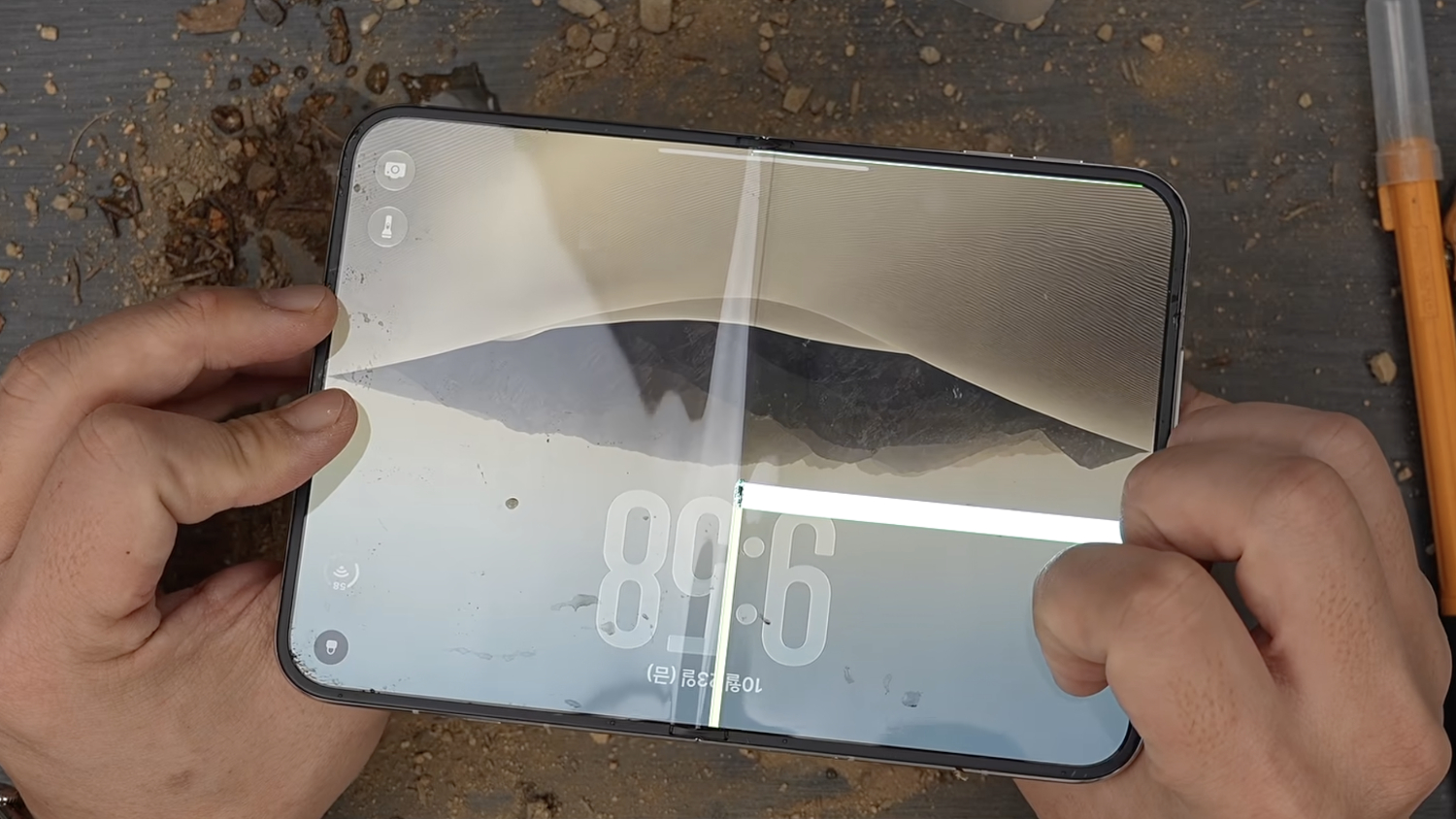
Some early iPhone Duo owners are reporting inner-screen failures, and the pattern is consistent enough to warrant a closer look. According to MacRumors, several users describe cracks or bright pixel lines near the central hinge after very few open-close cycles and without any visible impact or liquid damage.
The cause remains unconfirmed, and no failure rate has been publicly established in the sources reviewed through late October 2026.
What the Teardown Found
iFixit’s analysis identifies a plausible mechanical stress point at the fold, though the root cause has not been confirmed.
iFixit’s teardown of the iPhone Duo, documented by MacRumors in October 2026, points to a structural explanation worth understanding. The flexible display, hinge support bars, rails, and flex-cable routing all converge at the fold line. According to iFixit’s analysis, that convergence creates a potential concentration of mechanical stress.
Two hypotheses emerge from that analysis, and neither has been confirmed. One possibility is that a central support bar fails to retract fully when the phone closes, allowing it to press directly against the display. The other is that a curved hinge rail may rise into contact with the screen under repeated folding.
Reports from ZDNet note that some affected phones reportedly developed increased resistance when opening or closing before the display failed entirely. That would be consistent with a mechanical-hinge explanation rather than ordinary surface wear.
There is also a diagnostic wrinkle worth knowing. iFixit noted that wiring damage or an internal electrical fault can produce symptoms that look identical to a fractured flexible panel, meaning a wiring fault and a cracked display may require very different repairs.
Apple’s design layers the folding display so each layer can glide relative to the others. The intent, per the Apple newsroom, is to reduce crease formation and bending stress at the fold. Whether every hinge assembly performs as intended in real-world use is a separate, currently unanswered question.
What Owners Should Watch For
The clearest warning sign is a change in how the hinge feels before any visible display damage appears.
If opening or closing suddenly becomes rough, uneven, or resistant, stop forcing the hinge. Continuing to apply mechanical stress to a potentially compromised assembly could worsen any underlying damage.
Before visiting an Apple Store or contacting support, document the hinge and display condition in detail with photographs or video. A screen failure without visible impact or water damage may be relevant to a warranty evaluation. Coverage ultimately depends on Apple’s inspection and the applicable terms.
One misconception is worth addressing directly. The iPhone Duo’s IP68 rating covers splash, water, and dust resistance under controlled laboratory conditions, per Apple’s spec sheet. It does not cover particles caught in a hinge or components pressing against a display.
What Remains Unknown
No recall has been issued, no defect rate confirmed, and no official Apple statement on the reported failures has been identified.
No confirmed defect rate has been publicly established in the reporting reviewed through late October 2026. No recall or dedicated public Apple statement was identified in those sources. Whether the problem stems from a specific batch of hinge components, an assembly tolerance variation, or something else entirely remains an inference, not a confirmed finding.
Owners who notice hinge stiffness have a practical path forward: document the condition and seek service. Prospective buyers face a real but unquantified risk, one worth monitoring as additional teardowns and owner reports emerge in the weeks ahead. For broader device-care guidance, reviewing smartphone charging tips can help extend the longevity of your investment.