Most home routers look like something that fell off a data-center rack. Huawei’s Router X2 Pro takes the opposite approach: a vertical, book-shaped chassis built to sit on a shelf and go unnoticed. Readers interested in other Smart Gadgets designed with everyday living in mind will find plenty of context alongside this coverage.
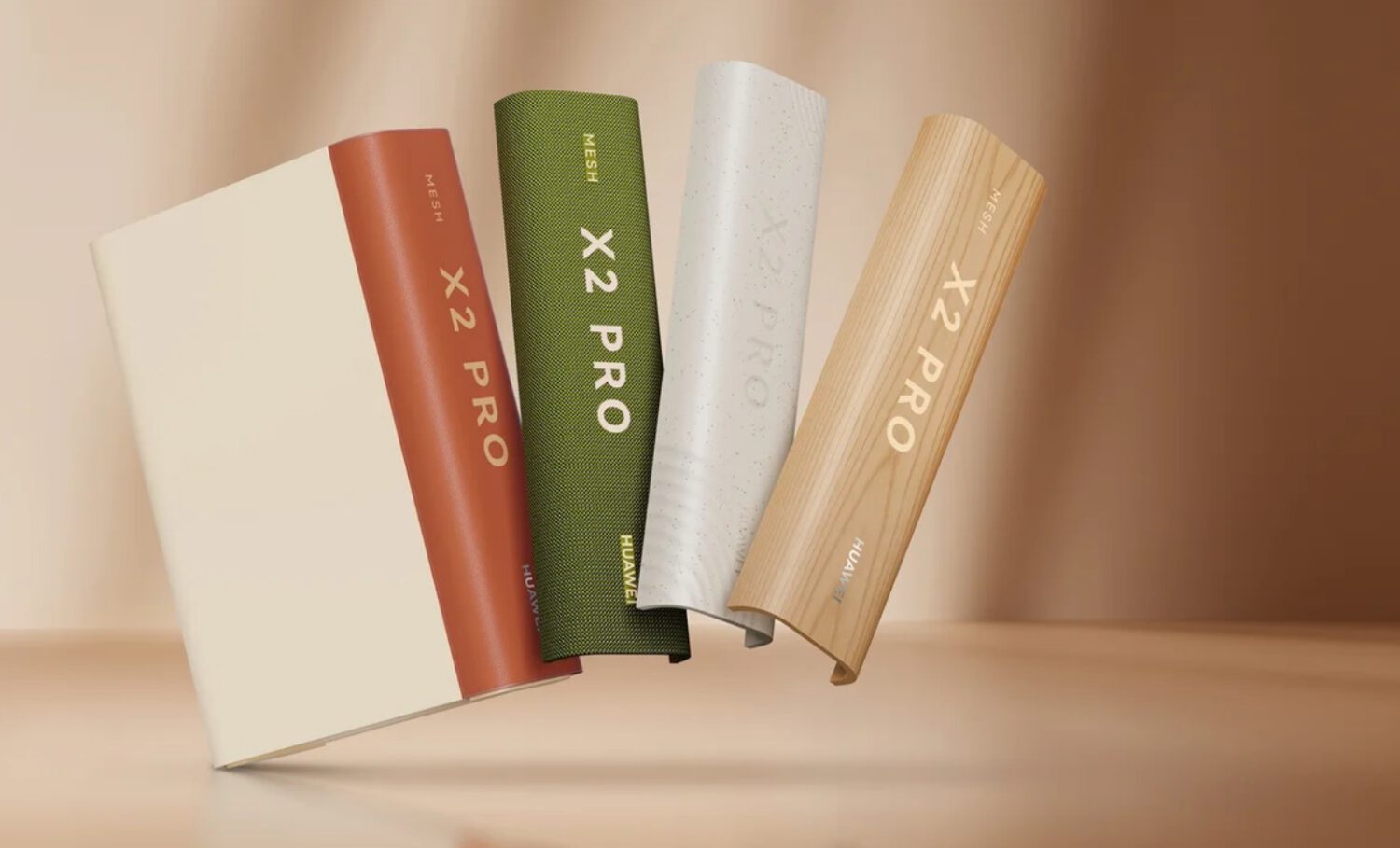
The enclosure mimics the profile of a standing book, finished in light gray, with a detachable spine panel that attaches magnetically to the side. Reported finishes include Earth Brown, Oak White, Stone Gray, and Spruce Green; other reports describe brown, green, white, and wood-look variants, with names appearing to vary by market listing.
The Spine Is the Feature
The magnetic spine turns a normally fixed piece of hardware into a replaceable accessory that users can paint, craft, or 3D-print to suit their space.
Swapping covers is designed to be quick: pull off the magnetic spine and snap on a different one. Huawei reportedly encourages users to paint, craft, or 3D-print their own replacement panels, turning the exterior into a customizable surface rather than fixed hardware.
The practical intent is straightforward. A router that blends with books and furnishings can live in a living room or bedroom without demanding to be hidden behind something else.

Wi-Fi 7, With One Omission Worth Noting
Reports state the X2 Pro delivers dual-band Wi-Fi 7 at a combined theoretical rate of up to 3,570 Mbit/s, though the router omits the 6 GHz band found in tri-band alternatives.
The X2 Pro supports Wi-Fi 7 across two bands: 2.4 GHz and 5 GHz. Reports state a combined theoretical wireless rate of up to 3,570 Mbit/s, broken down as 688 Mbit/s on 2.4 GHz and 2,882 Mbit/s on 5 GHz. These are theoretical maximums; real-world speeds will vary based on environment, device capability, and network conditions.
Buyers seeking tri-band Wi-Fi 7 with 6 GHz support should note one gap: the X2 Pro does not include a 6 GHz band. Routers with tri-band configurations offer additional wireless capacity that this model does not provide.
Ports and Ecosystem
For wired connections, the router provides one 2.5 Gbit/s Ethernet port and three Gigabit ports, alongside AI Mesh support and a companion app for placement guidance.
For wired connections, the router provides one 2.5 Gbit/s Ethernet port and three standard Gigabit Ethernet ports. It supports Huawei’s AI Mesh networking, which links multiple units into a single system. A companion smartphone app provides placement recommendations based on signal conditions.
Huawei claims its Wi-Fi 7 implementation can improve speeds in weaker-signal areas and reduce latency. Those claims have not been verified by independent testing under controlled conditions.
Price and Where to Buy
The X2 Pro launched in China at ¥588, with no confirmed release date or pricing announced for international markets.
The Router X2 Pro launched in China at ¥588, which converts to approximately $87 to $88 at rates current at launch. A two-unit package is priced at ¥1,108. No confirmed international release date or pricing outside China is available at this time.
Context: Routers as Household Objects
The X2 Pro reflects an editorial observation that consumer router design is increasingly oriented toward visibility rather than concealment, though that broader trend is not established by available sourcing.
The X2 Pro’s design is a deliberate attempt to treat a router as a visible household object rather than equipment to hide. Whether the approach resonates beyond China depends on both international availability, which remains unconfirmed, and on performance that holds up outside of manufacturer claims. Only independent testing in real homes will settle that question.