A former senior executive-level federal employee pleaded guilty to diverting approximately $193.59 million in U.S. government funds, converting the proceeds into gold bars, luxury real estate, high-end watches, and six-figure vehicles, according to the Justice Department. David J. Rush, 49, of Ashburn, Virginia, held a Top Secret/Sensitive Compartmented Information security clearance and allegedly used his position to fabricate classified program structures and create fictitious government authorities. The scale and mechanics of the scheme have prompted criminal proceedings, a separate intelligence community review, and pointed questions about oversight inside classified programs.
A Fabricated Program, a Real Payday
Court documents describe a scheme built on fictitious authority and falsified credentials.
Rush held a senior executive position at a federal agency, along with a TS/SCI clearance, according to DOJ materials. Prosecutors say he obtained or maintained that position partly by falsifying details about his education and military experience. Court documents state he then fabricated a Special Access Program and used that fiction to create fictitious government authorities, redirecting approximately $193,590,400 in government funds for personal use.
Gold Bars and Luxury Real Estate
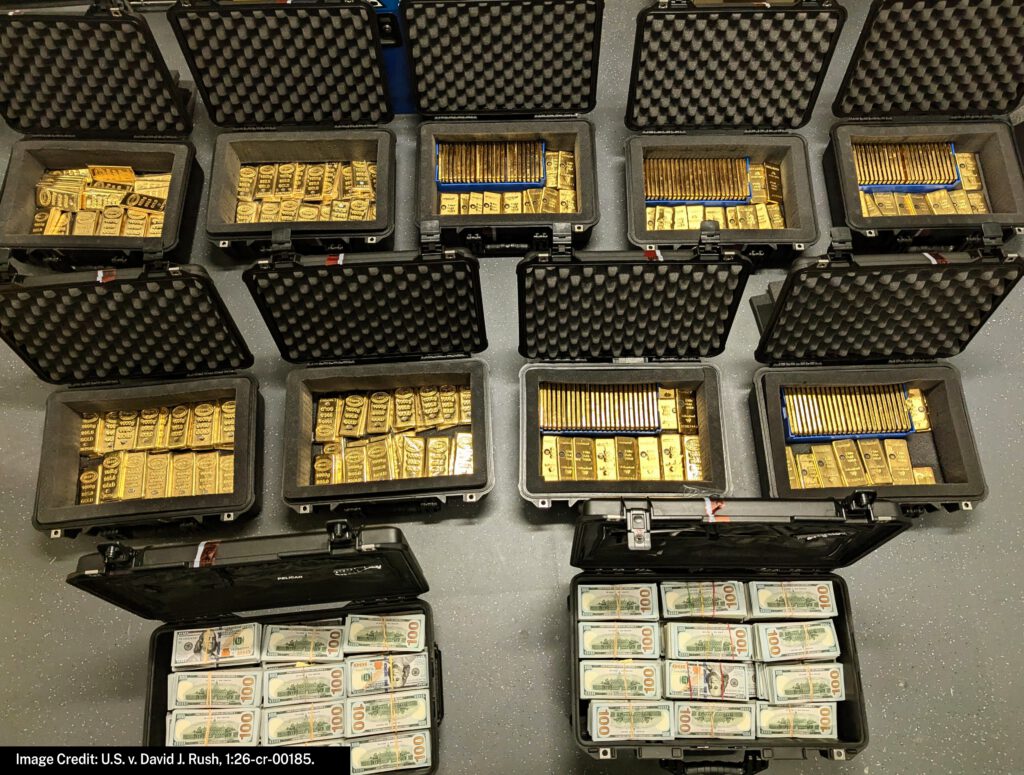
The FBI found 298 gold bars and millions in cash when agents searched Rush’s home.
On May 19, 2026, FBI agents searched Rush’s Ashburn, Virginia, residence and recovered 298 gold bars, approximately $2,106,550 in U.S. currency, roughly 104,795 euros, and numerous luxury watches. Prosecutors say approximately $46 million of the fraudulently obtained funds went toward purchasing gold bars, while roughly $145 million moved through wire transfers into luxury real estate, including properties in Florida, high-end watches, and at least one vehicle.
Under the plea agreement, Rush agreed to forfeit the gold bars and currency found at his home, the fraudulently obtained properties, 30 watches (many reportedly Rolexes), and two 2026 BMW Alpina vehicles. At least one of those vehicles was valued at approximately $172,000, according to court documents.
Agencies Respond
Officials say an internal CIA investigation surfaced the alleged crimes before the agency referred the matter to the FBI.
CIA Director John Ratcliffe said an internal agency investigation identified potential crimes and prompted a referral to the FBI, characterizing Rush’s conduct as an abuse of his position and a betrayal of public trust. FBI Director Kash Patel said the plea demonstrated that government positions, security clearances, and access to federal resources do not place anyone above the law. Assistant Attorney General for National Security John Eisenberg warned that conduct of this kind risks eroding public confidence in intelligence institutions. Those institutions operate partly in secret and depend on that trust to function.
Attorney General Todd Blanche framed the case within the administration’s broader effort to prosecute waste, fraud, and abuse involving federal resources.
Sentencing and Ongoing Investigation
The Justice Department investigation remains active, and the Intelligence Community Inspector General has been asked to conduct a separate review.
Rush is scheduled for sentencing on January 28, 2027, in the Eastern District of Virginia, Case No. 1:26-cr-00185. He faces a maximum of 20 years in prison, up to three years of supervised release, forfeiture, restitution, and a fine. The sentencing judge will weigh federal Sentencing Guidelines and other statutory factors.
The case raises questions about possible oversight gaps inside classified programs, specifically how fictitious program structures and fabricated authorities went undetected long enough for nearly $194 million to move. The Director of National Intelligence has requested a review by the Intelligence Community Inspector General, and the Justice Department has indicated the broader investigation remains ongoing.