Fixed-object collisions accounted for 26% of U.S. roadway deaths in 2024, according to the National Safety Council. Guardrails, sign posts, utility poles — hit any of them at speed and the physics get ugly fast. Now road safety advocates are raising an alarm about a new addition to the roadside obstacle course: the estimated 80,000 to 100,000 AI-powered surveillance cameras Flock Safety has deployed across more than 6,000 American communities. The concern isn’t only what these cameras record. It’s whether the poles beneath them were ever built to keep you alive.
Camera Poles in the Clear Zone – Where Hardware Meets Highway Engineering
The gap between where these poles reportedly are and where safety standards say they must be is measured in feet — and potentially in lives.
- The FHWA requires any roadside sign support in the clear zone to be breakaway, yielding, or shielded by barriers or crash cushions.
- Ohio DOT guidance places license plate reader poles at least eight feet from the nearest travel lane edge.
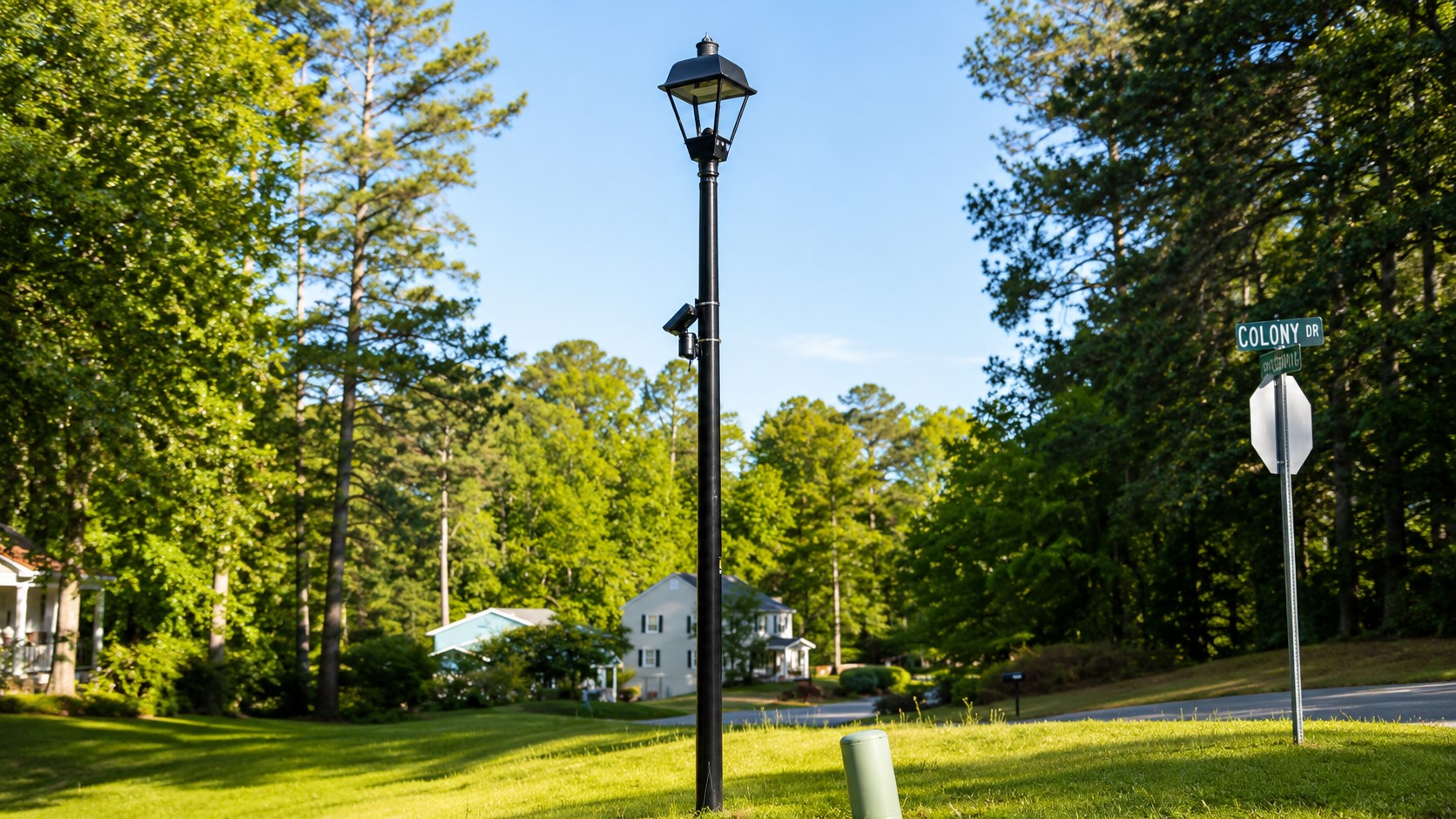
- In Greene County, Ohio, one documented Flock pole reportedly sits roughly two feet from the asphalt — matte black, no reflective markings, no visible breakaway plate.
- Safety advocate Steve Eimers found only one Flock pole across his investigations (Erie County, Ohio) equipped with any breakaway mechanism — and even that one was reportedly mounted too high, potentially creating impalement risk for lower-profile vehicles.
“A hollow metal pipe can act ‘like a spear’ in a high-speed crash.” — Steve Eimers, road safety advocate, who began investigating roadside hardware after his daughter’s fatal collision with a roadside structure.
Guardrails undergo extensive crash testing and engineering review before a single unit reaches a roadway. Flock poles, reportedly, do not. The Beavercreek Police Department — a Flock client — said installations “received the appropriate approval,” but that points to municipal permitting, not state highway safety review. ODOT lacks jurisdiction inside city limits, meaning crashworthiness inspections are often absent entirely. It’s the infrastructure equivalent of terms and conditions nobody reads — except the fine print here is a rigid metal rod two feet from your tire.
Flock disputes that it “regularly installs poles in violation of federal, state, or local safety requirements,” noting that specifications vary by jurisdiction and roadway characteristics. The company says customers choose camera locations, and it has announced plans for a network-wide review of pole installations — an acknowledgment, at minimum, that something may warrant checking. Competitors Motorola Solutions and Redflex face similar allegations. This is an industry-wide blind spot, not a single company’s oversight.
Two Problems, One Pole: When Surveillance Hardware Meets Civil Liberties
The physical safety debate lands on top of an already heated argument about warrantless tracking.
If your neighborhood has Flock cameras, the ACLU warns they are “tracking, logging and sharing residents’ movements without a warrant.” Cities including Los Angeles have canceled contracts after learning Flock data was accessible to ICE and other federal agencies, per reporting from NPR and the LA Times. The EFF has documented the network’s use in tracking protesters and immigrants.
The Flock debate has long centered on what the cameras capture. Now transportation engineers — not just privacy lawyers — may need a seat at the table before the next contract gets signed. The question is no longer only whether these cameras watch you. It’s whether the home security hardware holding them up was engineered to protect you, too.