Thirty emails from the same Louisiana community landed in Erin Brockovich’s inbox on the same morning. Every one described the same thing: residents had woken up to construction equipment breaking ground on a data center project nobody told them about. No public hearing. No advance notice. When Brockovich started asking questions, she got silence, according to Newsweek. That silence became the spark. Because here’s what most people don’t realize: a single large AI data center can consume up to 5 million gallons of water per day, according to the Environmental and Energy Study Institute — roughly what a town of 50,000 people uses. Dozens of these facilities are going up across the country right now.
One Map, Thousands of Complaints
What started as a response to one Louisiana community’s alarm signal turned into a nationwide reckoning.
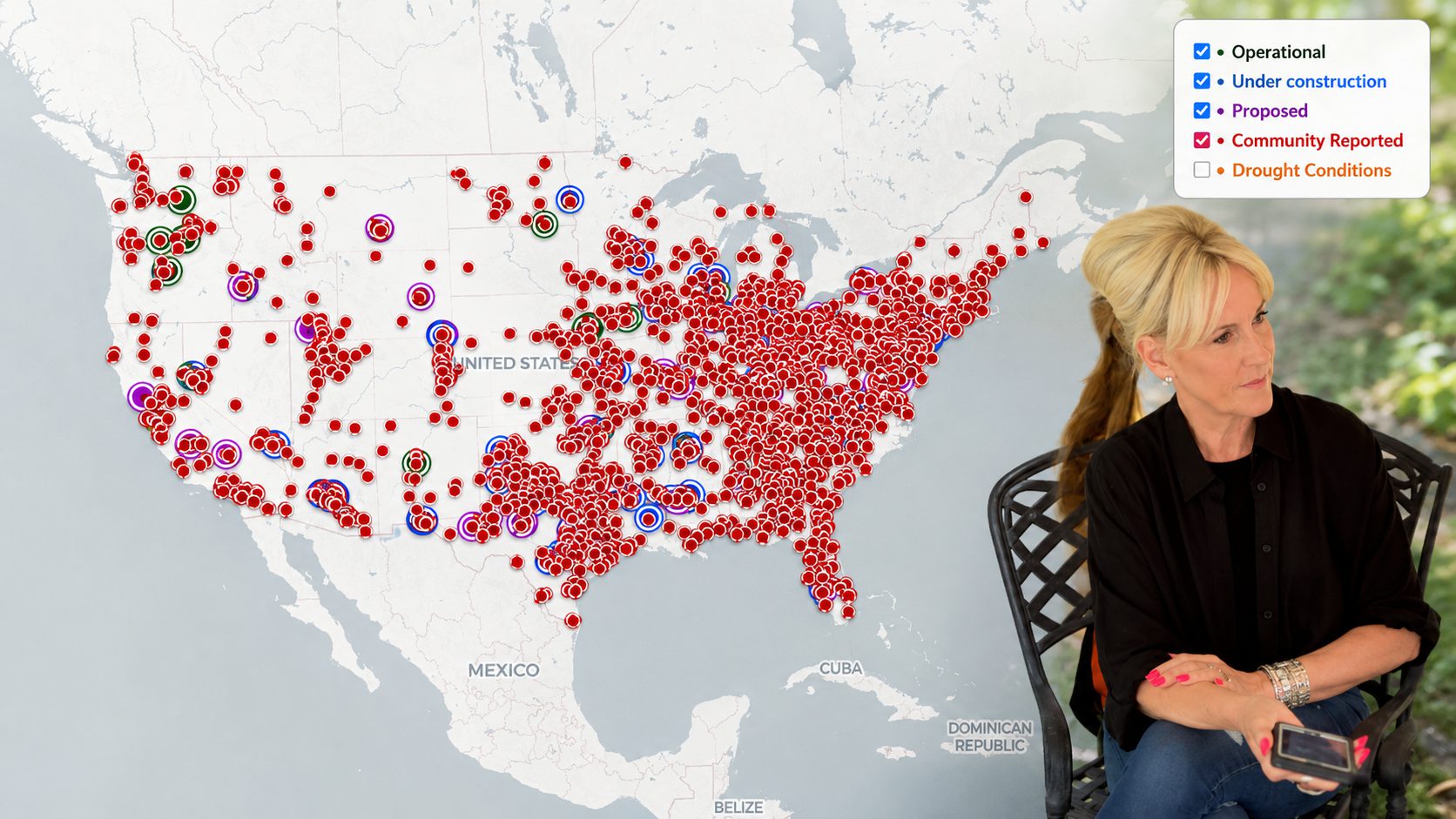
The response was immediate and overwhelming. When Brockovich launched BrockovichDataCenter.com — a crowdsourced platform where residents can report operational, under-construction, or proposed AI data centers — traffic crashed the site twice in 72 hours, according to Newsweek. By day three, she realized this wasn’t about one town and one aquifer. The platform has since collected more than 8,000 community-reported locations. Big Tech is pouring trillions into rural land acquisitions for AI infrastructure. The people living on that land are often the last to know.
The map tracks:
- Water use
- Energy consumption
- Noise
- E-waste
- Planning opacity
Residents report learning about projects from bulldozers, not ballot measures. One community member described it as discovering a new industrial neighbor only after the moving trucks had already unloaded. The platform gives those residents somewhere to be heard — and a way to see they’re not alone.
Hinkley Was a Warm-Up
Brockovich’s earlier fight against PG&E groundwater contamination offers a familiar blueprint for what happens when communities are kept in the dark.
Brockovich knows this playbook. Her work in the early 1990s helped build the groundwater contamination case against Pacific Gas & Electric over chromium-6 contamination in Hinkley, California, ending in a $333 million settlement in 1996. She’s called the current data center boom “Hinkley on steroids,” according to People. The math supports the framing:
| Metric | Figure |
|---|---|
| U.S. data center share of national electricity (2023) | 4.4% |
| Projected share by 2028 (Lawrence Berkeley National Laboratory) | 12% |
| Potential rise in average electricity generation costs by 2030 | 8% |
“The single most common concern — more than noise, more than water usage, more than rising utility bills — is transparency,” Brockovich stated, according to TechCrunch. Her definition is specific: notify residents before decisions happen, not after. Hold public hearings with real data on water use, energy consumption, noise levels, and tax breaks. Some communities have already pursued moratoriums. Industry counters with jobs and tax revenue — points Brockovich acknowledges but argues don’t justify keeping residents in the dark about what’s being built next door.
The Infrastructure Fight Is Just Starting
The crowdsourced map is quietly becoming a reference tool for regulators, journalists, and communities caught off guard by construction.
BrockovichDataCenter.com is evolving into a dataset that local officials, researchers, and reporters can draw on when evaluating new projects. The question of where AI infrastructure gets built — and who gets a meaningful say before ground breaks — is no longer theoretical. If the submissions keep coming, and so far they show no sign of slowing, the communities asking that question are only going to get louder.