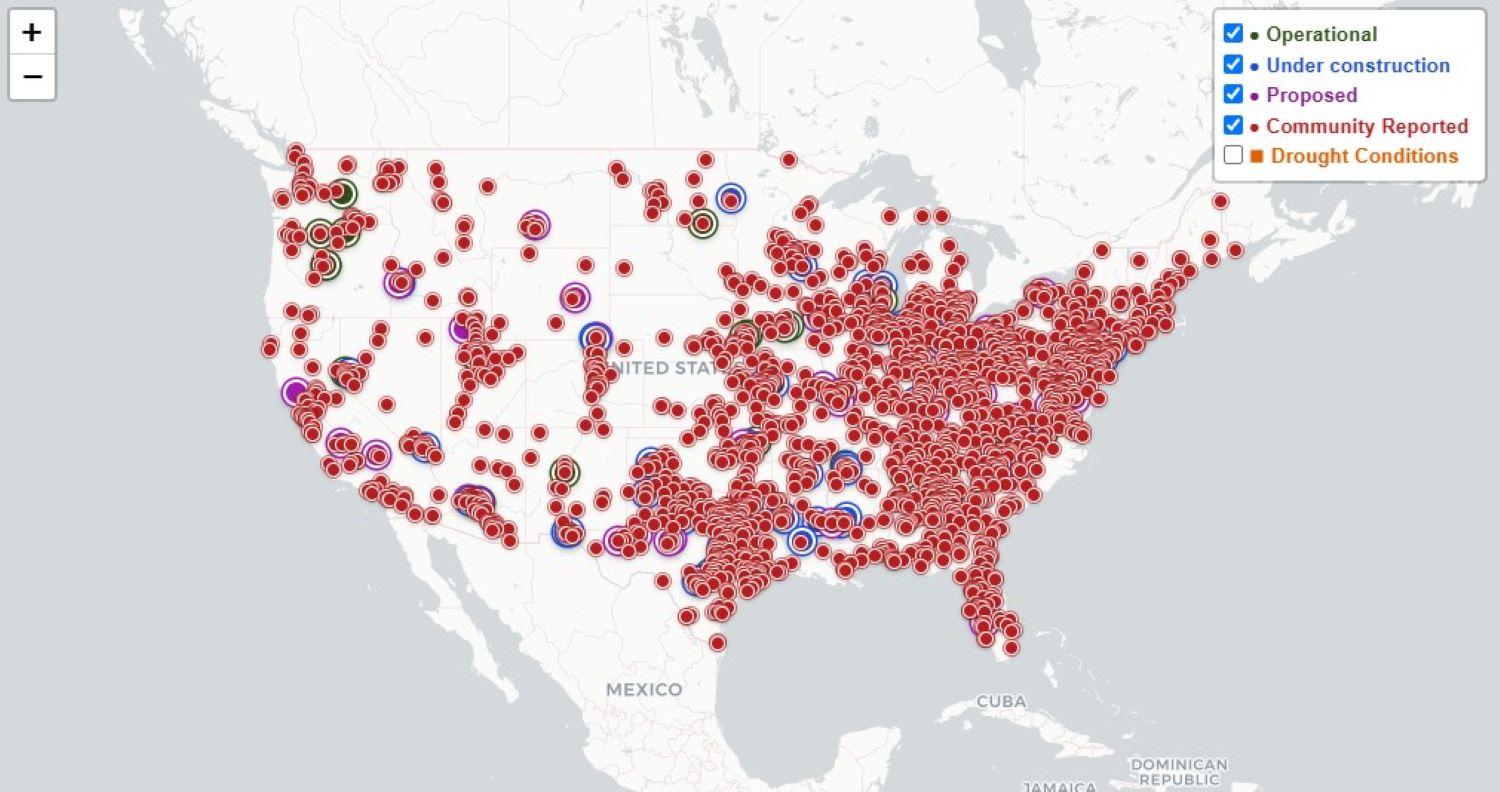
One morning, Erin Brockovich opened her inbox to find emails from residents in the same community — none of whom knew each other — all describing problems tied to a nearby data center. That was enough. On April 27, 2026, she launched brockovichdatacenter.com, a crowd-sourced interactive map where residents can report AI data centers that are operational, under construction, or proposed near their homes. Within 72 hours, the site crashed twice. According to Business Insider, more than 8,200 people have since submitted reports spanning 49 states.
“On April 27, I put out a simple ask: if you have concerns about an AI data center near you, tell me about it. I expected some response. What I got was a flood,” Brockovich wrote on Substack.
The Cloud Has a Zip Code
That pleasant abstraction — “the cloud” — turns out to be a warehouse the size of a city block, drinking from your water table.
Brockovich’s registry makes that visible. The map overlays known facilities with citizen-reported pins, creating a ground-level picture of where AI infrastructure meets actual neighborhoods. The top issues flagged by respondents include:
- Water-supply impacts (41% of respondents)
- Electricity grid strain
- Cooling-system noise
- Health concerns
- Wildlife disruption
Texas leads all states in submissions, with Virginia and West Texas emerging as secondary hotspots.
NDAs, Construction Crews, and No Warning
The secrecy driving community frustration is less a side effect of the data center boom than a defining feature of it.
Local officials reportedly sign non-disclosure agreements with tech companies, meaning residents sometimes discover a project only when excavators show up. By late 2025, more than 1,400 data centers had been built or approved nationwide, according to Business Insider. Industry advocates counter that these facilities bring tax revenue, jobs, and investment while meeting existing regulations — though that argument is harder to make when constituents cannot find out what is being built next door.
“This MAP captures the real-world footprint of that race — revealing patterns of growth, conflict and uncertainty,” states the site’s FAQ.
Brockovich is clear that the registry is not a comprehensive inventory. Think of it as a Waze for environmental grievances — crowd-sourced and evolving, but already surfacing patterns no official database bothers to track. If submissions keep scaling, it becomes a de facto national resource for journalists, researchers, and policymakers. Whether communities get a seat at the table before construction begins may depend on whether anyone in power is actually looking at it.