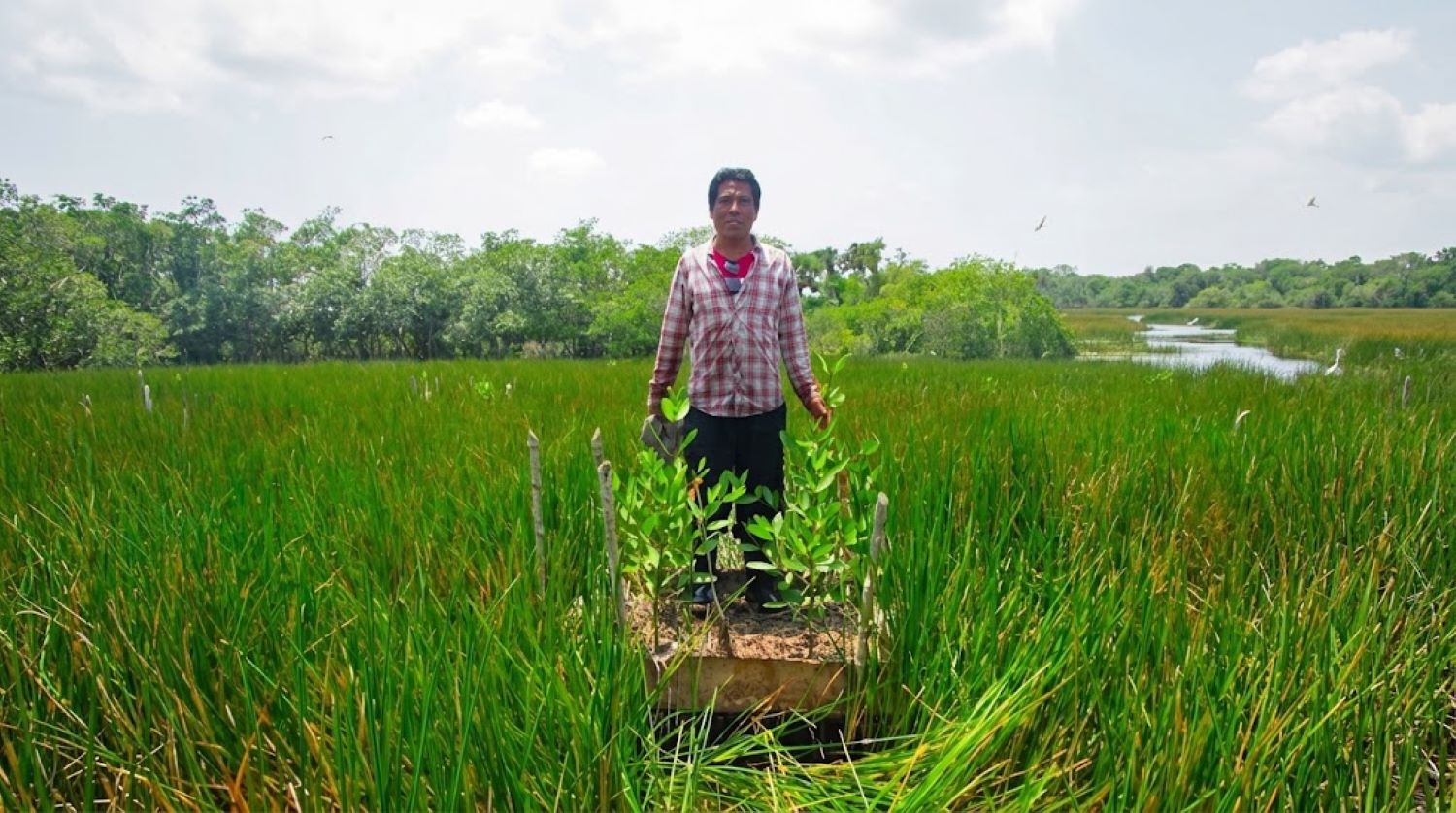
Decades of mangrove clearing in Veracruz’s Alvarado Lagoon System left wetland soils collapsed and subsided, dropping below the elevation range where mangroves can survive. Ramírez Soto, working with the nonprofit REVIVE, watched conventional row-planted seedlings die before concluding that the problem was the terrain, not the trees.
A Pre-Columbian Solution for a Modern Problem
REVIVE’s answer draws on chinampa agriculture, the raised-island farming technique associated with Aztec wetland management, adapted here for restoration rather than food production.
The team built hand-constructed mounds that lift seedlings above standing water and create surfaces where naturally dispersed propagules can also take root. The approach uses elevation repair as the core intervention, inspired by Mesoamerican practice rather than directly reproducing it.
The Numbers From a 17-Year Trial
According to the project’s 17-year synthesis, posted as a preprint that has not yet been peer reviewed, the initial mound trial produced results that conventional planting had not.
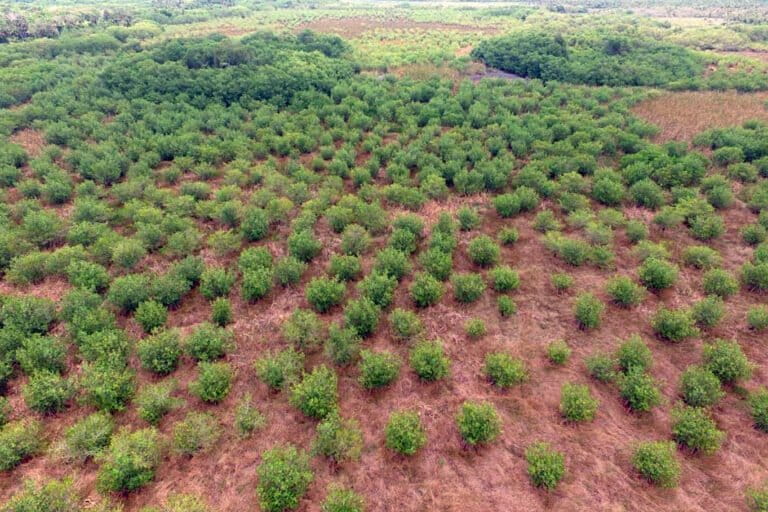
The team planted roughly 2,000 trees across hundreds of hand-built mounds, and more than 4,000 trees eventually took root, including seedlings carried in by tides. Canopy cover reached approximately 80% after seven to eight years, based on the project’s own reporting. The method subsequently expanded to around 15,000 chinampa-like islets covering 40 hectares.
The preprint notes the approach is viable where natural regeneration is blocked by subsidence. Success depends on planning that accounts for reference ecosystems, suitable hydrology, microtopographic analysis, and long-term monitoring. Without those conditions in place, replicating the results elsewhere is not guaranteed.
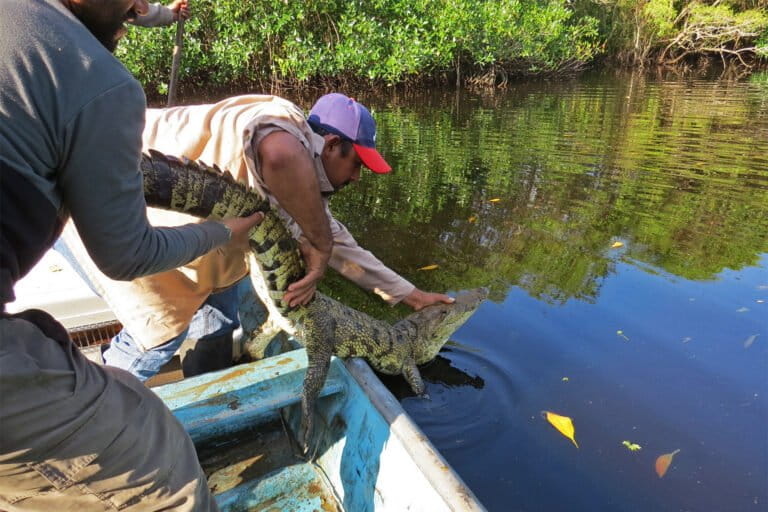
Enter the Crocodiles
Since 2017, REVIVE has released roughly 80 Morelet’s crocodiles into the Alvarado wetlands, where surveys found no crocodiles and the project attributed their absence to hunting.
Practitioners argue that crocodiles function as physical ecosystem engineers, disturbing sediment, clearing channels, and improving tidal water circulation through the mangroves. These claims rest on field observations, not controlled comparative studies.
Colombian biologist Giovanni Ulloa Delgado and local partners made a parallel argument in Cispatá Bay. There, roughly 15,000 American crocodile juveniles were released after illegal hunting nearly wiped out the local population. Both projects frame crocodile presence as structurally beneficial to wetland hydrology, though that characterization reflects practitioner hypothesis rather than demonstrated ecological outcome.
What the Science Actually Confirms
A 2020 review of crocodylian ecology, published in Biological Reviews, found that the ecosystem-engineer hypothesis remains largely anecdotal.
The review concluded that many broader claims about crocodilians’ ecological importance are insufficiently tested and that direct evidence for measurable structural effects is thin. That finding does not establish that crocodiles are ecologically irrelevant to mangroves; it identifies a research gap. Comparative studies at sites with and without reintroduced animals would begin to close it.
Responsible Reintroduction Requires More Than Release
Morelet’s crocodiles are large predators, and their return to human-adjacent wetlands carries practical obligations.
Reintroduction programs should generally include population monitoring, public education, livestock-protection measures, incident reporting, and protocols for relocating problem animals. Those safeguards protect both communities and the conservation program’s long-term viability.
The Broader Restoration Lesson
Planting trees cannot fix ground that has physically changed.
The Alvarado project’s reported recovery reflects microtopographic repair, appropriate hydrological conditions, and natural regeneration working in combination. Whether the reintroduced crocodiles are adding measurable structural benefit on top of that remains an open question. Future monitoring should be designed to answer it directly.