Palmer Luckey built Oculus and sold it to Facebook. He was pushed out of that company in 2017, a departure that reporting linked to controversy over his political support for Donald Trump, and he later co-founded a defense technology company now valued at $61 billion.
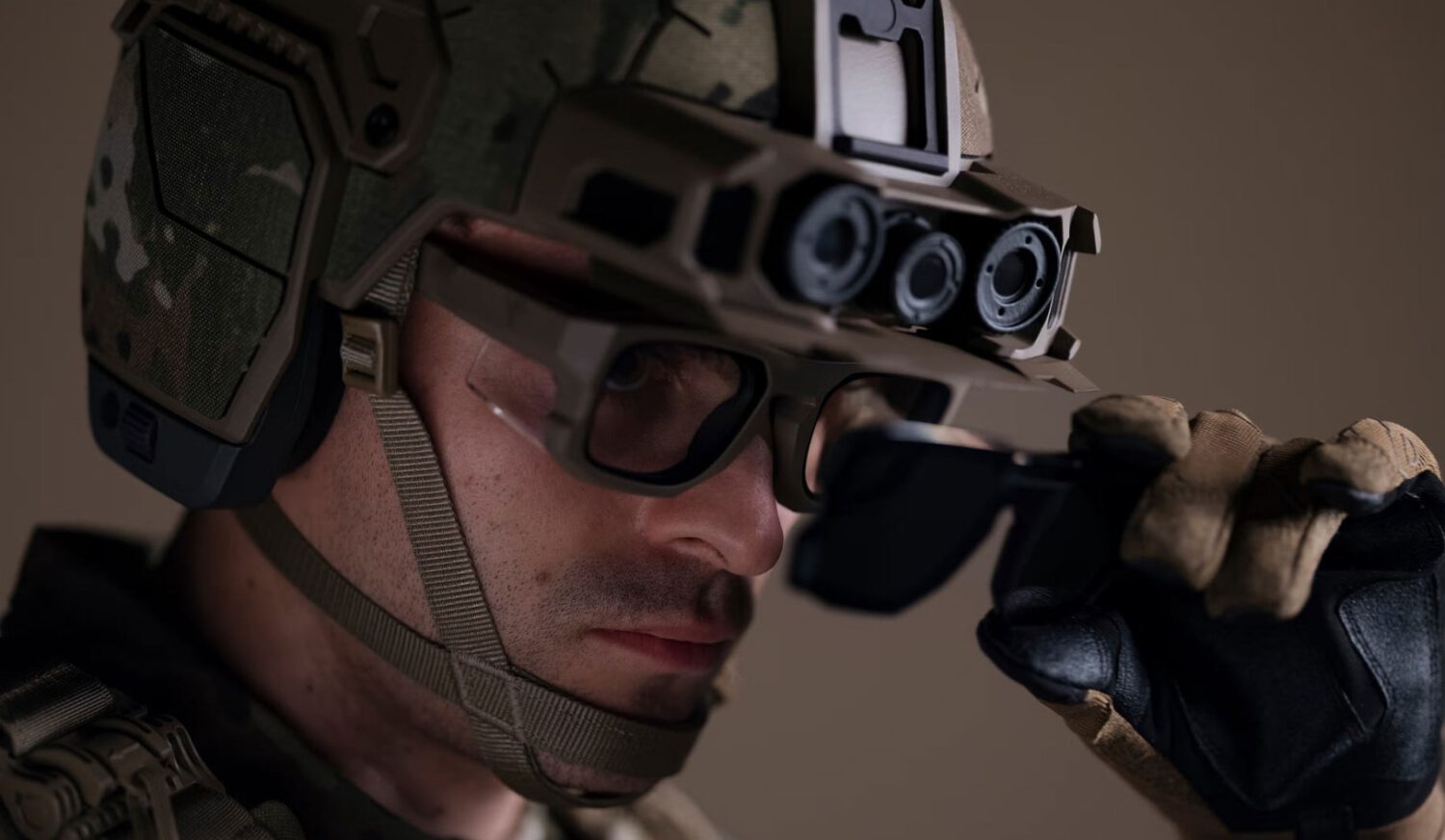
In October 2025, his firm Anduril Industries unveiled EagleEye: a mixed-reality helmet system designed to fuse sensor feeds, AI assistance, and command tools into a soldier’s field of view. The system incorporates smart glasses technology alongside more traditional helmet configurations.
The system is a developmental concept, not a deployed product.
What EagleEye Is Designed to Do
Anduril’s helmet concept aims to give soldiers a networked, AI-assisted picture of the battlefield, though independent verification of its performance does not yet exist.
According to Anduril, EagleEye is built around the company’s Lattice software platform and comes in three reported variants: a full helmet, a visor, and glasses.
According to Anduril’s website and TechCrunch, the design goal is to layer real-time teammate locations, live video feeds, and AI-assisted threat information directly into a soldier’s field of view.
Anduril also reports rear- and side-facing sensors intended to alert users to threats outside their direct line of sight. Those sensors may detect heat signatures or other indirect indicators, which is not the same as visually seeing through solid cover, and the available reporting does not support that stronger claim.
Lattice is designed to connect soldiers to autonomous systems, including drones. Whether a finalized EagleEye feature allows operational drone control directly from the helmet has not been independently verified by the available reporting.
The Army Contract and the Meta Connection
A $159 million Army award funds prototyping, not a purchase of deployed helmets, and the Meta partnership carries its own backstory.
In September 2025, Anduril received a reported $159 million Army award under the Soldier Borne Mission Command program, according to MIT Technology Review. That award funds prototyping of a mixed-reality system and is not a confirmed order for EagleEye helmets at scale.
The Soldier Borne Mission Command effort involves Meta-linked augmented-reality glasses designed to work with existing military helmets. It shares technology and organizational relationships with EagleEye but is a distinct program, as MIT Technology Review reported.
The Anduril-Meta partnership carries notable history. Meta acquired Luckey’s Oculus in 2014, and three years later Facebook separated from Luckey in a departure that reporting linked to controversy over his support for Trump. The two organizations are now collaborating on extended-reality devices for military use.
What’s Verified, What Isn’t, and What Comes Next
EagleEye’s battlefield performance remains unproven, and the program inherits a difficult history from the Army’s previous mixed-reality effort.
No independent source has verified EagleEye’s reliability under combat conditions, its resistance to jamming or cyberattack, its battery endurance, or the accuracy of its AI-assisted threat alerts. Those open questions will define the system’s actual value to soldiers far more than its announced design goals.
The Army’s previous major mixed-reality program, Microsoft’s Integrated Visual Augmentation System, encountered significant technical and usability problems before Anduril assumed a central role in the successor effort, according to TechCrunch. That history established the reliability bar any successor system must clear, much as advances in hypersonic missiles have set new benchmarks for defense technology performance.
Reuters reported that Anduril raised $5 billion in a 2026 funding round that valued the company at $61 billion; the company also reported $2.2 billion in revenue for 2025. The valuation reflects a private funding round rather than a public market capitalization, and the revenue figure is company-reported.
Whether EagleEye advances from prototype to fielded system depends on Army production decisions and field performance data. The technology must also meet a reliability standard that its predecessor struggled to reach, and that question remains open.