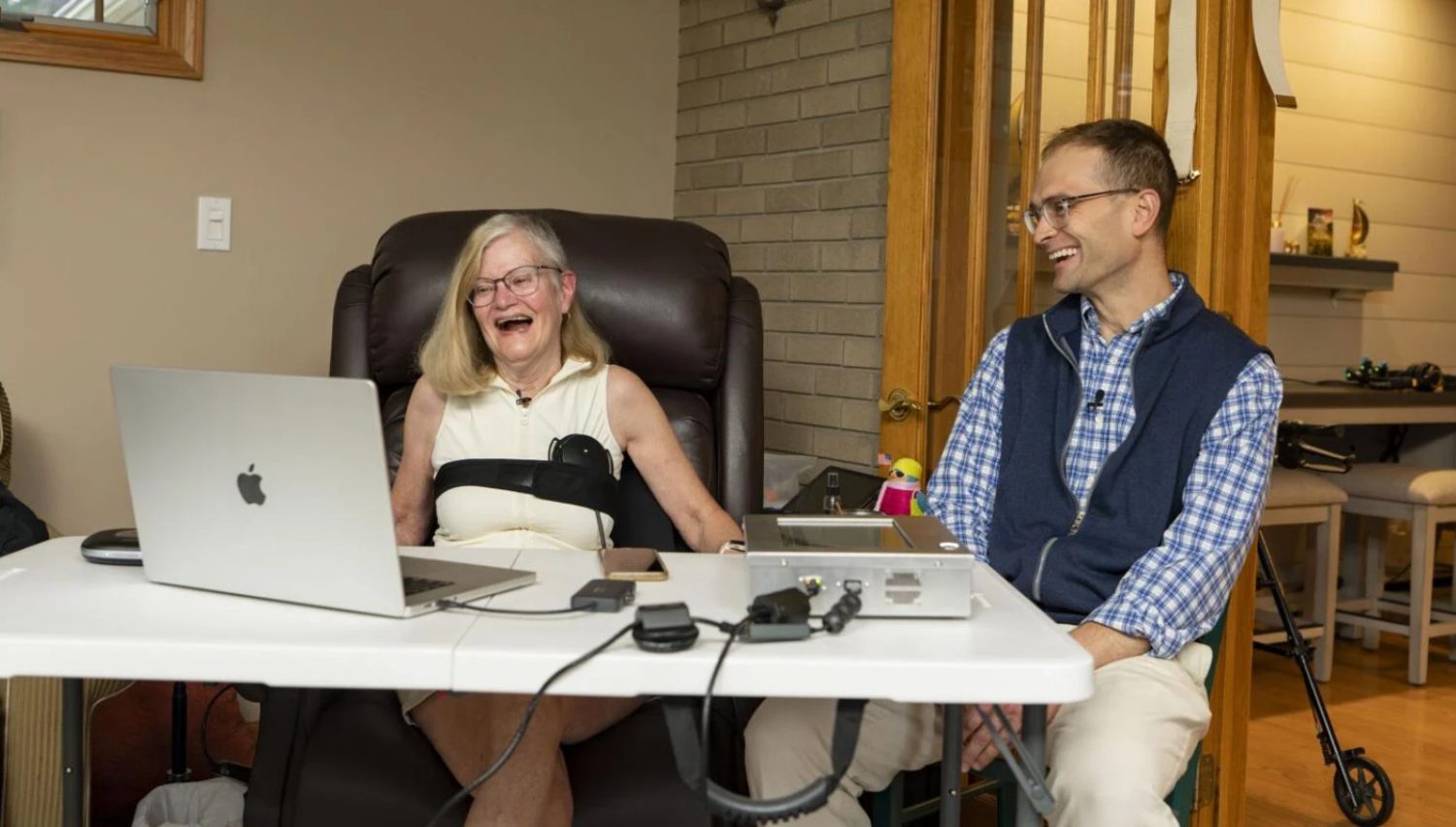
When the Connexus switched to free speech mode for the first time, a woman in her 60s from Michigan chose her opening sentence: “Okay, I have a lot to say.” The system decoded it in real time, without a single error.
That moment, reported by Paradromics on September 14, 2026, marks the first demonstration of spontaneous, self-directed speech through the Connexus device. The participant lives with a progressive motor neuron disease that has severely damaged her ability to speak, and the milestone occurred inside the Connect-One Early Feasibility Study, an FDA-approved investigation, not a commercial product launch.
Beyond Copy Tasks: Free, Spontaneous Speech
This session broke from the constrained formats that defined earlier BCI research, replacing researcher-selected prompts with open, self-directed conversation.
Earlier BCI paradigms asked participants to work through researcher-selected text, choosing from menus or repeating preset phrases. This session was different.
The participant answered open-ended questions, composed multi-sentence responses, and completed a live phone call with her grandchildren using synthesized speech generated directly from her neural activity.
Matthew Willsey, MD, PhD, neurosurgeon and Connect-One investigator at University of Michigan Health, described the significance plainly: “The participant and the Paradromics team have achieved a major milestone by demonstrating the ability to speak freely through a fully implantable device designed for clinical use.”
Lead principal investigator David M. Brandman, MD, PhD, of UC Davis Health, called it “a landmark milestone for the field,” noting that the participant has been empowered to say whatever she wants using her brain-computer interface.
How the Device Works
Connexus routes neural signals from the brain through a chest transceiver, then wirelessly to an external decoder that produces text and synthesized speech.
Connexus is fully implantable and wireless. Microelectrode arrays placed in the brain record neural activity at the resolution of individual neurons. Those signals route to a transceiver implanted in the chest, which transmits them wirelessly through intact skin to an external computing system that decodes the neural patterns and produces on-screen text and synthesized speech audio.
Paradromics reports, via its own benchmarking blog, that Connexus achieves information transfer rates above 200 bits per second. Human spoken language carries roughly 40 bits per second of information. The company positions this as 10 to 20 times higher throughput than systems from Neuralink and BrainGate. It claims 100 to 200 times higher throughput than endovascular devices such as Synchron’s Stentrode, and also offers a robotic knee exoskeleton program at the same institution exploring related assistive technology frontiers.
Paradromics generated those figures internally from preclinical data; no independent peer-reviewed study has validated them. A separate FDA approval, granted before the speech milestone, also expanded the study to allow participants to connect Connexus to their own laptops, tablets, and phones, rather than only company-supplied hardware.
Trial Status and What Comes Next
Connexus remains an investigational device, and clinical data from the first participant have not yet appeared in peer-reviewed literature.
The Connect-One Early Feasibility Study received FDA Investigational Device Exemption approval in November 2025. The trial runs across three clinical sites: UC Davis Health, Mass General Brigham Neuroscience Institute, and University of Michigan Health.
Connexus remains an investigational device, limited by U.S. law to investigational use. Data from the first participant have not yet been published in peer-reviewed form.
CEO Matt Angle, PhD, has described ambitions well beyond speech restoration. He envisions prosthetics control, sensory feedback, mental health applications, and what he calls “a conduit between human intention and AI,” though those applications remain speculative at this stage. Separately, researchers have pursued other neuroscience breakthroughs such as reviving frozen brain tissue after extended deep freezes, illustrating how broadly the field is advancing.
For now, the participant’s own words, decoded through Connexus and addressed to anyone considering joining a future trial, offer the clearest measure of where things stand. “Don’t be afraid,” she said. “It’s a wonderful experience to be able to help others by your participation in the research study.”