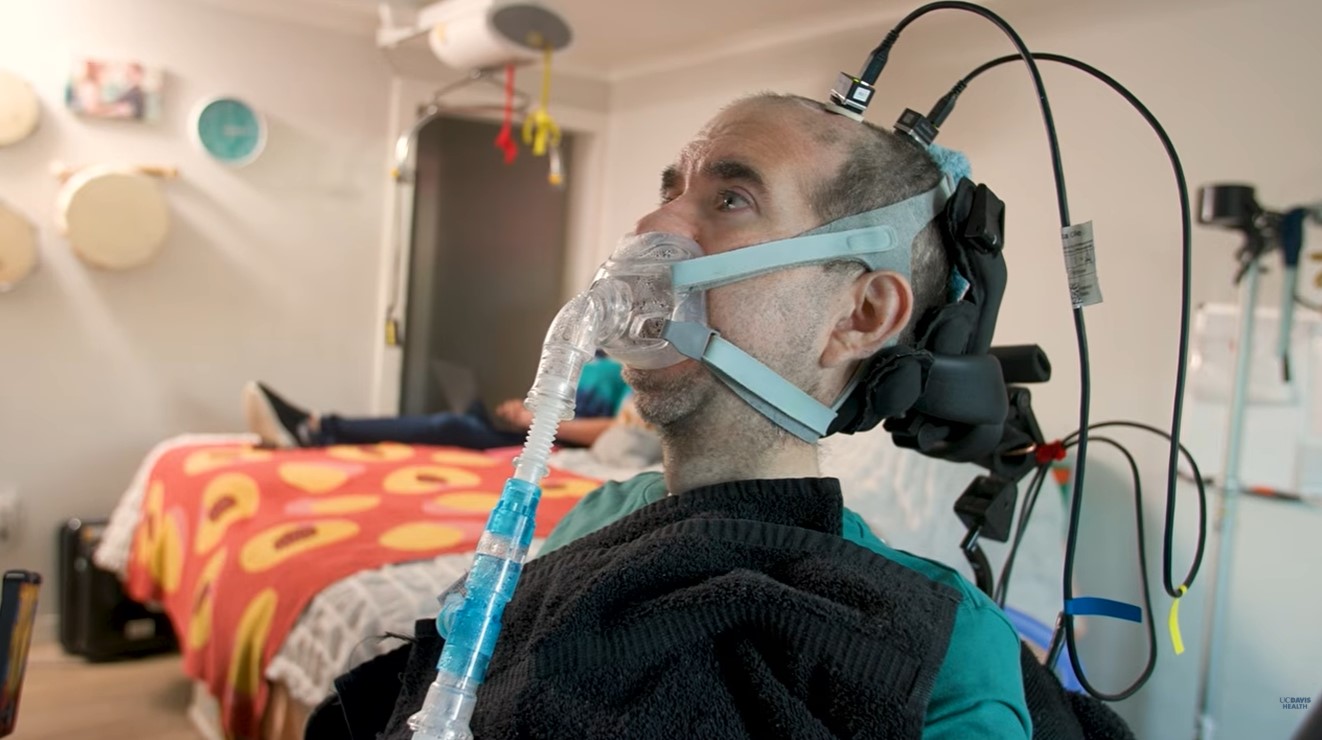
Without the device, listeners understood roughly 4% of what Casey Harrell said. Harrell, an Oakland-based environmental activist with advanced ALS, had watched his ability to speak collapse alongside his motor function. Then, in July 2023, surgeons at UC Davis implanted 256 microelectrodes into his speech motor cortex — the brain region that normally tells your mouth how to form words. Twenty-two months later, he’d produced nearly two million words at home, without a single researcher in the room. Neuroengineer Sergey Stavisky called him “the first power user of a speech BCI,” according to MIT Technology Review.
How It Works – Without the PhD
Think of it like voice-to-text, except the cable runs directly into the brain’s source code.
When Harrell attempts to speak silently, the electrodes capture neural firing patterns. Machine-learning software maps those signals to the 39 phonemes of American English, assembles them into words, and pushes them out as synthesized speech. Four arrays of 64 electrodes each — 256 total — sit in his left speech motor cortex, wired to connectors fixed to his skull.
- Day one: 50-word vocabulary, 99.6% accuracy
- Current performance: 125,000-word vocabulary, ~99% accuracy, ~56 words per minute
- Home use: 3,800+ hours; 183,000+ sentences; ~2 million words
- Intelligibility: Volunteers understood ~60% of sentences via the BCI versus ~4% without it
“We are making the road as we walk it, or roll it, so to speak.” — Casey Harrell
Across those 3,800 hours of unsupervised home use, the results reveal something the lab could never demonstrate alone: this thing actually works in real life. Daily life now runs on a simple ritual: a caregiver plugs him in each morning, and Harrell works, browses the web, and reads to his seven-year-old daughter — profanity filter engaged, naturally. A privacy mode auto-deletes decoded text on demand. These aren’t gimmicks. They’re features shaped by someone who lives inside this system every day.
What This Actually Proves
Independent experts say the home setting is the only test that actually matters for BCI credibility.
Mariska Vansteesel of Utrecht Medical Center stressed that brain-computer interfaces — devices that translate neural activity into commands for computers or synthesized speech — only matter when they function in homes, not labs. Jane Huggins at the University of Michigan called independent, long-term communication “the holy grail of BCI,” but cautioned that many patients with progressive diseases resist hospitalization, even for potentially transformative surgery.
Fair enough. This remains investigational. No FDA approval exists for speech BCIs. One earlier patient’s implant stopped working after seven years, likely from brain degeneration. Eye-tracking and other non-invasive tools still serve people who won’t — or can’t — undergo brain surgery. Results from a single participant don’t guarantee the technology scales.
But Harrell has been clear: ALS is supposed to come with diminished dreams. He doesn’t accept the premise. The team is now building a brain-to-voice system designed to restore his actual pre-illness voice — cadence, inflection, even sarcasm. Speaking when your body has gone silent turns out to be less science fiction and more stubborn engineering, one phoneme at a time.