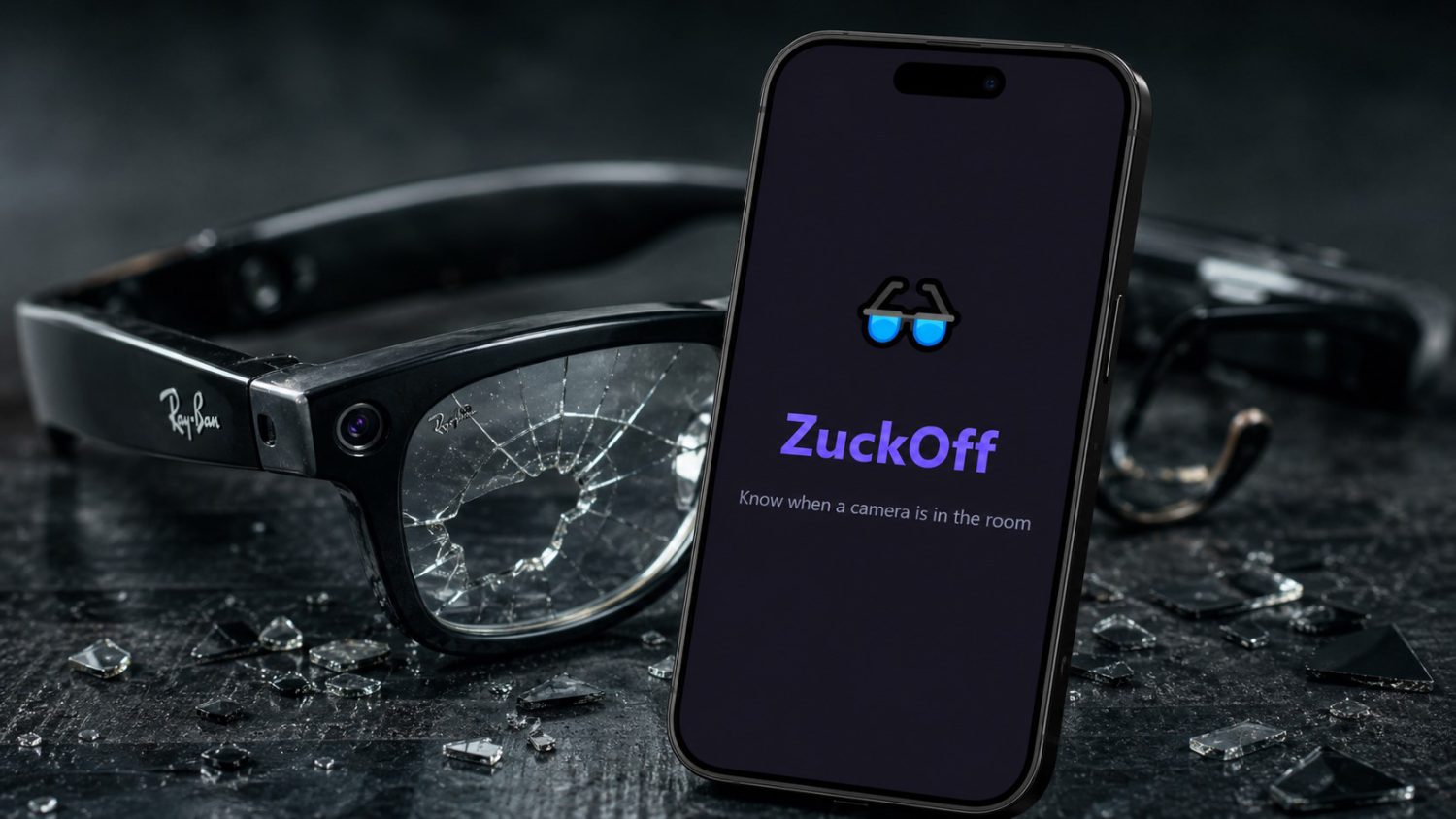
Meta’s smart glasses carry a forward-facing camera and microphones inside frames that look, to anyone nearby, like a regular pair of sunglasses. There is no obvious lens, no viewfinder, and no passive signal to bystanders beyond a small capture LED that some users have physically covered to hide the fact they are recording.
A new iOS app called Zuckoff is built on one premise: you should not have to guess whether a camera is pointed at you.
Developer Paweł Szydłowski launched Zuckoff on the App Store in early August 2026. Within roughly one month, around 5,000 users had downloaded it. The app’s name is a direct reference to Meta CEO Mark Zuckerberg, and its purpose is equally direct: scan nearby Bluetooth signals and alert you when camera-equipped smart glasses are in range.
How It Reads the Room
Zuckoff turns the radio signals smart glasses broadcast into plain-language warnings you can act on.
Smart glasses stay connected to a paired phone by broadcasting Bluetooth advertisement packets. Those packets contain manufacturer IDs, service UUIDs (unique identifiers assigned to specific hardware functions), and sometimes human-readable names like “Ray-Ban” or “Meta.”
Szydłowski purchased Ray-Ban Meta, Oakley Meta, and Snap Spectacles models, catalogued their Bluetooth signatures, and built a matching engine around that database. When a nearby device’s UUID and manufacturer ID both match a known profile, confidence is high. “If the unique identifier matches, and also if the manufacturer identifier matches, then we have like an ultimate combo there,” Szydłowski told Business Insider.
The app labels each detection as “possible,” “likely,” or “strong” and explains the specific evidence behind the flag, so you are not trusting an opaque verdict. Proximity is estimated from signal strength, though direction is unavailable and accuracy drops in crowded spaces where multiple devices create radio noise.
“Camera glasses announce themselves over Bluetooth. ZuckOff listens for those announcements and tells you when a lens is in the room.” (Zuckoff App Store listing)
What Zuckoff Can and Cannot Do
Bluetooth presence is not the same as active recording. The app cannot confirm the camera is on, identify who is wearing the glasses, or show what is being captured.
Glasses can also reduce their Bluetooth advertising traffic after pairing, which may cause a detection to fail. Zuckoff works from a defined catalogue of supported devices, meaning new models with different fingerprints will go undetected until Szydłowski adds them.
Meta’s own answer to the transparency problem is a front-facing capture LED that lights whenever photo or video is taken. Meta CTO Andrew Bosworth has argued the LED makes the glasses more accountable than a smartphone. Smartphones carry cameras everywhere yet display no recording indicator at all.
That argument has limits. Reports emerged of users covering or disabling the LED to film without the tell-tale light, prompting Meta to push firmware updates that permanently disable the camera on any unit where tampering is detected. The company says cameras have been bricked on thousands of devices, representing less than 0.1% of units sold.
The concern behind Zuckoff is not hypothetical. In late 2024, two Harvard students demonstrated a surveillance app called I-XRAY. It livestreamed footage from Meta Ray-Ban glasses to Instagram while facial recognition software pulled the names and addresses of strangers in real time. The project was a proof-of-concept designed explicitly to expose the risk. Reports of “rizzcam” content, where boys use AI glasses to covertly film and harass girls in schools, added urgency to the conversation.
Zuckoff is free on iOS with real-time foreground scanning. Background detection with push notifications requires a paid upgrade: approximately $9.99 per year or $24.99 as a one-time purchase. An Android version is in testing, and competing apps including Antizuck Smart Glasses Scanner and Nearby Glasses use similar Bluetooth sweeps. EU regulators have reportedly contacted Szydłowski for more information, though no formal proceedings have been confirmed.
The app cannot stop a recording. What it can do is restore the one thing these glasses, by design, take away from everyone else in the room: the basic awareness that a camera is there.