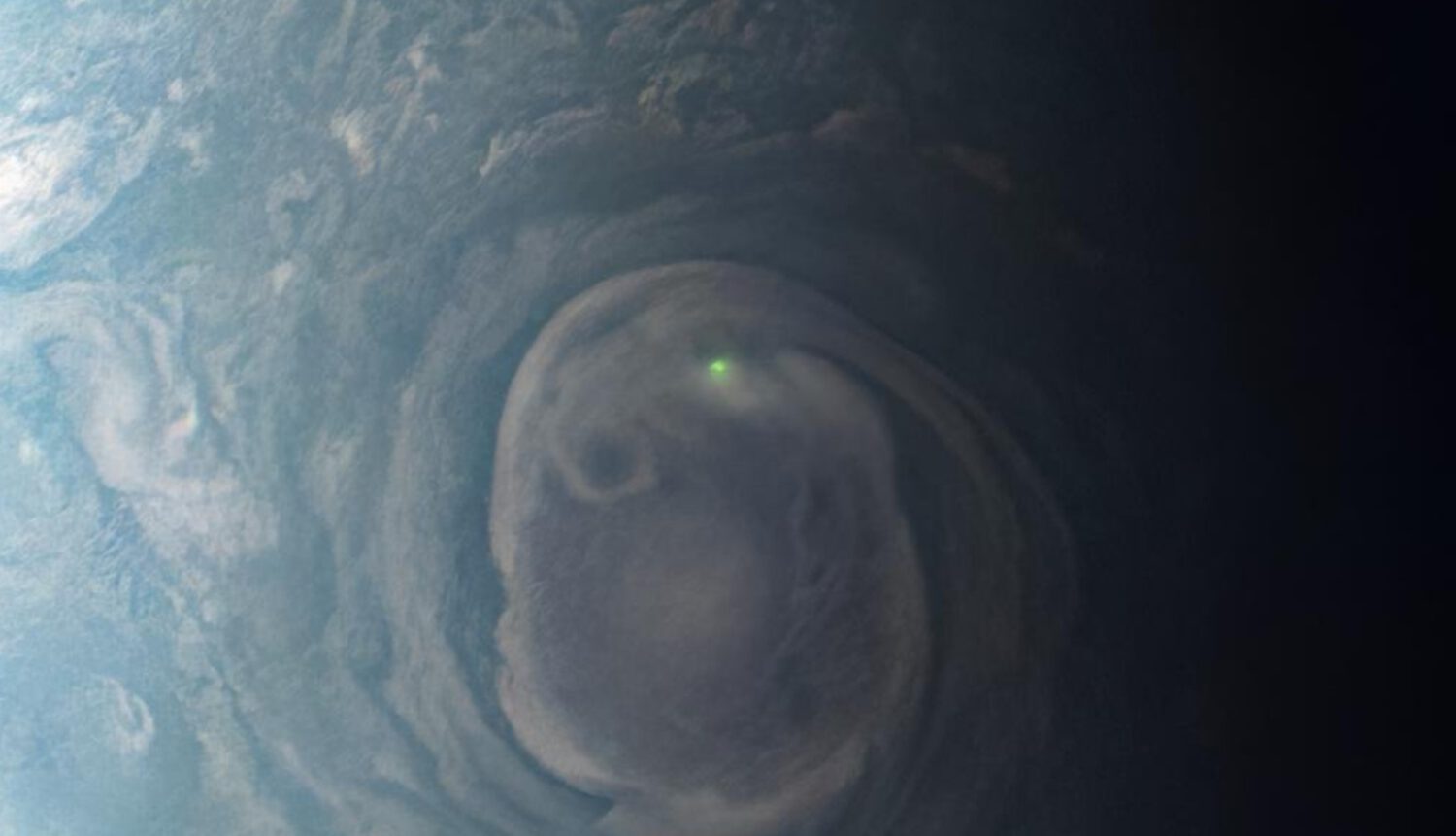
A video posted to r/interesting shows what appears to be a brief, repeating flash near Jupiter. The thread is predictably ablaze with theories.
Before concluding anything, it helps to know that Jupiter flashing is not unusual. The planet is one of the most active objects in the solar system when it comes to transient light events.
NASA’s Juno mission has photographed lightning in Jupiter’s atmosphere, particularly near its poles, generated by deep convective storms. Some of that lightning is substantially more powerful than anything Earth produces, and active Jovian storms have been observed generating several strikes per second.
When It’s Not Lightning, It’s Often Something Worse
Asteroid and comet fragments strike Jupiter regularly, producing brief but intensely bright flashes.
Jupiter’s size and gravitational pull make it a frequent target for incoming debris. NASA documented one such impact flash in footage recorded in September 2021. The object responsible was probably comparable in size to a bus, though its exact identity could not be determined.
These impact events are brief and intensely bright, which is precisely what makes them easy to confuse with lightning. A post-impact dark smudge or debris cloud in later images can help confirm that something struck the planet, though not every confirmed impact leaves such a mark.
Why the Reddit Clip Leaves the Question Open
Earth’s atmosphere and camera limitations can produce flickers that have nothing to do with Jupiter.
Amateur telescope footage carries real limitations. Variations in Earth’s atmosphere cause Jupiter’s image to shimmer and distort, which can make a stable feature appear to pulse or flash on camera.
Compression artifacts in reposted or screen-recorded video may compound the effect. A single short clip cannot reliably distinguish between a genuine Jovian event and a trick of optics.
What Verification Actually Looks Like
Confirming a Jupiter flash requires corroboration from multiple independent sources, not just a compelling video.
Scientists would start by checking whether independent observers recorded the same event at the same time from different locations. A flash appearing in footage from multiple sources simultaneously becomes far less likely to be an artifact.
Researchers would also examine whether the flash remained fixed relative to Jupiter’s cloud bands. A fixed position would suggest the event originated on the planet, not in Earth’s atmosphere.
Follow-up imaging in the hours and days after the event would reveal whether a dark debris mark appeared, though its absence would not rule out an impact. All of that work starts with original, uncompressed footage rather than a repost.
The Honest Bottom Line
Jupiter is the right place to look for dramatic transient events; this one still needs more eyes.
Jupiter is a well-observed planet where lightning storms rage and space rocks regularly announce their arrival in fire. Dramatic flashes there are documented, expected, and scientifically interesting.
Whether this particular clip joins that record is a question that requires more than a viral thread. The science to answer it exists. The footage to settle it may not yet be in hand.